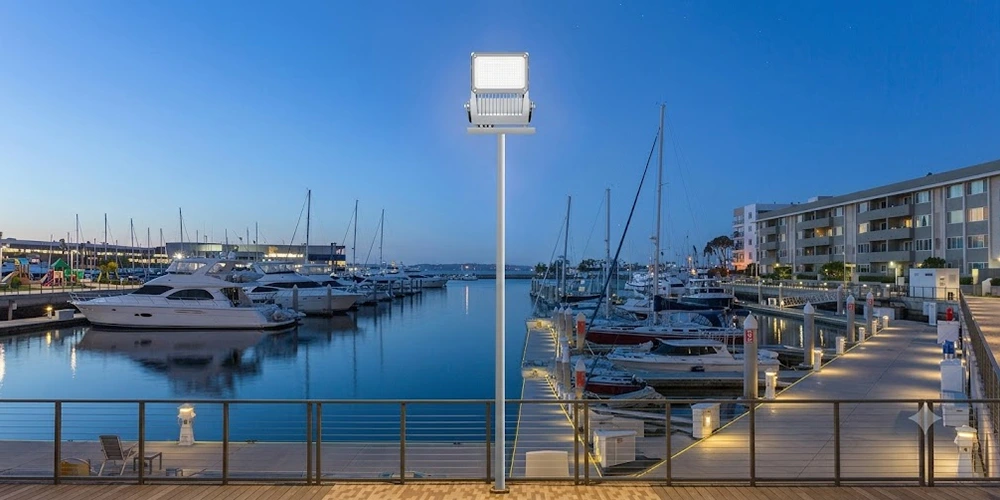

Marine environments are among the most demanding applications for flood lights. Continuous salt spray, strong UV exposure, and rapid temperature changes can accelerate material degradation and cause premature lighting failures. For vessels, offshore platforms, and port facilities, these failures can lead to unplanned downtime, safety concerns, and increased maintenance costs.
One of the main reasons outdoor flood lights fail in marine environments is the aluminum alloy used in the housing. Many housings contain higher levels of copper, sometimes up to 4%. When exposed to seawater and salt mist, copper accelerates galvanic corrosion, causing surface damage, cracking, and structural weakening over time.
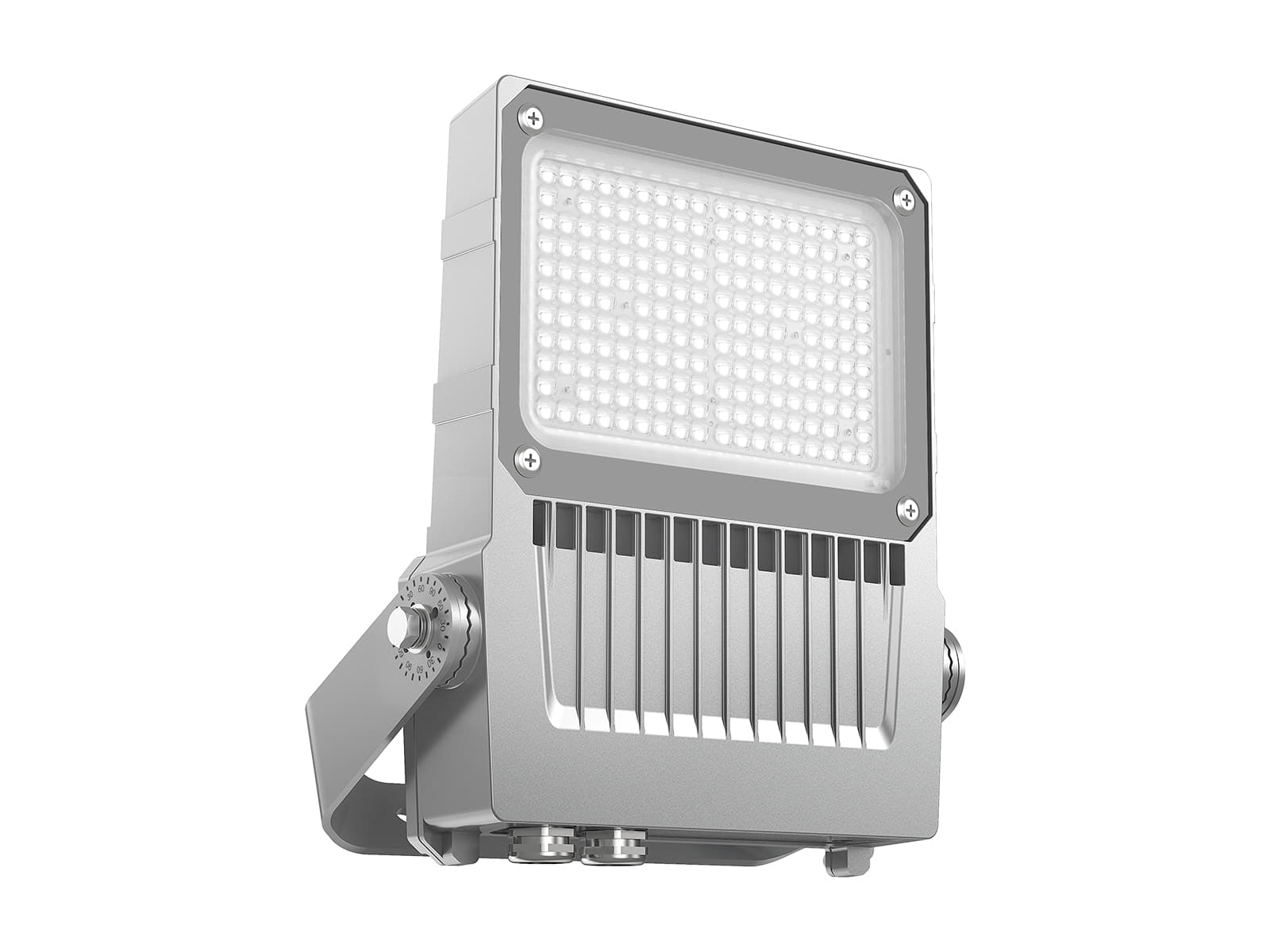
To improve long-term reliability in marine applications, our FL57 marine flood lights use EN AC-44300 die-cast aluminum, with copper content controlled to 0.1% or lower. This low-copper alloy provides better corrosion resistance in chloride-rich environments compared with conventional aluminum alloys.
The housing is further combined with 316 stainless steel and AL6063 aluminum components to create a corrosion-resistant system. This construction helps reduce chloride pitting, prevent oxidation, and maintain mechanical strength in coastal and offshore conditions.
What Is EN AC-44300 Die-Cast Aluminum?
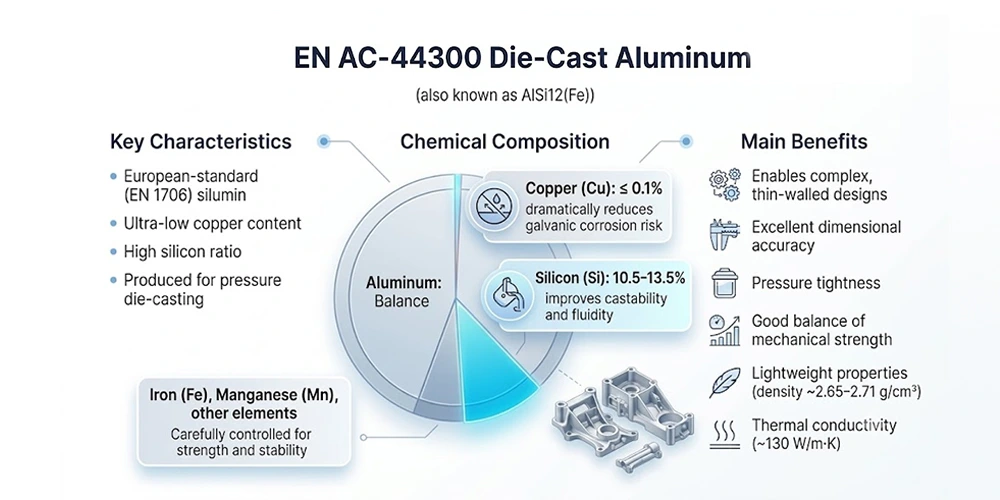
EN AC-44300 (also known as AlSi12(Fe)) is a European-standard (EN 1706) silumin die-casting aluminum alloy defined by its ultra-low copper content (typically <0.1% Cu) and high silicon ratio (10.5%–13.5% Si).
Chemical Composition of EN AC-44300 Aluminum
- Copper (Cu): ≤ 0.1%; dramatically reduces galvanic corrosion risk.
- Silicon (Si): 10.5–13.5%; improves castability and fluidity.
- Iron (Fe), Manganese (Mn), and other elements: Carefully controlled for strength and stability.
- Aluminum: Balance.
This alloy is produced specifically for pressure die-casting, allowing complex, thin-walled designs with excellent dimensional accuracy and pressure tightness. It offers a good balance of mechanical strength, lightweight properties (density ~2.65–2.71 g/cm³), and thermal conductivity (~130 W/m·K).
Why EN AC-44300 Low-Copper Aluminum for Marine Flood Lights
The primary reason for selecting EN AC-44300 aluminum for marine flood lights is its extremely low copper content and corrosion resistance. Thus, it helps marine flood lights achieve longer service life and lower maintenance costs in demanding environments.
EN AC-44300 is a low-copper aluminum-silicon alloy designed to provide improved corrosion resistance while maintaining the casting performance and thermal properties required for high-power LED lighting applications.
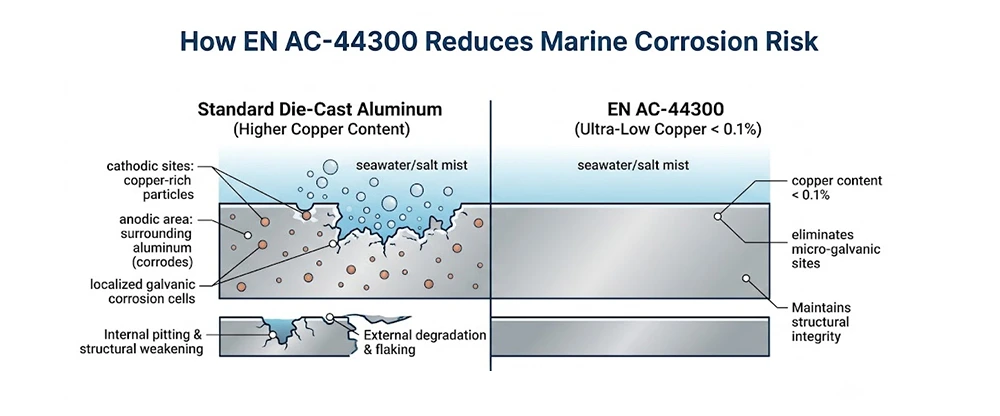
How EN AC-44300 Reduces Marine Corrosion Risk
When seawater or salt mist reaches an aluminum alloy surface, differences in electrical potential between aluminum and copper-rich areas can create localized galvanic corrosion cells. In these microscopic cells, copper-rich particles act as cathodic sites, while the surrounding aluminum becomes the anodic area and gradually corrodes.
Over time, this process can lead to internal pitting, surface degradation, and reduced mechanical strength, even when the external surface appears acceptable.
By limiting copper content to below 0.1%, EN AC-44300 significantly reduces the formation of these micro-galvanic corrosion sites. This helps the aluminum housing maintain better structural integrity and corrosion resistance in coastal, offshore, and marine applications.
Key Benefits of EN AC-44300 Aluminum
A marine flood light housing must solve two challenges at the same time: it must transfer heat away from high-power LEDs efficiently while withstanding years of exposure to salt, humidity, and harsh weather conditions.
Many die-cast aluminum alloys, such as A380 and ADC12, offer good casting performance but contain higher copper levels, which can reduce corrosion resistance in marine environments.
EN AC-44300 provides a balanced combination of thermal performance, corrosion resistance, casting quality, and coating durability, making it well suited for marine lighting applications.
Efficient Heat Dissipation
EN AC-44300 provides good thermal conductivity, allowing the housing to transfer heat away from LED modules and drivers effectively. This helps maintain stable operating temperatures and reduces thermal stress on internal components.
Improved Corrosion Resistance
By capping copper levels at under 0.1%, EN AC-44300 virtually eliminates the micro-galvanic cells that cause standard aluminum to bubble, pit, and turn into white powder when exposed to seawater. This improved corrosion resistance helps extend fixture service life and reduces maintenance requirements in marine applications.
Reliable Die-Casting Performance
The alloy’s silicon content provides excellent fluidity during high-pressure die casting. This allows manufacturers to produce complex housing designs with consistent wall thickness, high dimensional accuracy, and strong mechanical performance.
Durable Coating Protection
A stable aluminum substrate provides a stronger foundation for protective coatings. EN AC-44300 helps reduce oxidation-related coating failures, allowing powder coatings and surface treatments to maintain better adhesion and durability in outdoor and marine conditions.
What Else Makes a True Marine Lighting System?
A reliable marine flood light is not defined by the housing material alone. Every component, including fasteners, vents, coatings, and mounting structures, must be selected and engineered to withstand the corrosive environment.
At AGC Lighting, we design marine flood lights as complete corrosion-resistant systems. Each component works together to protect the fixture, maintain performance, and extend service life in demanding marine environments.
Take our FL57 marine flood light as an example. While the EN AC-44300 low-copper aluminum housing provides the primary thermal and structural foundation, the complete system includes:
- 316 Stainless steel fasteners: All screws are made from marine-grade 316 stainless steel. With excellent resistance to chloride-induced pitting and crevice corrosion, 316 stainless steel helps maintain mechanical reliability in saltwater environments.
- AL6063 vent with electrophoretic Treatment: The pressure-equalizing breather helps reduce internal condensation by balancing air pressure while limiting moisture intrusion. Made from AL6063 aluminum with electrophoretic surface treatment, the vent provides additional corrosion protection for long-term outdoor and marine operation.
- Advanced surface protection: The EN AC-44300 aluminum housing is protected with a durable powder coating to improve resistance against UV exposure, salt spray, and environmental wear. The mounting bracket uses a hot-dip galvanized coating combined with paint protection to enhance corrosion resistance and structural durability.
If you're sourcing for a coastal project or evaluating a manufacturing partner, we can share full material documentation, test data, and specs for any fixture in the range. Reach out, and we'll walk through what fits your application.