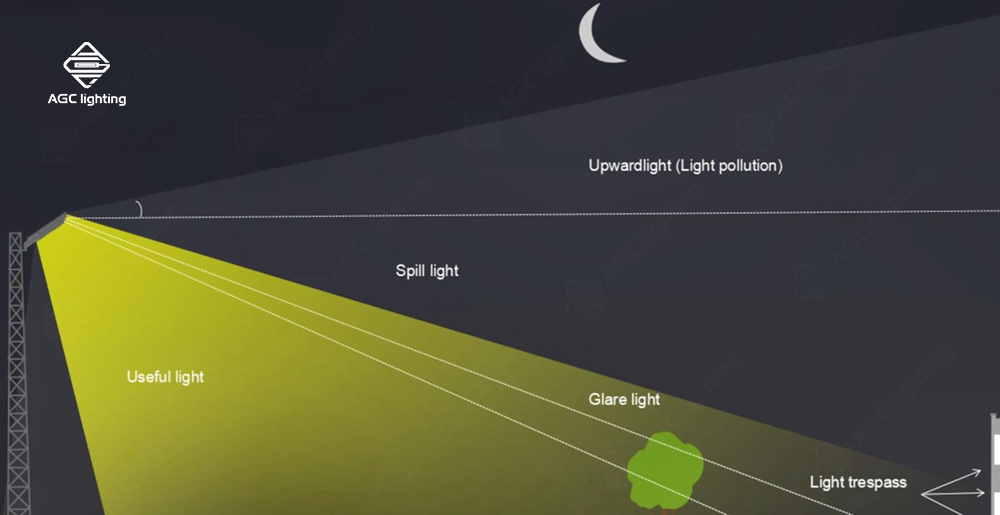
Upward Light Ratio (ULR) is the proportion of total luminous flux emitted by a luminaire or lighting installation directly into the sky at and above the horizontal plane.
It is expressed as a percentage of total luminaire flux. A ULR of 5% means that 5 of every 100 lumens go upward.
Upward light contributes to sky glow, wastes energy, and affects wildlife. Therefore, ULR is used to limit sky glow on roads, car parks, sports fields, and industrial sites. Keeping ULR low ensures project compliance while redirecting wasted energy downward onto the target surface.
What Is Upward Light Ratio (ULR)?
According to the CIE International Lighting Vocabulary (CIE S 017:2020), upward light ratio (ULR) is the “proportion of the flux of a luminaire or installation that is emitted, at and above the horizontal, when the luminaire(s) is (are) mounted in its (their) installed position.”
ULR = (luminous flux emitted at and above the horizontal) / (total luminous flux of the luminaire or installation) × 100 %
The key phrase is “in its installed position.” The value is not a fixed property of the bare luminaire sitting on a laboratory bench. Mounting height, tilt angle, aiming, and any adjustment of the optical assembly all change the portion of flux that crosses the horizontal plane.
Upward Waste Light Ratio (UWLR) is used in some Australian and New Zealand standards with a similar installed-position emphasis.
How to Calculate ULR
For the mathematical formulation, ULR is calculated by integrating luminous intensity over the upper hemisphere from γ = 90° to γ = 180° and dividing by the total luminaire flux:

In discrete zonal flux calculations, the total upward flux is typically partitioned into two primary angular bands:
- Low Uplight (Φ90-100° ): High-angle light just above the horizon.
- High Uplight (Φ100-180° ): Light directed toward the zenith.
Many software packages report ULR directly once the geometry is set. ULR is obtained from photometric data, almost always an IES or EULUMDAT file, processed in lighting calculation software such as DIALux, Relux, or AGi32.
Here is a report of our SL73 solar bollard light. As shown in the report, the ULR is 0.3%, which means that only 0.3% of the total light emitted by the light fixture goes up into the sky. It can easily satisfy the strict limits for rural or suburban areas, which often require a ULR under 2.5%.

What Are the Impacts of High ULR?
Why does upward spill matter? The environmental and operational costs are driven by basic atmospheric physics and biological sensitivities.
Sky glow
Direct uplight and the portion of light reflected from the ground both brighten the night sky. Over large urban or industrial areas, the cumulative effect reduces visibility of stars and the Milky Way and interferes with astronomical observation.
High CCT LED fixtures (5000K–6500K) with poor ULR amplify sky glow far more than warm light (2200K–3000K).
Energy waste
Emitting light above 90° provides zero functional ground illuminance.
If a 300W industrial luminaire has an installed ULR of 10%, 30 watts of continuous electrical power per fixture is used to light the atmosphere. Across a container terminal or industrial rail yard with 500 luminaires operating 4,000 hours annually, a 10% ULR equates to roughly 60,000 kWh of wasted electricity each year.
Ecological disruption
Upward-directed light alters behavioral triggers for migratory birds, bats, and insects. Phototactic insects become trapped in bright vertical light cones, causing exhaustion and mortality. Artificial sky glow also strips natural lunar cues used by aquatic life, amphibians, and mammals for foraging and reproduction.
Coastal projects add the further concern of disorienting sea turtles; full-cut-off designs combined with long-wavelength (amber or red lights) sources are commonly specified in those locations.
Does a Low ULR Mean There Is No Lighting Pollution?
No.
Light pollution is generally perceived as sky glow, while obtrusive light can take many forms of disturbing and glaring light in urban or street environments.
ULR counts only direct upward flux. It leaves out reflected light, absolute lumens, and glare and intrusion, which can cause lighting pollution.
Light that reaches the ground and reflects upward is not ULR, but it can also brighten the night sky and cause light pollution.
Furthermore, ULR is a percentage, and it doesn’t count the absolute lumens. A 1% ULR can be 200lm on a 20,000lm luminaire and 20lm on a 2,000lm one. Excessive lighting can also cause light pollution.
Another problem is that ULR says nothing about glare and intrusion. The glare toward drivers or light entering windows of surrounding residential areas is also lighting pollution. Those need BUG glare values, intensity limits, and vertical illuminance checks.