Yes. White LED lighting with a specially designed antibacterial wavelength can help reduce bacteria like Escherichia coli, Listeria, and Salmonella in meat and food processing environments.
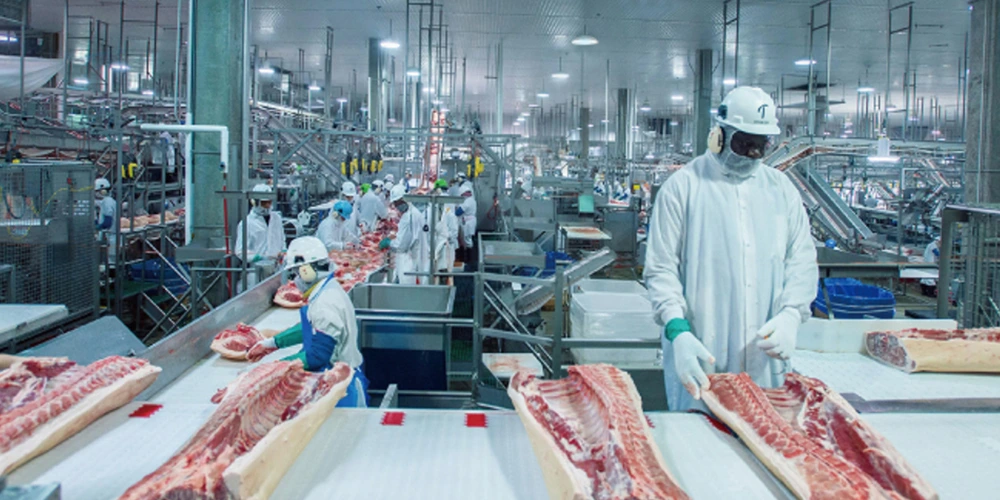
Washdown cycles, condensation from refrigeration lines, and high ambient humidity in meat processing plants can all create conditions where bacteria can survive and grow. The same challenge exists across many food processing facilities.
UVC disinfection and chemical sanitation are important parts of a plant's hygiene program. However, their effects do not last throughout the entire production shift. As raw proteins move along the processing line and workers handle products and equipment, bacteria can be reintroduced to surfaces and the surrounding environment before the next cleaning cycle.
This creates a hygiene gap between scheduled sanitation cycles.
Our team developed antibacterial white LED lighting to help address this gap. These fixtures can provide continuous antibacterial action during normal production hours while also delivering the illumination needed for workers to inspect products, equipment, and work areas.
Why UV-C isn't practical on a live processing line
When we talk about light-based disinfection, germicidal UV-C, typically around 254 nm, is often the first technology that comes to mind. UV-C can be highly effective at inactivating microorganisms, but it is not well suited to continuous operation on an occupied processing line.
The main limitation is worker safety. Direct exposure to germicidal UV-C can damage the skin and eyes, so UV-C systems must be designed to prevent exposure when workers are present. This makes continuous UV-C treatment difficult on an open production line where employees are working around the equipment.
Also, prolonged exposure can accelerate the degradation of some plastics, rubbers, seals, and gasket materials. For meat plants, the direct UV radiation on exposed meats can cause surface oxidation.
For these reasons, UV-C systems in food processing facilities are generally used in controlled applications, such as unoccupied rooms, enclosed equipment, or closed-air and HVAC systems where exposure can be managed safely.
This is where our antibacterial white LED lighting takes a different approach. Instead of using germicidal UV-C, specially designed visible-light wavelengths can be incorporated into white LED lighting to provide antibacterial effects during normal production hours, while still providing the visible illumination workers need to inspect products and operate the line.
What antibacterial white light actually is
Antibacterial white light looks like normal white LED lighting. The fixture provides the illumination needed for production and inspection, while a controlled portion of its visible-light spectrum is designed to provide antibacterial activity throughout the production shift.
To develop antibacterial lighting that can operate during production, we focused on visible light, particularly narrow-band violet light centered around 405 nm.
However, a standalone 405 nm LED produces a deep violet light. That is not suitable for a meat processing line. Operators need clear white light to inspect meat, identify contamination, evaluate trim quality, and safely operate cutting and processing equipment.
To solve this, our engineers combined the 405nm disinfection wavelength with broad-spectrum phosphors. We then integrated this technology into the HB69 high bay, a food processing lighting platform designed for demanding washdown environments, with NSF certification, IP69K protection, and a no-glass construction.
The resulting fixture combines three key functions:
- Integrated 405 nm violet light, providing an antibacterial component within the overall light spectrum.
- Approximately 5000K CCT, providing a neutral white appearance similar to daylight and suitable for industrial work areas.
- CRI above Ra 80, providing good color rendering so operators can distinguish meat color, surface condition, and product details with less visual distortion.
To the workers on the line, the space simply feels well-lit with neutral daylight. But throughout the shift, the light continuously works to suppress airborne microbes.
How antibacterial white light inactivates bacteria
Many bacteria naturally contain light-sensitive molecules called endogenous porphyrins.
When exposed to 405 nm light, these porphyrins absorb the light energy and generate reactive oxygen species (ROS) inside the bacterial cell. The resulting oxidative stress can damage essential cellular structures and ultimately inactivate the bacteria.
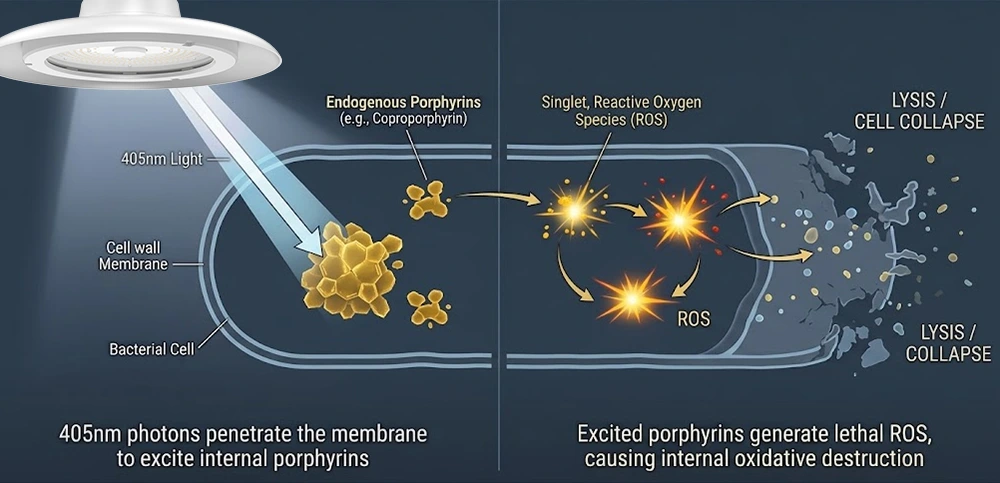
The key advantage is that 405 nm light is in the visible spectrum. When the lighting system is properly designed and operated within appropriate exposure limits, it can be used in occupied areas without the direct skin and eye hazards associated with germicidal UV-C exposure.
This also makes 405 nm antibacterial lighting better suited to continuous operation on an active processing line. Visible antibacterial light can be integrated into the general lighting system and operate while employees are working.
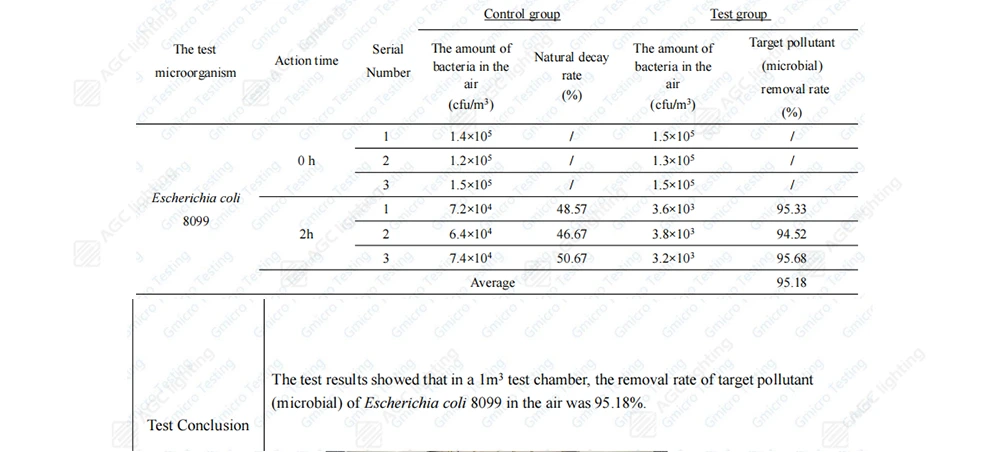
To verify the disinfection performance, we submitted our product HB69 (with antibacterial white light ) for laboratory evaluation. The test shows meaningful reductions under continuous or extended exposure.
After 2 hours of operation, the test recorded an average removal rate of 95.18% of airborne E. coli, with natural microbial decay already accounted for and eliminated from the result.
What the light does not replace
Antibacterial white LED lighting does not replace daily washdowns, cleaning, or chemical sanitation. Heavy organic debris, grease, and other contaminants must still be physically removed according to the plant's established hygiene procedures.
Instead, antibacterial lighting provides an additional, ongoing layer of microbial control. Cleaning and sanitation reduce contamination during scheduled cleaning periods, while the integrated 405 nm light operates during production to provide antibacterial activity and help reduce the opportunity for bacterial growth and re-contamination between sanitation cycles.
This is especially useful in areas where continuous operation makes frequent manual cleaning impractical. The lighting does not replace good sanitation practices. It complements them by adding another control measure that operates while the production line is running.
Looking for a Better Lighting Solution?
If you are evaluating lighting for a meat, seafood, dairy, or other food processing facility, we can help you assess whether antibacterial white LED lighting is suitable for your projects.
Contact our team to review available test reports, photometric data, and fixture specifications for your facility.