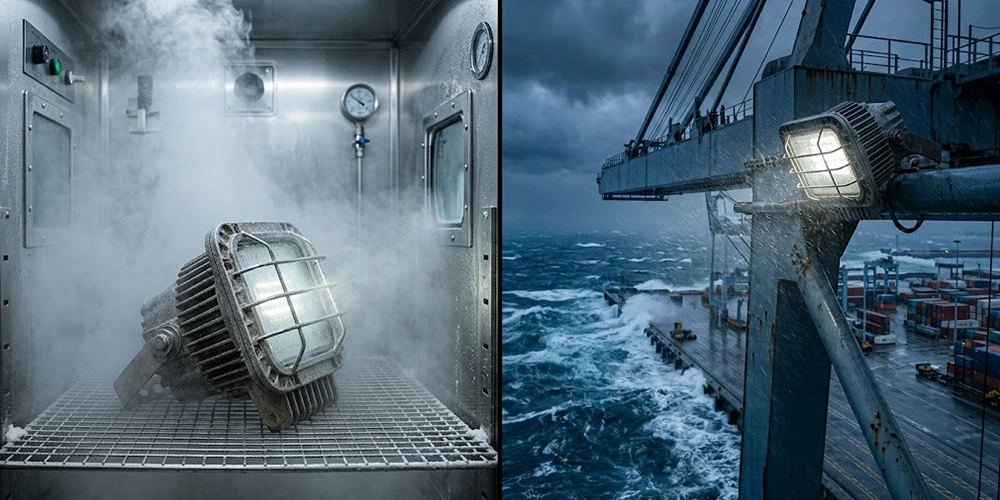
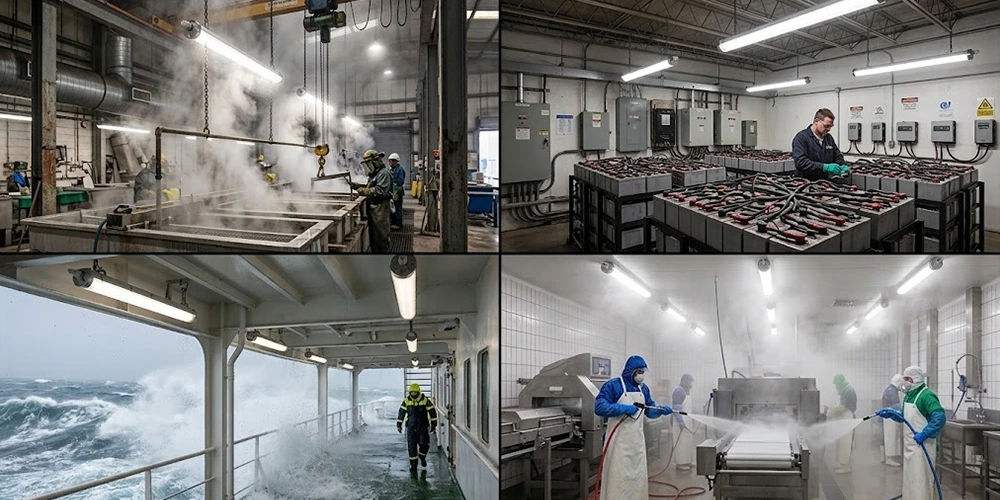
For linear lights in environments such as acid pickling lines, electroplating workshops, battery charging rooms, coastal marine decks, and washdown areas, PMMA/PC tubes can deteriorate rapidly under exposure to corrosive vapors, aggressive cleaning chemicals, and high-pressure alkaline sanitizers. If it fails, the electronics inside lose their protection.
We started thinking: What if we replaced the plastic tube with glass?
That idea led us to develop a corrosion-resistant linear light with a 5 mm borosilicate glass tube, 316 stainless steel end caps, and EPDM seals. Designed for challenging environments, it offers a different approach to protecting lighting from chemical exposure, moisture, and corrosion.
- How Corrosive Environments Affect Lighting Materials
- Environmental Stress Cracking in Polycarbonate
- Solvation and Ammonia Degradation
- High-Pressure Washdown and Aggressive Cleaning
- UV Exposure, Yellowing, and Optical Performance
- Enclosure That Improves Long-term Performance
- Borosilicate Glass as the Primary Envelope
- 316 Stainless Steel End Caps
- EPDM Seals for Chemical Compression
- Protection Ratings for The Corrosive Environment
- Where This Linear Light Is Designed to Perform
How Corrosive Environments Affect Lighting Materials
We first considered what touches the lighting fixtures and break down the fixture in corrosive environments. Here are stressors for some sites.
|
Site |
Environment Stressors |
|
Lead-acid battery rooms |
Sulfuric acid mist, electrolyte splashes, humidity, and potential hydrogen accumulation during charging |
|
Wastewater, chemical plants |
Corrosive gases, mixed chemicals, high humidity, and condensation |
|
Offshore, ships, coastal sites |
Salt spray, chloride deposits, moisture, and temperature fluctuations |
|
Plating and picking |
Acid or alkaline mist, chemical splashes, and potentially aggressive process chemicals |
|
Food processing, car wash, farm |
Alkaline and disinfectant cleaner, hot jets, fats, oils, and high-pressure washdown |
These conditions do not affect every material in the same way. The key is to select materials based on the actual exposure conditions
Environmental Stress Cracking in Polycarbonate
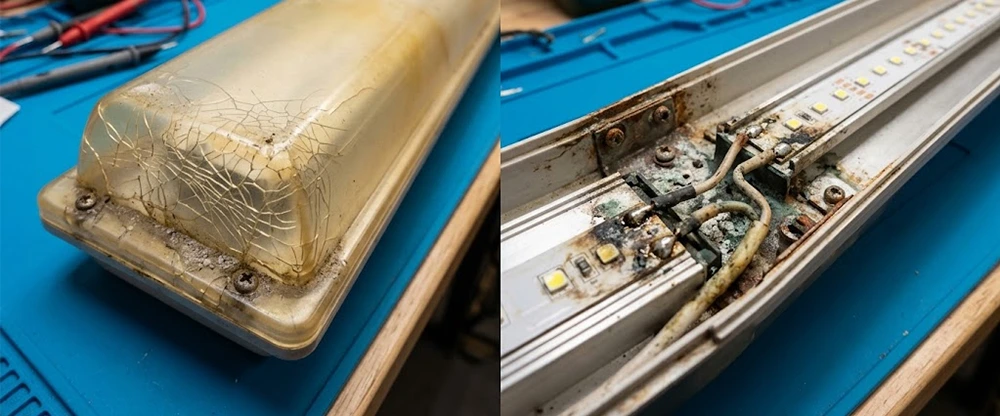
Polycarbonate is an amorphous thermoplastic. When exposed to chemical agents such as sulfuric acid droplets, battery electrolytes, nitric acid fumes, or industrial degreasers, these chemicals attack the polymer matrix.
When mechanical stress from thermal cycling or mounting clamps is present, micro-voids develop and propagate into spiderweb fractures. This phenomenon, known as environmental stress cracking (ESC), causes the housing to crack open, allowing moisture to reach the driver and LED boards.
As the cracks grow, the diffuser may lose its mechanical integrity. If the damage extends into a sealing surface or compromises the enclosure, moisture and contaminants can enter the luminaire and affect the electronics.
Solvation and Ammonia Degradation
PMMA offers good optical clarity and can provide better resistance than polycarbonate to certain chemicals.
But in agricultural barns, composting plants, and wastewater facilities, ammonia gas reacts with polymers. While PMMA resists ammonia better than PC, it lacks high impact strength and degrades under high-pH caustic wash chemicals.
Furthermore, both PC and PMMA exhibit surface degradation when exposed to airborne solvents, thinners, and hydrocarbon vapors common in coating and metallurgical processing.
High-Pressure Washdown and Aggressive Cleaning
Food processing plants, commercial vehicle wash bays, and other hygiene-sensitive facilities often require frequent cleaning with hot water, alkaline detergents, or disinfectants.
These conditions can challenge several parts of a luminaire at once. Repeated chemical exposure may affect the diffuser, while heat can accelerate material degradation or alter the performance of seals. High-pressure water can also penetrate poorly designed joints, damaged gaskets, or inadequately protected cable entries.
UV Exposure, Yellowing, and Optical Performance
Outdoor coastal facilities, ship decks, and exposed industrial installations may experience prolonged UV radiation alongside heat, humidity, and salt deposits.
Over time, UV exposure can cause some polymer diffusers to yellow, haze, or become brittle.
Yellowing and haze can reduce light transmission and change the way light is distributed across a working area. As a result, the illumination reaching the task may decline even while the LEDs continue to operate normally.
Enclosure That Improves Long-term Performance
After examining the challenges that lighting fixtures face in corrosive environments, we focused on how we can make a linear light more durable by improving the enclosure itself.
The enclosure is the first line of defense against chemicals, moisture, salt spray, and cleaning agents.
Rather than relying on a c plastic tube, we looked for a material that could offer better chemical resistance and long-term optical stability. Borosilicate glass emerged as a promising choice.
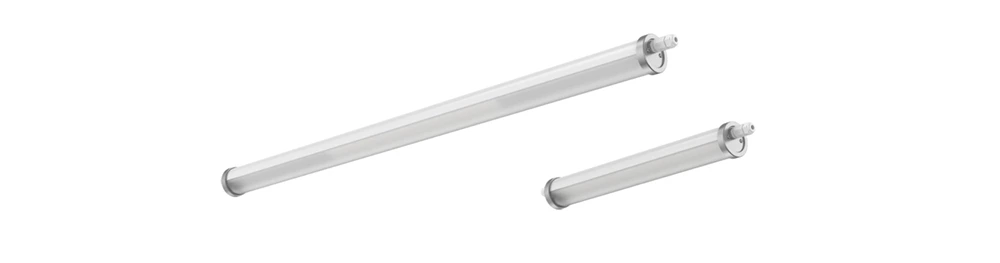
Our design uses a 5 mm-thick borosilicate glass tube, paired with 316 stainless steel end caps and EPDM sealing gaskets. The glass provides a chemically resistant optical enclosure, the stainless steel helps resist corrosion, and the gaskets help prevent moisture and contaminants from entering.
Borosilicate Glass as the Primary Envelope
Borosilicate glass has a long record in laboratory and process equipment precisely because it resists most industrial acids, alkalis, and solvents. The only common exceptions are hydrofluoric acid, hot concentrated phosphoric acid, and strong hot caustic solutions.
The low coefficient of thermal expansion also matters. When a fixture is washed with hot water or experiences rapid ambient changes, the glass expands and contracts far less than polycarbonate or acrylic. This reduces the risk of seal distortion and thermal cracking.
Optical clarity remains stable; the glass does not yellow under prolonged exposure to process vapours or UV the way many plastics do.
316 Stainless Steel End Caps
Cable entries, mounting points, and end closures are where corrosion and leaks usually start. We used 316 stainless steel end caps because the metal itself provides the corrosion resistance.
316 stainless steel includes 2% to 3% molybdenum, which enhances pitting resistance against chlorides and coastal salt spray. Its passive chromium oxide film self-heals in the presence of oxygen, eliminating the risk of coating delamination.
However, 316 stainless steel is not corrosion-proof. Prolonged exposure to concentrated chlorides, stagnant seawater, deposits, or narrow crevices can still cause localized corrosion.
EPDM Seals for Chemical Compression
While silicone is widely used in luminaires, it can swell or break down when exposed to strong industrial acids or aromatic vapors.
Ethylene Propylene Diene Monomer (EPDM) is a synthetic rubber commonly used for sealing applications. It generally offers good resistance to water, steam, ozone, weathering, and many polar chemicals, making it a useful option for industrial and outdoor environments.
But EPDM is generally unsuitable for many petroleum-based oils, fuels, and hydrocarbon solvents,
When compressed against ground borosilicate edges with 316 stainless steel end caps, EPDM maintains constant elastic recovery.
Protection Ratings for The Corrosive Environment
Material selection is only one part of luminaire performance. The complete fixture must also provide appropriate protection against dust, water, mechanical impact, electrical surges, and corrosion.
IP66, IP69K, IK07, C5, and 10 kV surge protection address different aspects of performance.
Ingress protection must go beyond basic dust and water resistance. IP66 rating protects against powerful water jets. IP69K rating adds resistance to high-pressure, high-temperature washdowns (typically 80–100 bar at elevated temperature), which is routine in food processing, car washes, and many chemical clean-down routines.
Impact resistance of IK07 indicates the glass tube can withstand moderate mechanical shocks. Higher IK values are achievable with thicker plastics, but the chemical and optical advantages of glass often outweigh a modest reduction in impact rating when the installation is not subject to heavy physical abuse.
Corrosion classification according to ISO 12944 is useful for metallic components and coatings. Category C5 covers very high corrosivity atmospheres: industrial sites with aggressive pollution or coastal/marine zones with high salinity.
A stated 10 kV surge-protection level can indicate the intended surge withstand capability of the luminaire or its driver. But it does not replace appropriate grounding, bonding, circuit protection, or installation practices.
Where This Linear Light Is Designed to Perform
Our borosilicate glass linear lighting design is intended for applications where conventional lighting materials may face challenging combinations of chemical exposure, moisture, salt spray, or frequent cleaning.
Potential applications include:
- Acid pickling, galvanizing, and electroplating lines
- Lead-acid battery charging rooms
- Marine decks and port facilities
- Offshore utilities
- Wastewater treatment facilities
- Metallurgical facilities
- Food processing plants and abattoirs
- Commercial car washes
Interested in this glass linear light? Contact us for more details.