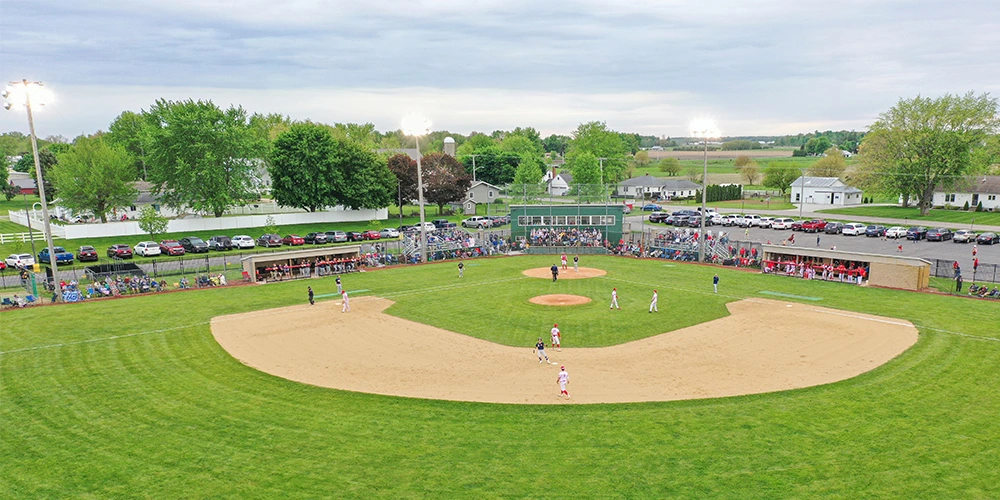
Unlike soccer pitches or running tracks, a baseball diamond is an asymmetric sporting environment with severe visual demands. A white ball measuring only 73 mm in diameter travels at over 140 km/h across varying elevations, from rolling ground balls on red clay to towering pop-ups 30 meters in the air.
When designing baseball lighting, the field may achieve the required lux level on the ground, yet outfielders lose sight of fly balls, batters experience dangerous afterimages, and neighbors file complaints about light trespass.
Designing an efficient, safe ballpark lighting system requires understanding the optical geometry of baseball, designing strictly around European standard EN 12193, and accounting for the physical limitations of tall sports poles.
EN 12193 Baseball Lighting Standards
For baseball lighting projects, lighting performance must comply with EN 12193:2018 (Light and lighting - Sports lighting). The standard divides baseball into three operational classes: Class I, Class II, Class III.
|
Competition Class |
Intended Level of Play |
Infield Avg (Eav)
|
Outfield Avg (Eav)
|
Uniformity (U2: Min/Avg)
|
Glare Rating (GRmax)
|
|
Class I |
National & international top-tier leagues, elite training |
750 lx |
500 lx |
≥ 0.7 (Infield) / ≥ 0.5 (Outfield) |
≤ 50 |
|
Class II |
Regional club competition, intermediate training |
500 lx |
300 lx |
≥ 0.7 (Infield) / ≥ 0.5 (Outfield) |
≤ 50 |
|
Class III |
Amateur leagues, school grounds, local recreation |
200 lx |
100 lx |
≥ 0.5 (Infield) / ≥ 0.3 (Outfield) |
≤ 55 |
Beyond lux levels, two mandatory compliance factors often create friction during planning: glare rating and environmental lighting pollution.
Strict Glare Rating
Under EN 12193, the maximum Glare Rating for competition matches is capped at 50.
Achieving GR≤50 requires precision-cut asymmetric lenses and visors. Open floodlights without upper beam cutoff will invariably fail DIALux glare evaluations when observers are placed at the batter's box and outfield positions.
Environmental Light Pollution (EN 12464-2 & CIE 150)
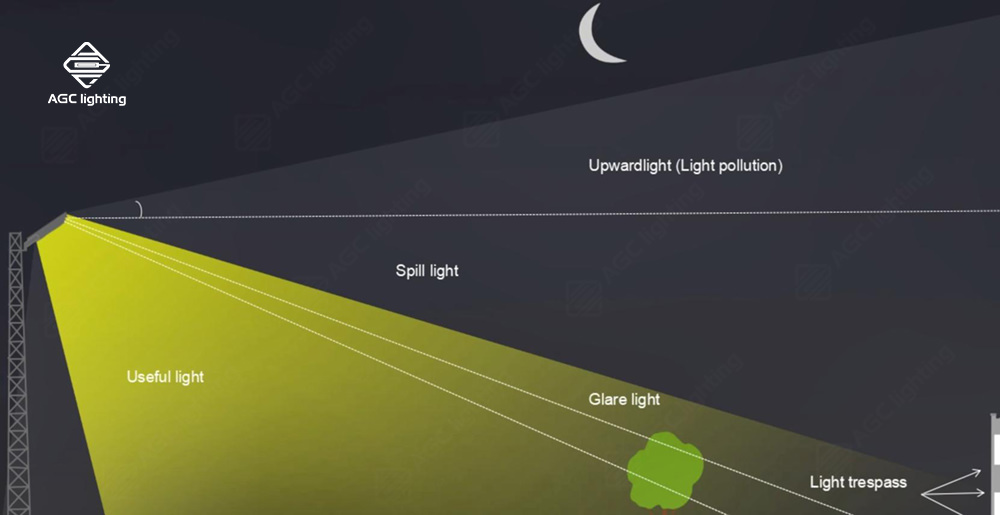
Municipalities enforce strict boundaries regarding upward light ratio (ULR) and obtrusive light spilling into surrounding residential areas.
Ballpark optics must demonstrate a ULR below 1%, ensuring virtually zero direct light shoots upward into the atmosphere to cause sky glow.
Pole Layout Architecture
When target class is set, you must establish pole locations. Pole coordinates and mounting heights determine the throw distance, beam spread, and fixture quantities needed in your calculation software.
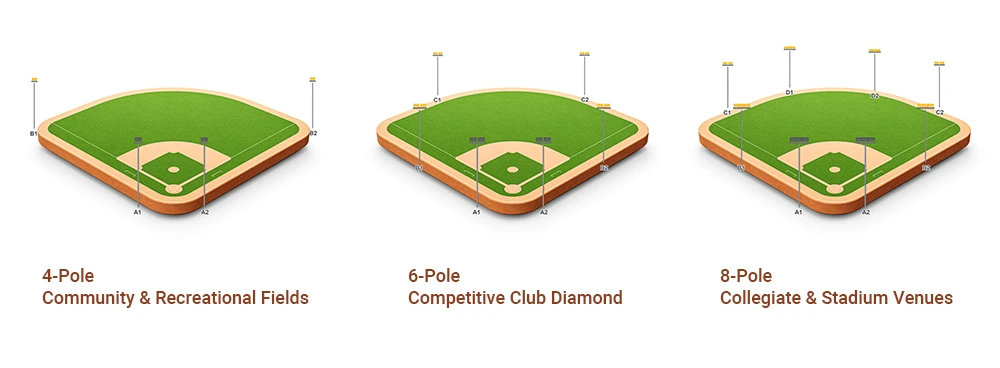
Ballparks typically use three types of pole layouts: 4-pole, 6-pole, and 8-pole.
4-Pole Layout (Community & Recreational Fields)
In this setting, 2 poles are positioned along the baseline corners behind home plate; 2 poles are placed outside the outfield foul lines.
This is the most economical setup for civil works and cabling. Because the outfield relies entirely on two wing poles, luminaires must project light across extensive lateral distances. It is cost-effective for civil foundations but cannot satisfy Class I uniformity requirements.
6-Pole Layout (Competitive Club Diamond)
2 poles behind the backstop; 2 poles down the 1st and 3rd baseline corners; 2 poles situated in left-center and right-center outfield.
The 6-pole setup is commonly used for municipal sports facilities and competitive club grounds.
This configuration provides true cross-lighting across the infield diamond. Shadows behind baserunners and fielders are minimized, and uniformity becomes straightforward to achieve in DIALux calculations.
8-Pole Layout (Collegiate & Stadium Venues)
2 backstop poles, 2 baseline poles, 2 outfield foul line poles, and 2 deep outfield poles.
The 8-pole system provides overlapping light distributions that eliminate player shadows at home plate and generate the vertical illuminance (Ev) required by broadcast cameras.
Safety Rule: Batter's Eye Exclusion Zone
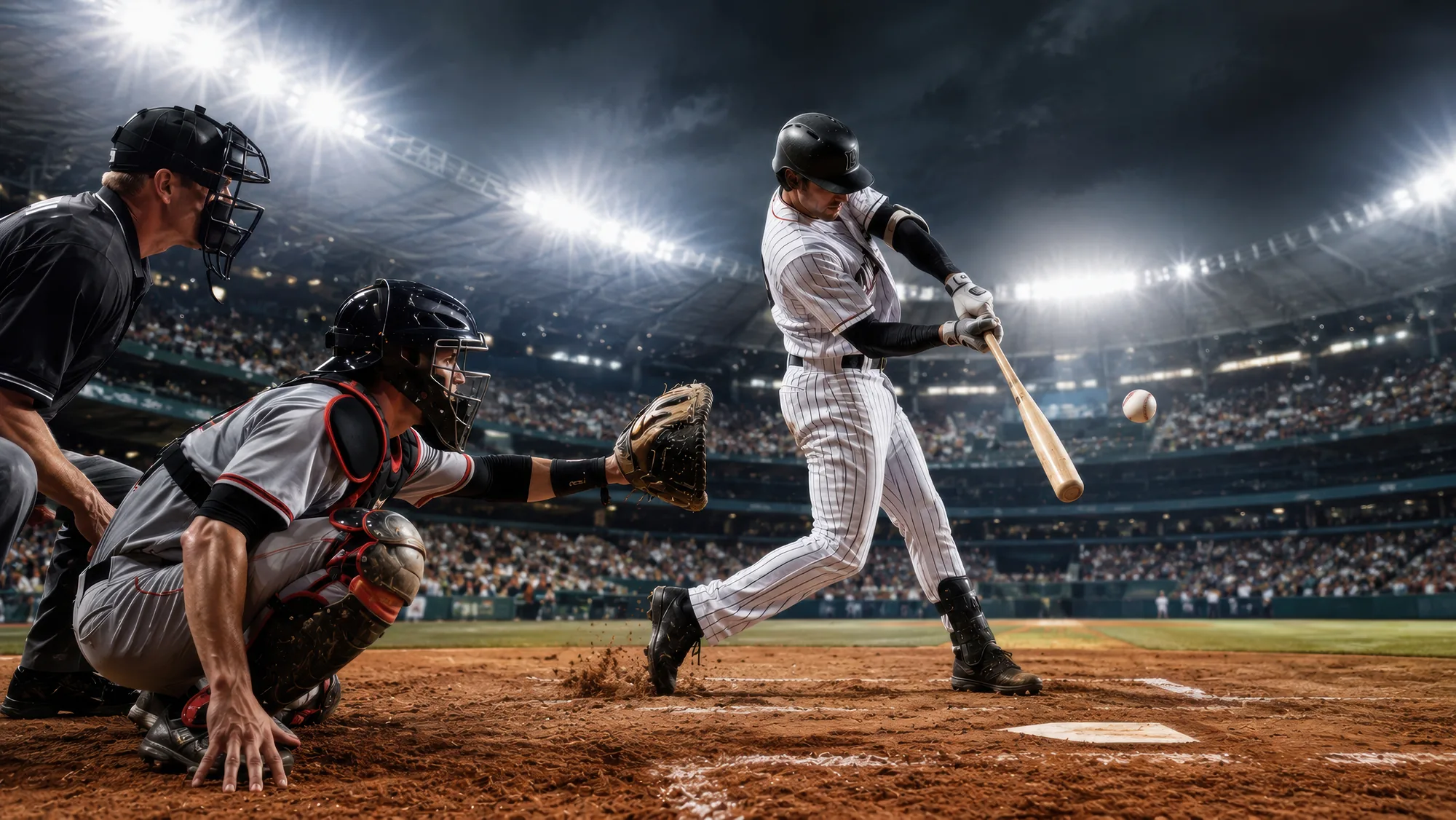
When laying out outfield poles, one non-negotiable safety constraint applies to all configurations: never place light poles directly behind the center field fence on the pitcher-batter axis.
This dark area is known as the Batter's Eye. A batter watching a 140 km/h pitch relies on this high-contrast backdrop to track the ball cleanly from the pitcher's hand. Placing a floodlight directly in this zone blinds the batter and the home plate umpire. Deep outfield poles must always be split symmetrically into left-center and right-center positions.
Optics for Aerial Ball Tracking
In sports like football, horizontal illuminance (Eh) on the turf is the dominant calculation parameter. In baseball and softball, vertical illuminance (Ev) above the ground is equally critical.
When an outfielder tracks a fly ball rising 25 meters into the night sky, the ball must remain illuminated from underneath and from the sides. If lighting fixtures are aimed steeply downward simply to pump up ground lux numbers, the ball becomes a black silhouette against the darkness as soon as it leaves the infield.
Therefore, to maintain continuous spherical tracking, here are three practical tips:
- Use narrow sports optics on taller poles to project high-intensity light into the aerial volume above the diamond.
- Aim lighting fixtures in cross-firing pairs across the field rather than pointing them straight ahead. Overlapping beams fill in visual shadows on the ball as it travels across different fields of view.
- Keep lighting fixture aiming angles under 65° from the downward vertical. Angles exceeding 65° drastically increase Glare Rating (GR) values and cause light to spill past field boundaries.
Wind Loads and Maintenance
In outdoor ballpark applications, tall masts operate under continuous environmental stress. Wind loads act as the primary mechanical threat to structural integrity, while high-altitude component placement dictates long-term operating costs.
Wind Load and Effective Projected Area (EPA)
Wind load represents the total physical force and bending moment exerted by air currents on the pole shaft, cross-arms, and luminaire heads.
To determine whether a mast can support a given lighting configuration, structural engineers evaluate the Effective Projected Area (EPA) of the luminaire assembly rather than its physical weight alone.
For greenfield installations, it is critical for controlling civil and structural capital. For retrofit projects, it can prevent structural failure on existing poles.
Our SP13 sports light features a low EPA of 0.25㎡ at 45°, which helps reduce costs for greenfield installations and prevent the need for expensive structural mast replacement during retrofits.
Mitigating Maintenance with Remote Drivers
In high-mast ballpark lighting, integrated driver boxes add weight and increase the EPA at the top of the cross-arm, worsening mast vibration during high winds. They also expose sensitive electronics to intense heat and require heavy boom lifts on the field for routine servicing.
Adopting a remote driver lowers the wind drag and enhances the thermal and vibration protection. Most importantly, it provides easier maintenance access.
In a baseball lighting project, we used 135 remote drivers (a total of 264 lighting fixtures were installed in this project) to avoid costly mast reinforcement and streamline long-term servicing.
Whether you are upgrading existing floodlights on older masts or designing a multi-diamond sports facility from the ground up, AGC Lighting provides complete engineering support.
Contact us to request a photometric plan.