
One specification you will often see for outdoor lighting is a salt spray test result, such as “1,000-hour salt spray tested.”
Salt spray hours should be treated as one piece of corrosion-resistance evidence, not a direct measure of how many years a lighting fixture will last outdoors.
Real outdoor exposure is more complex than a laboratory salt spray test. A fixture may go through repeated cycles of salt deposition, humidity, condensation, rainfall, drying, temperature changes, UV exposure, and industrial contamination.
In this blog, let’s take a look at what salt spray testing measures, what the hours mean, where the test has limitations, and how to assess corrosion resistance more realistically.
- What Is a Salt Spray Test and How Does It Work?
- What Does “1,000 Hours of Salt Spray” Actually Mean?
- Why More Salt Spray Hours Do Not Equal More Outdoor Years
- Salt Spray Alone Is Not the Full Corrosion Picture
- The Environment Matters More Than the Hour Number
- Salt Spray Hours and Real-World Lighting Durability
What Is a Salt Spray Test and How Does It Work?
The salt spray test is an accelerated laboratory corrosion test used to evaluate the resistance of metallic materials and protective coatings to a controlled saline atmosphere.
One of the most commonly used methods is Neutral Salt Spray (NSS) according to ISO 9227.
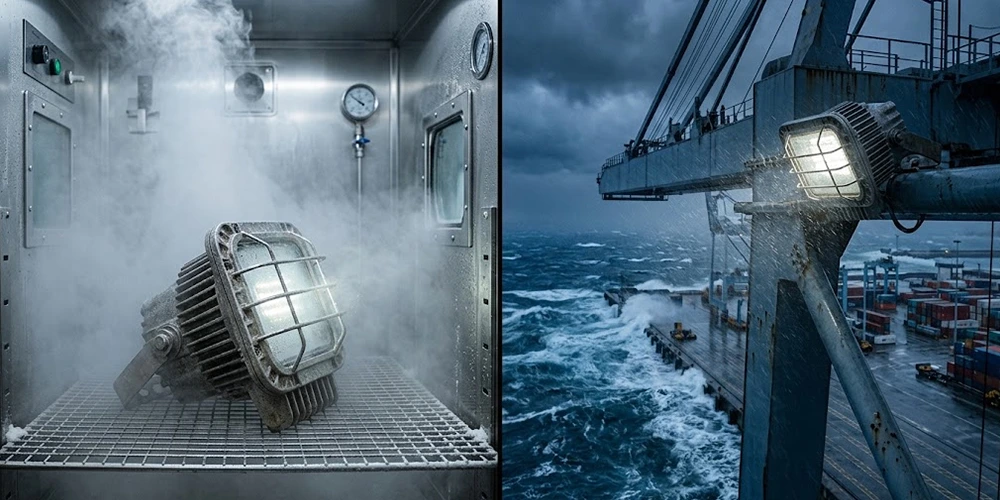
In natural coastal or marine air, airborne chloride particles gradually settle on metal surfaces, degrading protective coatings and corroding the underlying metal over years.
Because manufacturers and contractors cannot wait five or ten years to verify whether a powder coating formulation holds up, an accelerated laboratory chamber is used instead.
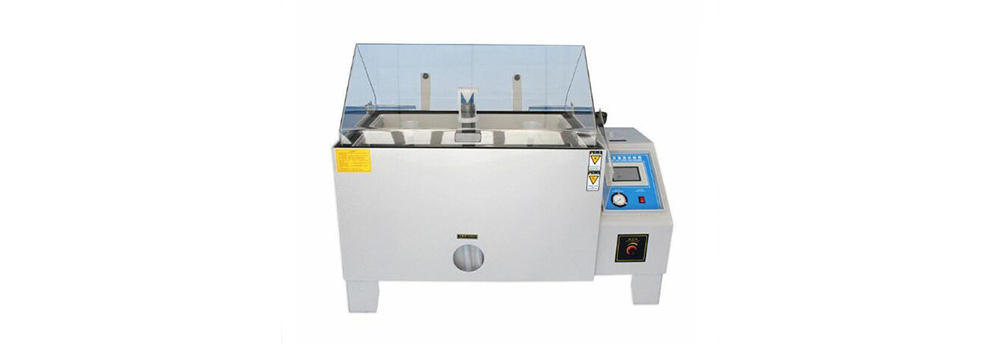
In an NSS test, specimens are exposed inside a controlled chamber to a fine spray of saline solution. The test is designed to produce a repeatable and aggressive corrosion environment so different materials or coating systems can be compared.
The luminaire housing or test coupon is placed inside an enclosed chamber maintained at an elevated temperature (typically 35°C).
A calibrated saline solution (5% sodium chloride dissolved in deionized water, buffered to a neutral pH between 6.5 and 7.2) is atomized through nozzles, creating a continuous, dense salt fog that envelops the fixture.
Common test durations range from a few dozen hours for light-duty finishes up to many hundreds or thousands of hours (e.g., 480 h, 720 h, 1,440 h) for demanding outdoor applications.
After the exposure, specimens are evaluated for:
- Overall visual appearance
- Degree of blistering, rusting, cracking, or flaking
- Corrosion creep from intentional scribes
- Condition of fasteners, seals, and critical interfaces
What Does “1,000 Hours of Salt Spray” Actually Mean?
It means the tested specimen completed a defined salt spray exposure period under the specified laboratory conditions.
It does not mean 1,000 hours equals a specific number of outdoor years or that two products with the same salt spray rating will perform identically in every outdoor environment.
ISO 9227 itself does not define a universal interpretation of exposure hours or a direct relationship between test hours and field service life.
This distinction matters because laboratory salt spray is a controlled continuous exposure, while outdoor corrosion is a combination of different environmental conditions.
The test chamber maintains a constant saline fog at 35°C, but outdoor environments involve cyclic variables like UV radiation, daily wet/dry cycles, and temperature swings. The laboratory test does not reproduce all of these conditions at the same time.
Why More Salt Spray Hours Do Not Equal More Outdoor Years
It is tempting to create a simple conversion:
1,000 salt spray hours = X years outdoors
That approach is not technically sound.
A strong coating can perform poorly if the luminaire design allows water and contaminants to remain trapped around vulnerable areas. This is why ISO 12944-6 describes laboratory performance testing as an aid for selecting protective coating systems, rather than as an exact method for determining service life.
Salt spray is a comparison tool, not a service-life calculator.
A higher test-hour requirement can provide stronger evidence under the specified test conditions. But the number should always be considered together with the coating system, substrate, product construction, test method, acceptance criteria, and intended installation environment.
Salt Spray Alone Is Not the Full Corrosion Picture
Salt spray testing tells you how a coating handles chloride-driven pitting. It does not tell you how the same coating handles sustained humidity without salt, which is a different failure mode entirely.
That is what outdoor lighting often faces: continuous moisture and morning condensation.
Moisture softens the protective paint matrix and induces osmotic blistering, creating microscopic pathways for chloride ions to reach the metal substrate.
ISO 6270-1 specifies a condensation test for evaluating the resistance of paint films and coating systems to condensation exposure. It is therefore useful as a complementary test when moisture resistance is relevant to the application.
The important point is that salt spray and condensation testing answer different questions. ISO 9227 evaluates resistance to controlled saline corrosion environments, while ISO 6270-1 evaluates the resistance of coating systems to condensation exposure.
At AGC, laboratory qualification pairs ISO 9227 with ISO 6270-1 to simulate both salt deposition and cyclic humidity.
The Environment Matters More Than the Hour Number
A useful way to think about corrosion resistance is to start with the installation environment, then work backward to the required product performance.
ISO 9223 provides a classification system for atmospheric corrosivity. It considers factors such as the temperature-humidity conditions, airborne salinity, sulfur dioxide pollution, and time of wetness. The standard uses environmental information and corrosion rates of standard specimens to classify atmospheric corrosivity.
Those are the claims you see, like “C4” or “C5”.
ISO 12944-2 provides environmental classifications used in the selection of protective coating systems. It describes atmospheric corrosivity categories and typical environments associated with them.
Salt Spray Hours and Real-World Lighting Durability
A useful way to evaluate corrosion resistance in the real world should connect three things:
Test evidence → product construction → installation environment
For example, a demanding coastal application may require more than a high salt spray test number. The specification should also consider the actual housing material, coating system, fasteners, drainage, sealing, and exposure conditions. These may include low-copper aluminium, marine-grade architectural powder, and 316 stainless steel hardware.
That means you should not ask only:
“How many salt spray hours does it pass?”
but:
“What environment is this luminaire designed for, what materials and construction are used, and what test evidence supports that application?”
At AGC, we not only provide durable lighting solutions for coastal, marine, and industrial environments; we also have test evidence.
If your project requires documented corrosion performance for a specific atmospheric category, contact us and provide the site conditions and the relevant models. The corresponding test results and category declaration can be supplied directly.