Parking lots at commercial and industrial sites present demanding lighting requirements. Large paved areas, multiple vehicle and pedestrian routes, and high security expectations all require reliable, well-designed illumination.
At the same time, rising grid electricity costs, lengthy permitting processes, and corporate ESG targets are pushing site owners and facility managers to reconsider how they power outdoor lighting. Solar parking lot lighting is one practical option, particularly for sites where extending grid power is costly or disruptive.
This guide explains where solar parking lot lights make sense, what lighting performance to expect, which European regulations and standards apply, the costs and potential savings, and how solar lighting can be integrated with parking carports.
- Why Solar Lighting Makes Sense for Parking Lots
- What Good Parking Lot Lighting Actually Needs to Deliver
- Uniformity: Eliminating Dark Zones
- Security and CCTV Visibility
- Year-Round Reliability: Designing for Winter Conditions
- Standards and regulations you need to know
- Combining Solar Lights with Carports
- FAQ
Why Solar Lighting Makes Sense for Parking Lots
The main reason businesses adopt solar parking lot lighting is not environmental sustainability alone. It is the combination of lower infrastructure costs, simpler installation, and greater control over long-term operating costs.
For both new installations and retrofits, civil works can account for a large share of the project cost of grid-connected lighting. Solar lighting eliminates the need for underground power cables, which can reduce civil works and simplify project installation.
Because each solar light operates independently from the electrical grid, installation can also be completed much faster. For suitable sites, this can shorten project schedules from months to days. There is no ongoing electricity cost for lighting.
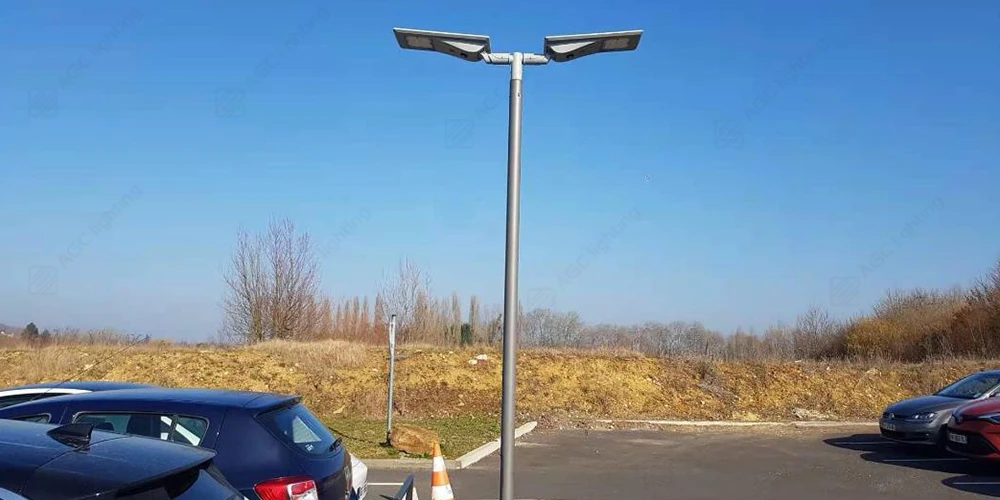
Solar parking lot lights also give site planners greater freedom when positioning poles. Each fixture has its own solar panel, battery, and lighting system, so poles do not need to be located close to an existing power supply. They can be positioned according to the lighting layout, such as along parking aisles, at entrances and exits, around pedestrian routes, or in overflow parking areas.
What Good Parking Lot Lighting Actually Needs to Deliver
A commercial parking lot is not a simple pathway or single lane road. It is a dynamic environment where cars, delivery vehicles, trucks, and pedestrians move through the same space. Lighting must support safe movement, security, and reliable operation throughout the year.
A well-designed solar lighting system should meet three core requirements.
Uniformity: Eliminating Dark Zones
Cheap or poorly designed fixtures create "hot spots" of bright light directly under the pole, leaving deep shadows between parked vehicles.
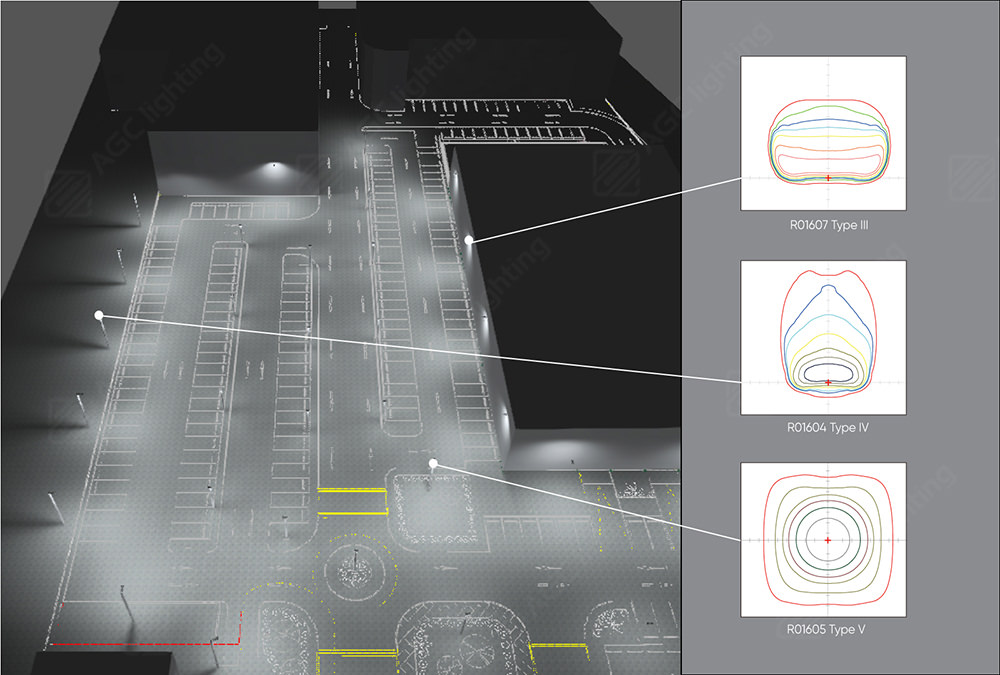
Good parking lot lighting uses the right optical distribution for the pole location and mounting height. Type V optics are often suitable for poles positioned within the parking area, while Type III distributions can work well along perimeters and road edges. The exact optic should be selected based on the site layout, pole spacing, mounting height, and required lighting level.
The goal is consistent illumination across the entire target area, not simply high light levels directly below each pole.
Here is a parking lot project. By strategically deploying a tailored combination of Type III, Type V, and Type IV optic distributions, we achieved full, high-uniformity coverage across this entire parking lot.
Security and CCTV Visibility
Parking lot lighting also supports security systems. Facility managers often depend on CCTV footage for monitoring vehicles, investigating incidents, and protecting people and property.
- Color rendering: A CRI of 70 or higher is common for outdoor applications, while CRI 80 or higher can provide better color identification where accurate recognition is important.
- Low flicker: Quality LED drivers should minimize visible and camera related flicker. This helps reduce rolling shutter artifacts and other image distortions that can affect CCTV footage.
- Vertical illuminance: Light should reach vertical surfaces such as faces, vehicle sides, and license plates, not only the pavement. This is particularly important when CCTV identification is part of the lighting objective.
Year-Round Reliability: Designing for Winter Conditions
Solar parking lot lighting must be designed for the site's worst seasonal conditions, not its best summer performance. In many European locations, winter brings shorter daylight hours, lower solar radiation, and extended periods of cloud, rain, or snow.
For commercial and industrial sites, 2 to 5 days of autonomy is a common design range, but the correct figure depends on the climate, project requirements, and acceptable risk of reduced output. An MPPT solar charge controller can improve energy harvesting by operating the solar panel closer to its maximum power point, particularly under changing weather and irradiance conditions.
Standards and regulations you need to know
These requirements of parking lot lighting can vary by country and by the type and use of the site.
EN 12464-2 provides requirements and recommendations for lighting of outdoor workplaces, including criteria for illuminance, uniformity, glare, and other aspects of visual conditions. EN 13201 is primarily concerned with road and public area lighting and may also be relevant where parking areas connect to access roads or other traffic routes. In the UK, BS 5489 provides additional guidance for the design of road and car park lighting.
In addition to lighting regulations, some European countries are introducing requirements for photovoltaic installations on larger parking facilities. France, for example, has introduced requirements covering photovoltaic installations or alternative measures for certain large car parks, subject to specific size, site, and exemption criteria. Germany also has photovoltaic requirements for parking facilities in several federal states, although the rules and thresholds vary by state.
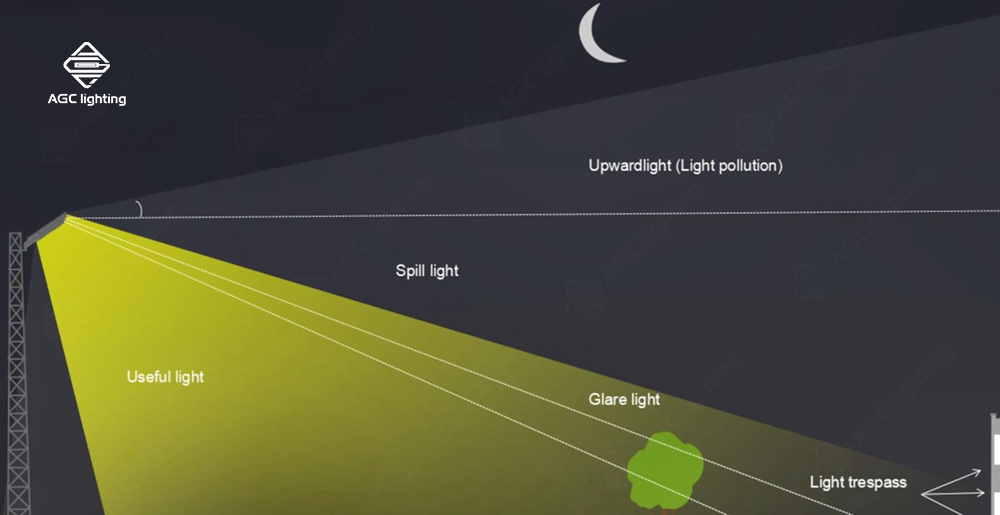
Local light pollution requirements can affect both the design and specification of parking lot lighting. Depending on the location, projects may have limits on upward light, glare, operating hours, or correlated color temperature. Full or well controlled cut-off optics and appropriate LED color temperatures can help reduce unnecessary light spill into surrounding areas.
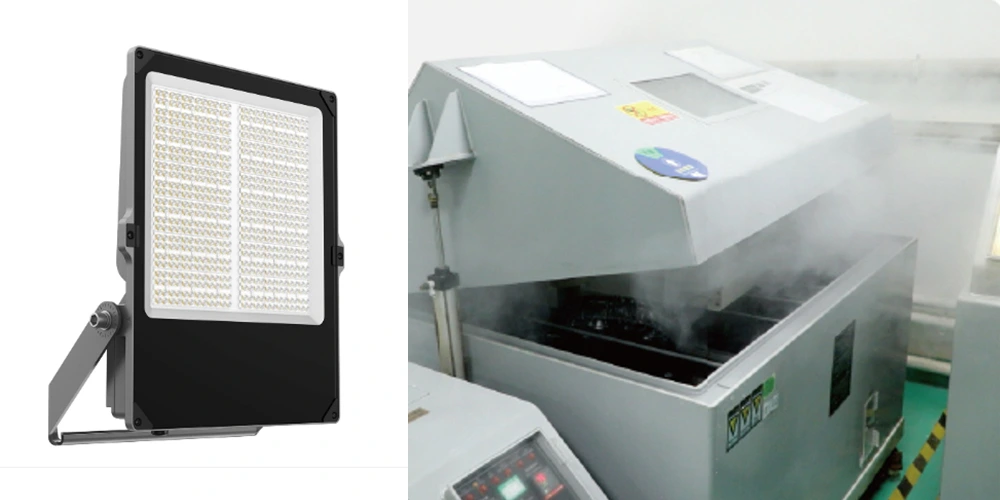
Solar lighting products supplied in Europe must also meet the applicable product and safety requirements. Depending on the system design and components used, this can include CE marking requirements, battery regulations, electromagnetic compatibility requirements, electrical safety requirements, and relevant LED and photovoltaic standards.
Combining Solar Lights with Carports
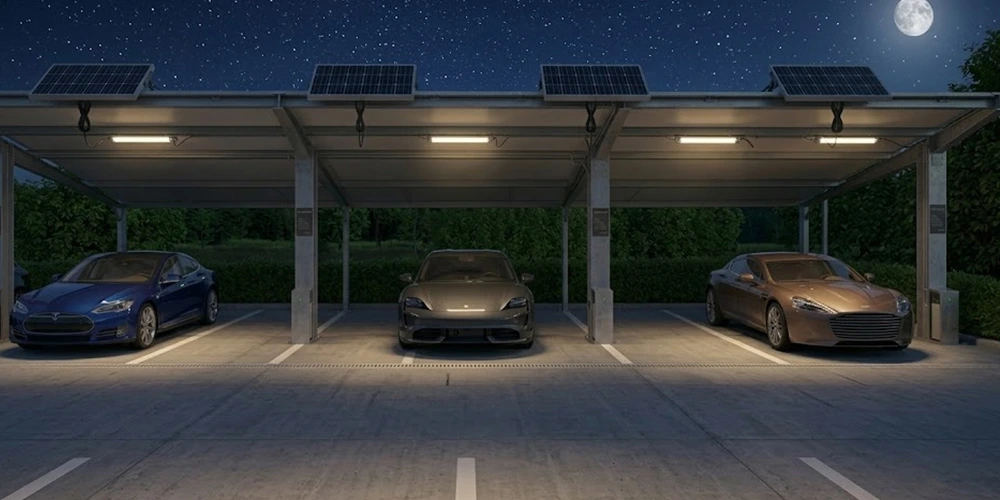
As we mentioned before, solar lighting is increasingly being integrated into parking lot carports, particularly as more European markets require or encourage photovoltaic installations on large parking facilities
In countries like France, recent legislation mandates that large existing and new commercial parking lots (over 1,500 square meters) cover at least 50% of their area with solar canopies.
Carports require low-profile, wide-distribution luminaires mounted directly to the canopy steelwork rather than traditional high poles.
Our SL62 solar tube light is designed for applications where solar lighting needs to be integrated with a carport or other canopy structure. Its split design separates the solar panel from the lighting unit, providing greater flexibility when positioning the components.
The system delivers an efficacy of up to 180 lm/W and uses a LiFePO₄ battery with monocrystalline solar panels for efficient energy generation and storage. A stepped adjustable support bracket provides flexible mounting and helps improve structural stability and wind resistance.
If you're evaluating options for an existing or new parking area, our team can review your site details and put together a recommendation.
Contact us to discuss your parking lot lighting project.
FAQ
How many lux are required for a commercial parking lot in Europe under EN 12464-2?
Standard commercial parking lots generally require 5 to 20 lux depending on traffic density. High-activity industrial yards and logistics hubs require 20 to 50 lux with an overall uniformity ratio Emax/ Emin of at least 1:4 to ensure safe vehicular and pedestrian movement.
Can solar parking lot lights charge in temperatures below 0°C during European winters?
Yes. Solar lighting systems utilize LiFePO4 battery systems paired with smart battery management systems (BMS) and thermal insulation or heating elements. This prevents lithium plating during sub-zero charging while preserving battery cycle life.
What solar optics are best for central vs. perimeter parking poles?
Center-lot poles require Type V (360-degree square or circular) symmetric optics to distribute light uniformly in all directions around the pole. Perimeter poles require Type III or Type IV asymmetric optics to throw light forward into the lot while cutting off backlight behind the pole to prevent light spill onto surrounding properties.