
Solar lighting is a green solution that requires no electricity connection and no trenching. It has become a popular choice for both urban and rural areas. However, there is still confusion about its performance, especially when some solar lights fail to last through the night or perform poorly on cloudy days.
Many people assume the problem comes from the solar panel. They believe there is not enough sunlight or that the panel cannot generate enough power. While the solar panel is indeed a critical factor in solar lighting performance, it is not the only one.
Another important component is the charge controller. Unlike the solar panel, this part is not visible from the outside, so it is often overlooked. However, it plays a key role in managing how energy is stored and used in the system.
There are two main types of charge controllers on the market: PWM and MPPT. The difference between these two technologies can determine whether a solar light can reliably operate throughout the entire night.
What Is the Charge Controller?
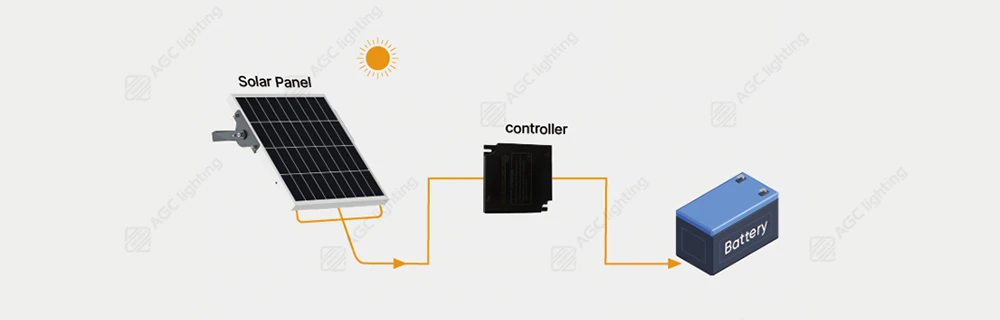
In a solar lighting system, the solar panel collects energy, the battery stores it, and the light uses it. However, the solar panel and the battery cannot work together directly.
A solar charge controller acts as the mediator or the intelligent brain between them. It regulates how energy flows from the solar panel to the battery. If too much charge comes in too quickly, the controller reduces the flow. When the battery approaches full capacity, it limits the charging to protect the battery.
This is why the choice of a charge controller can strongly affect the performance of a solar lighting system. It determines how efficiently energy is stored, how long the battery lasts, and ultimately how many hours the light can operate during the night.
What Is a PWM Controller?
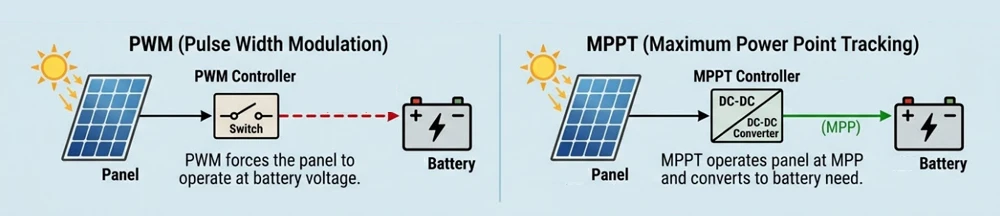
A PWM controller, or Pulse Width Modulation controller, works like a very fast light switch. It connects the solar panel directly to the battery and regulates charging by rapidly switching the connection on and off.
When the battery approaches full capacity, the controller repeatedly connects and disconnects the solar panel to maintain a steady voltage. This process allows small amounts of energy to flow into the battery, which helps prevent overcharging while keeping the battery fully charged.
The limitation is that a PWM controller can only operate at the battery’s voltage at any given moment. If the solar panel produces more voltage than the battery can accept, the extra energy cannot be used and is simply wasted.
On cloudy days or during winter, when sunlight is weaker and the sun sits lower in the sky, a PWM system may struggle to capture enough energy to keep lights running throughout the night. For this reason, PWM systems often require larger solar panels to compensate for the lower energy efficiency.
Despite this limitation, PWM controllers remain a reliable and cost-effective option for simple solar lighting projects.
What Is an MPPT Controller?
MPPT stands for Maximum Power Point Tracking. An MPPT controller continuously monitors the power produced by the solar panel and adjusts the charging process to deliver the optimal power the battery needs. Instead of letting excess energy go to waste, it converts that power into a form the battery can use more effectively.
One of the key advantages of an MPPT controller is its ability to convert excess voltage into additional charging current. This allows the system to capture more usable energy from the same solar panel. As a result, MPPT controllers can achieve efficiency gains of about 20% to 30% compared with PWM systems using the same panel.
Because of this higher efficiency, MPPT controllers are well-suited for applications that require maximum brightness, longer runtime, and reliable performance in changing weather conditions.
PWM vs. MPPT Controllers: Which Is Better?
MPPT controllers are generally the better choice for most solar lighting systems because they can deliver up to 30% higher efficiency and capture more usable energy from the same solar panel. However, PWM controllers can still be effective in smaller systems, lower-cost projects, or locations with stable and consistent sunlight.
The following table compares the key differences between PWM and MPPT controllers.
|
|
PWM Controller |
MPPT Controller |
|
How it works |
On/off switching |
Smart power conversion |
|
Energy efficiency |
Loses power when the panel’s voltage at maximum power is higher than the battery’s nominal charging voltage |
Maximized across varying conditions |
|
Performance in cloudy/cold weather |
Less effective |
Highly effective |
|
Upfront cost |
Low |
Higher |
|
Best for |
Sunny climates, small, simple systems |
Outdoor, all-weather use, larger or high-output systems |
So which one is the right choice for your project?
If you need a lower cost and simpler solution, and the solar lighting system will be installed in a region with consistent sunlight, a PWM controller can perform well and meet the basic requirements.
If you need consistent and reliable lighting regardless of weather conditions, such as for bus shelters, parking lots, or street lighting, an MPPT controller is usually the better option because it can capture more energy and maintain longer lighting hours.
FAQ
Can I upgrade an existing PWM-based solar light to an MPPT system?
Yes. Just make sure the MPPT controller’s voltage and current ratings match your solar panel and battery.
Does MPPT really make a difference on cloudy days?
Yes. When solar output drops, MPPT can extract more usable energy from the panel, helping keep the battery charged and the lights running longer.
Is MPPT worth the extra costs?
Usually, yes, especially if you want more consistent performance throughout the year.
Which controller does AGC Lighting use in solar lighting systems?
AGC Lighting uses both PWM and MPPT controllers across different solar lighting models. The controller type depends on the product design and project requirements. Customized solutions are also available if the standard configuration does not meet your needs.