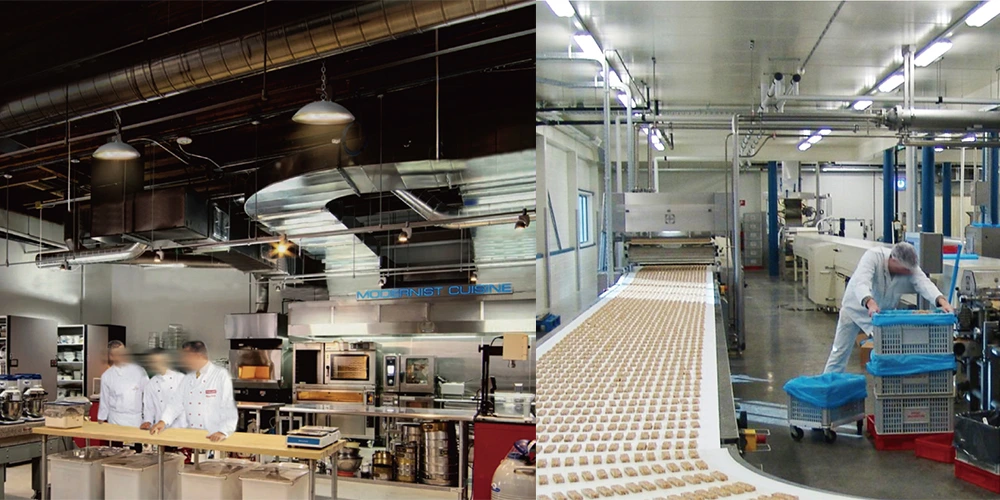
It was great to be at the Canton Fair and the Hong Kong International Lighting Fair 2026, 9 full days of meeting partners, walking projects, and showing our lighting solutions.
But here is something most people don’t pay attention to. The lighting in the exhibition halls themselves.
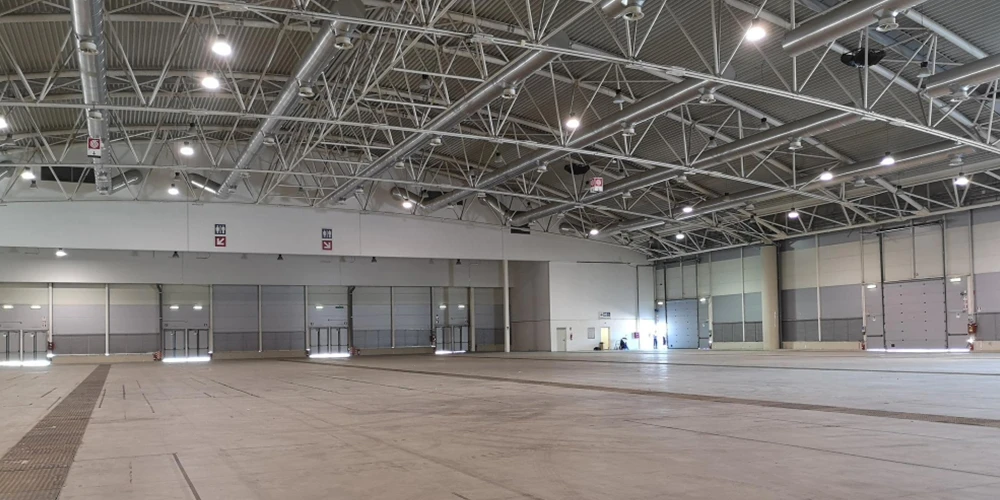
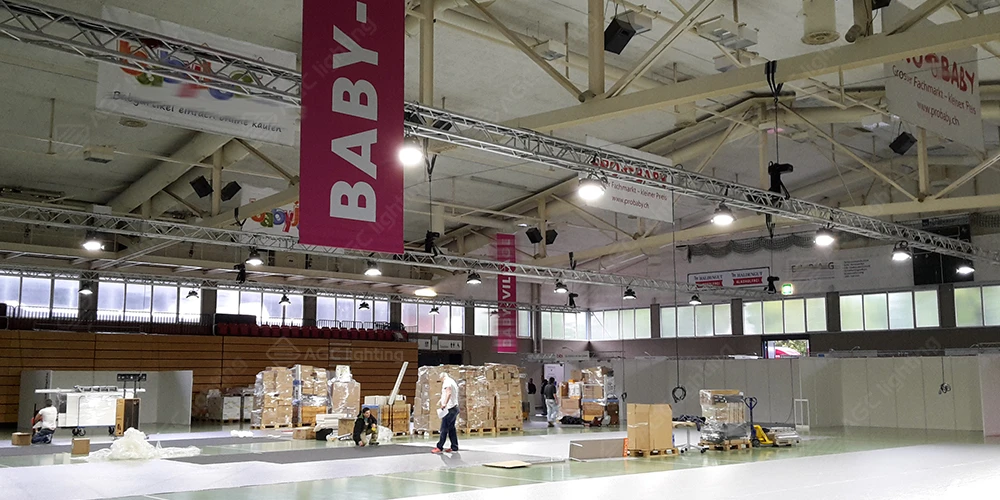
Next time you are in one, look up at the ceiling. You will notice it right away. High bay fixtures everywhere, either round or linear.
High bay lights do have a place in exhibition centers. But not every high bay is suitable, and not every layout makes sense.
The goal is not just to reach a certain lux level on the floor. The lighting needs to be even, comfortable, and visually clean. Displays should look right. People should not feel eye strain. Cameras should be able to capture without issues.
That takes more thought than simply installing high bays across the ceiling.
What Makes Exhibition Hall Lighting Different
Exhibition centers look a lot like warehouses. Large floor areas, high ceilings, and wide open spaces. So it is easy to assume the same lighting approach used in factories or storage buildings will work here.
That assumption does not hold up in practice.
Warehouse lighting is mostly functional. Exhibition hall lighting supports branding, guides movement, and affects how products are seen and judged.
The biggest difference is how the space is used. Exhibition centers do not store goods. They host trade shows, product launches, conferences, and sometimes live broadcasts. The layout changes constantly. One week it is heavy machinery, the next it is jewelry, then a medical conference.
That means the lighting has to be flexible, provide wide and even coverage, and hold up from different viewing angles. Exhibitors invest heavily in booths and displays. If the lighting distorts colors or creates harsh shadows, it makes the entire event look cheap.
People and products are both under the light, and both matter. Exhibitors are presenting their brands, and visitors may spend hours walking the floor. Even with similar ceiling heights, usually around 10 to 20 meters, exhibition halls need lighting that is uniform and comfortable, without hot spots or glare.
Lighting Requirements for Exhibition Halls
When looking for high bay lights for exhibition halls, consider sufficient illuminance, good color rendering, consistent color temperature, uniform coverage, proper glare control, and the flexibility to handle changing layouts.
Illuminance
There is no single fixed standard for exhibition hall lighting. Most venues use EN 12464-1 as a reference point and adjust based on the event.
The entrance and registration zones can work with 300 lux. For the exhibition floor, it needs at least 500 lux for general display. For the loading and logistics areas, 200 lux sit comfortably. For high-detail display, like jewelry, electronics, or fine art, where high visibility is a sales driver, it requires up to 1000+ lux.
Color Rendering Index (CRI)
CRI 80 is the minimum acceptable threshold. If the venue hosts product-focused exhibitions such as automotive, jewelry, food, or cosmetics, a CRI 90 or above should be considered.
Low CRI does more than flatten colors. It makes products look dull and lower in quality. That has a real impact on how visitors perceive what they are seeing.
Glare Control
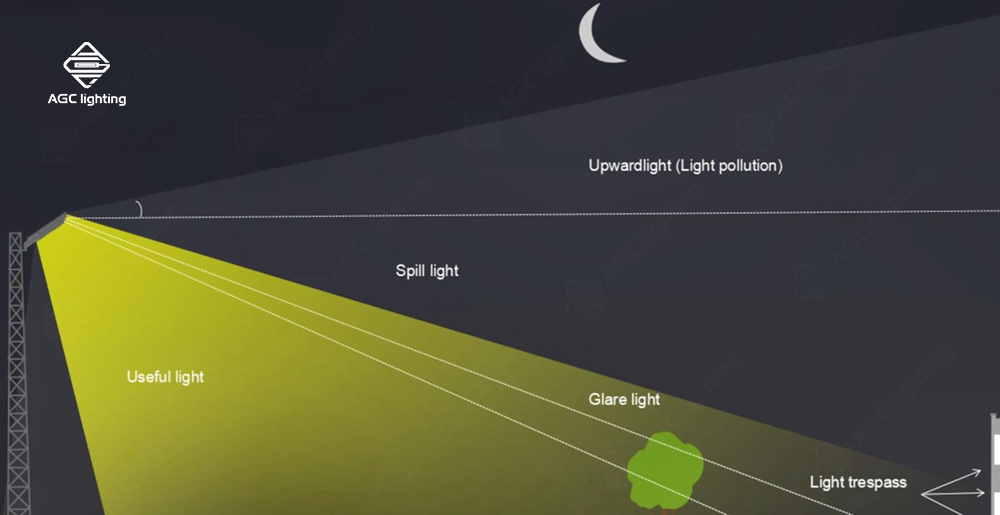
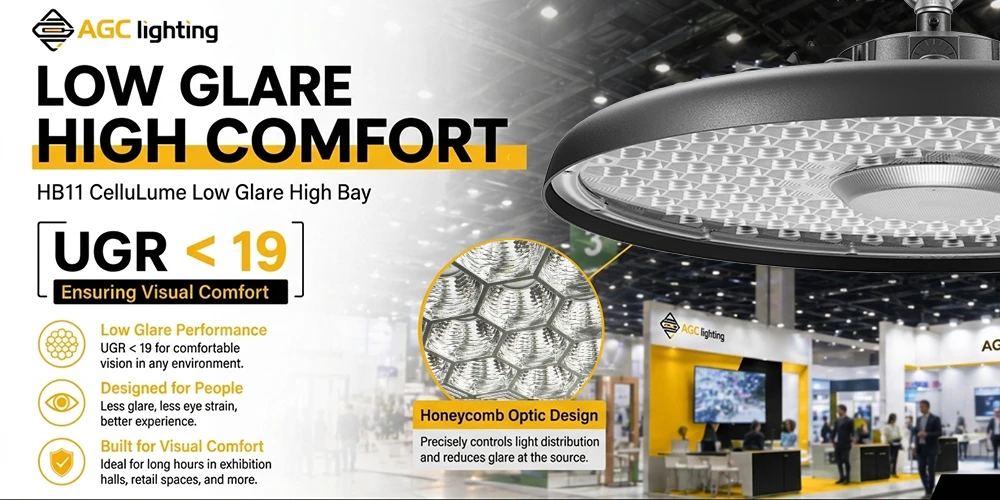
People spend hours in the space, often looking up at signage, screens, and lighting. Poor glare control leads to eye strain and reduces overall comfort. Target UGR < 19 or < 22 for exhibition floors.
At AGC, we know fixture design matters here. Optics, shielding, and mounting height all affect glare control performance. Take HB11 CelluLume as an example. It features a unique honeycomb optic design that delivers a UGR <19, ensuring visual comfort.
We also provide customized lighting solutions that help reduce glare. For example, we provided an unconventional way to reduce the UGR of high bay lights: install the high bay lights upside down. The fixture reflected light off the ceiling instead of pointing directly downward, which effectively reduced glare.
Flexibility for Changing Layouts
Exhibition spaces do not stay the same. Layouts change from one event to the next, sometimes within days. So lighting must adapt.
One solution we provide is the high bay lights with adjustable power and CCT. Simple controls like a dip switch allow users to adjust the light output without complex wiring or programming. This also helps reduce SKU count and simplifies inventory.
Another solution is the smart lighting control. Both wired systems, like DALI, and wireless systems like Casambi are commonly used. The system offers dimming capabilities, color tuning, and dynamic lighting effects, allowing for versatile lighting designs.
Controls and Energy Management
Energy use and operating cost are what matter to venue operators. In large exhibition halls, lighting is a major part of the electricity bill, so facility managers and finance teams pay close attention to it.
Two things make the biggest difference. Fixture efficacy and how the lighting is controlled.
High Bays with High Efficacy
Efficacy has a direct impact on energy consumption. It means how much usable light you are getting for that wattage.
For example, a high bay with higher lumens per watt can achieve the same illuminance level with fewer fixtures or lower wattage. That translates into lower energy use and lower running costs.
Our high bay fixtures can reach 190 lm/W, meeting the target lux levels without overloading the system.
Smart Controls for Zoning and Scene Setting
Exhibition halls are almost never used as a single, uniform space. Different zones are active at different times. With the right control system, operators can divide the hall into zones, adjust light levels based on use, and set scenes for different events or time periods.
We have worked with clients who needed a simple setup they could manage themselves, including dimming and basic grouping. In one case, a wireless solution based on Zigbee allowed the system to integrate smoothly and meet the required 500 lux target without overcomplicating the installation.
At the same time, many larger venues require integration with a central building system. Protocols like DALI or platforms like Casambi are commonly used to connect lighting with the building management system for monitoring and control.
For more details about the industrial smart lighting solutions, feel free to contact us at info@agcled.com.
High Bay Options: Round vs. Linear
Both round and linear high bays are valid options for exhibition halls. The real question is not which one is better. It is the one that fits the space and the layout.
Round high bays produce a circular beam pattern. They work well in wide, open areas where you need broad coverage without a strict layout.
Linear high bays produce a rectangular distribution. They are better suited for structured layouts, especially where booths or aisles follow clear rows.
Most exhibition halls have structured row layouts. In those cases, linear high bays give smoother, more even illumination across the floor.
The right choice depends on the layout, mounting height, and what the space is being used for.
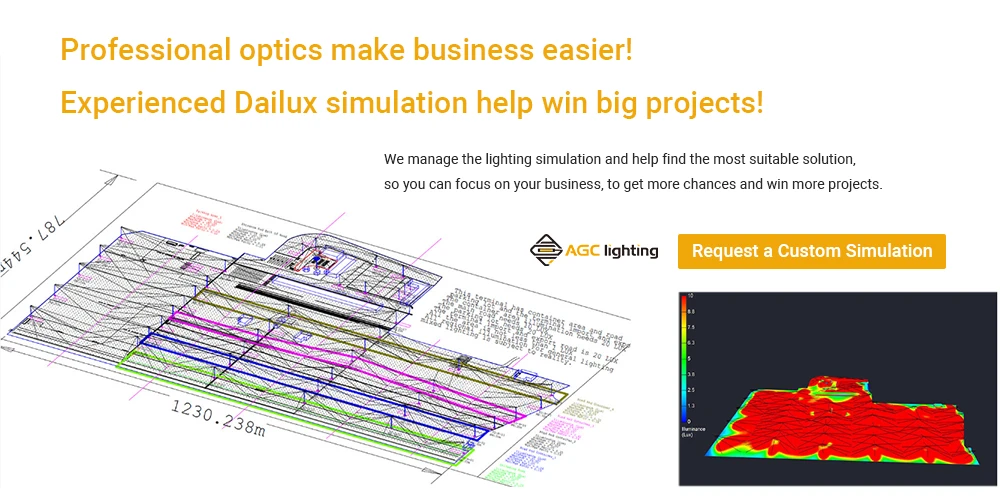
That is why lighting simulation matters.
A proper simulation takes into account fixture type, beam angle, mounting position, and spacing. It shows how light will actually perform in the space before anything is installed.
At AGC Lighting, this means collecting accurate project details, understanding how the hall will be used, and then selecting the right fixture and setup to match. Adjustments like beam angle and aiming can make a significant difference in uniformity and glare control.
If you are working on an exhibition or convention center project, it is worth doing this step properly. It saves time, avoids rework, and leads to better results on site.
A Quick Checklist for Choosing the Right High Bay Lights
- Illuminance: 300 lux at entrances, 500 lux on the general floor, 1000+ lux for high-detail zones.
- Color rendering: CRI 80 minimum; CRI 90+ for product-focused events.
- Glare control: Target UGR < 22 or UGR < 19.
- Fixture type: Linear for row layouts; round for open spaces.
- Lighting simulation: Confirms lux, uniformity, and glare
- Flexibility for layout changes: Adjustable power/CCT or smart controls
- Efficacy: 160 lm/W or above.
- Zoning planned: Zones can be dimmed and scene-set independently.