DIN 18032-3 is the testing of safety against ball throwing. It requires a luminaire to survive 36 impacts at 16.5 m/s without structural failure or releasing parts.
This standard is often confused with IK ratings or the DIN 57710-13 ball test. They are not the same thing. As a lighting manufacturer with a TÜV SÜD-recognized laboratory, we test against the actual use conditions defined in DIN 18032-3.
In this article, we explain what DIN 18032-3 requires and why IK ratings and DIN 57710-13 do not provide the same level of verification for sports lighting applications.
Why Ball-Impact Safety Matters in Sports Halls
Ball-impact safety is first and foremost about protecting people. It is also a liability issue for facility operators.
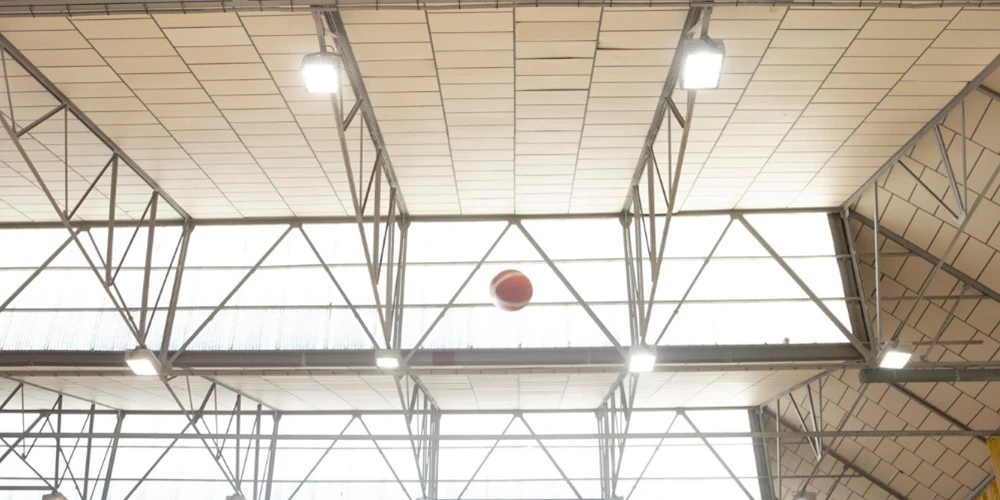
In a sports hall, impacts are normal. A handball can reach speeds of around 90 km/h. Volleyball spikes and basketball shots also regularly strike the ceiling in enclosed spaces.
When a luminaire cannot withstand that impact and fails, it becomes a safety hazard. Falling components in an occupied space create an immediate risk of injury.
For facility operators, the implications are straightforward. Standards require installed fixtures to be ball-impact resistant. Non-compliant lighting in public or regulated facilities increases exposure to legal claims and insurance issues.
Upstream, specifiers and contractors are asking for ball-proof test reports and compliance evidence more frequently.
What DIN 18032-3 Covers
DIN 18032-3 is a mechanical safety standard. It defines how ceiling and wall mounted equipment must perform when struck by a ball in a sports hall.
It does not stand alone. DIN 18032-1 is the planning standard. It sets the requirement that all permanently installed elements, including luminaires and their mounting systems, must be ball-impact resistant.
DIN 18032-3 specifies the test method used to prove ball-impact resistance. It answers a single, practical question:
Can the product withstand repeated, high-energy impacts without breaking, detaching, or creating a safety risk?
The standard applies to the complete assembly, including:
- Mounting hardware and fixings
- Housing and frame
- Diffusers, covers, and lenses
- Internal components such as drivers and connectors
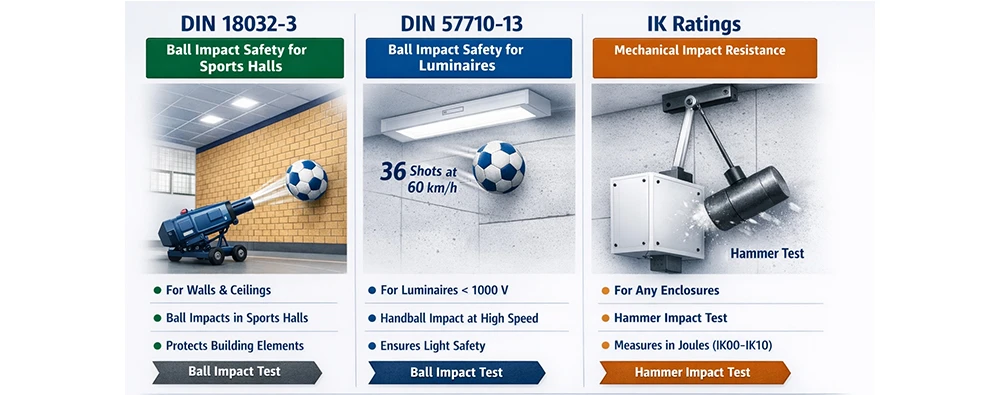
Differences Between DIN 18032-3, IK Ratings, and DIN 57710-13
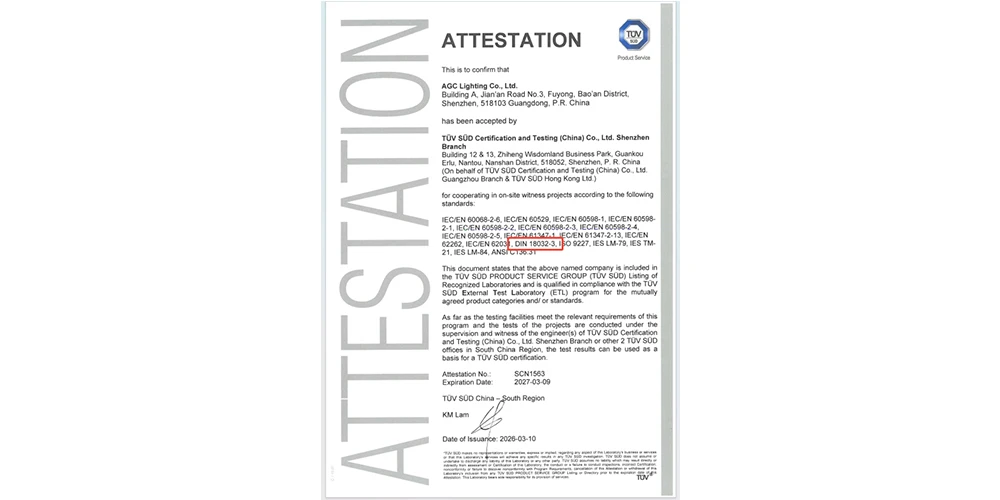
DIN 18032-3, IK ratings, and DIN 57710-13 all address impact resistance, but they differ in test method, scope, and what they actually prove. With a TÜV SÜD recognized laboratory, AGC Lighting can perform not only the IK rating test but also the DIN 18032-3 ball impact safety test.
IK Ratings: Single Impact Resistance of Enclosures
IK ratings provide limited information about enclosure strength under a single impact. The test is controlled and static.
DIN 57710-13: Ball-Impact Test for Luminaires
DIN 57710-13 is an older German standard for luminaires exposed to ball impact. It was used before DIN 18032-3 became the reference for sports hall applications.
DIN 18032-3: Ball-Impact Safety for Sports Halls
DIN 18032-3 tests real-use conditions and complete system integrity. This standard verifies that a luminaire can withstand repeated, high-energy ball impacts under realistic conditions.
The Actual Test Requirements in DIN 18032-3
The current version is DIN 18032-3:2023-12. It introduces a precise calibration formula for impact velocity, and it formally separates laboratory accreditation requirements into a companion document, DIN 18032-301.
The standard defines two test protocols: one for ceiling-mounted elements and one for wall-mounted elements. The test equipment includes a ball-shooting machine capable of consistent velocity and angle, approved handballs (IHF size 3), and hockey balls, where required.
Ceiling elements, categories D1 and D2
Both categories follow the same shot sequence using a handball. The test consists of impacts from two angles, resulting in at least 36 hits in total. The difference between D1 and D2 lies in the impact velocity and intended application level.
|
Category |
Ball |
Impact velocity |
Angles |
Total impacts |
Application |
|
D1 |
Handball |
60 ± 2.9 km/h |
90° / 60° |
36 |
General sports halls |
|
D2 |
Handball |
85 km/h |
90° / 60° |
36 |
Professional basketball venues |
.
Wall elements, categories W1, W2, and W3
Wall-mounted luminaires are tested under W1, W2, or W3. W1 uses a handball only, while W2 and W3 include both handball and hockey ball impacts. W3 is the most demanding category, intended for high-use, multi-purpose sports facilities
The handball shot sequence is the same across all three categories: 30 shots at 90° and 12 shots from each of two 45° angles. For W2 and W3, an additional 12 hockey ball impacts are added, 4 shots from each of the same three angles.
|
Category |
Handball velocity |
Handball impacts |
Hockey ball velocity |
Hockey ball impacts |
Angles |
|
W1 |
85 km/h |
54 |
— |
— |
90° / 45° / 45° |
|
W2 |
85 km/h |
54 |
85 km/h |
12 |
90° / 45° / 45° |
|
W3 |
100 km/h |
54 |
85 km/h |
12 |
90° / 45° / 45° |
Pass criteria for all categories
Assessment is carried out after the full test sequence. To pass, the luminaire, including its mounting bracket, substructure, and fastening system, must satisfy all of the following:
- No parts are destroyed, detached, or fall out
- Structural stability is maintained
- Function and electrical safety are not impaired
- Any visible damage is minor and does not affect use
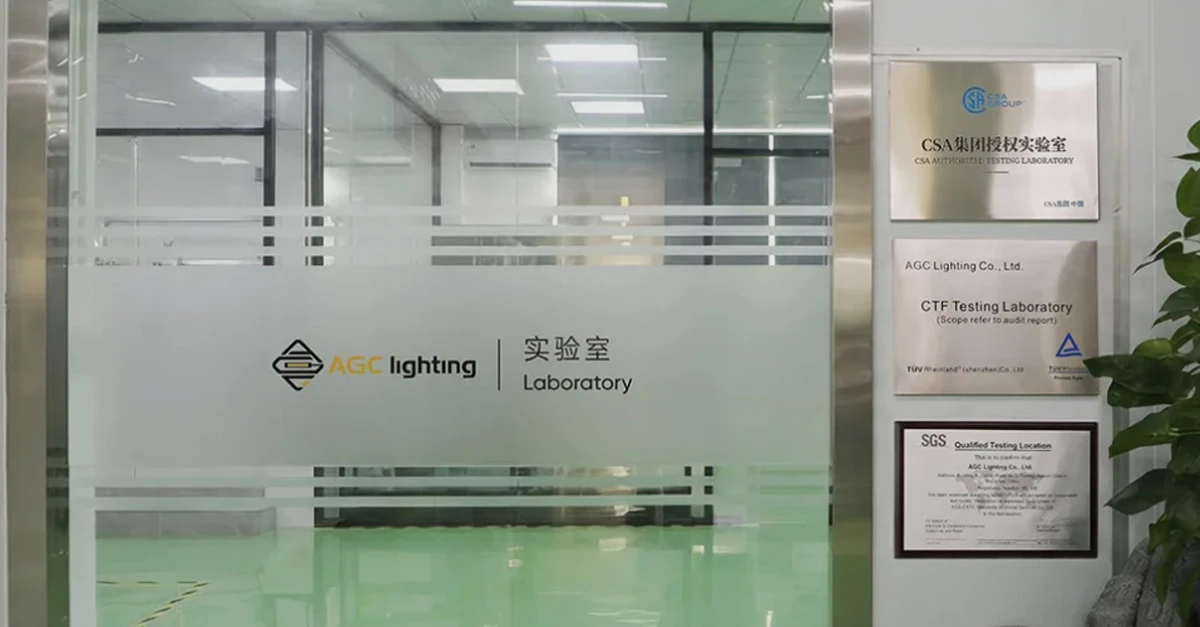
At AGC Lighting, we treat verified safety as a requirement, not a claim. Our TÜV SÜD–accepted laboratory allows us to test in-house, control quality at each stage, and avoid delays caused by third-party scheduling.
For projects such as sports halls, squash courts, or multi-purpose arenas, this means you get documented compliance and predictable lead times.
If you are sourcing lighting for these applications, involve us early.