Batteries drive solar lighting performance, but they don’t manage themselves. The component that decides whether a battery lasts three years or eight is the Battery Management System (BMS).
A BMS is an electronic circuit board built into the battery pack. A BMS controls how the battery charges and discharges, balances the cells, and protects the pack from conditions that cause early failure, such as overcharge, deep discharge, high current, and temperature extremes. BMS keeps the battery working within safe limits that define its cycle life.
In this article, we will look at how the BMS affects battery lifespan in solar lighting systems.
What BMS Actually Does in a Solar Lighting System
In a solar lighting system, the BMS is the interface between the chemical energy stored in the battery and the electronic demands of the controllers and LEDs. It manages how stored energy is delivered to the controller and LEDs, and how energy from the panel is accepted by the battery.
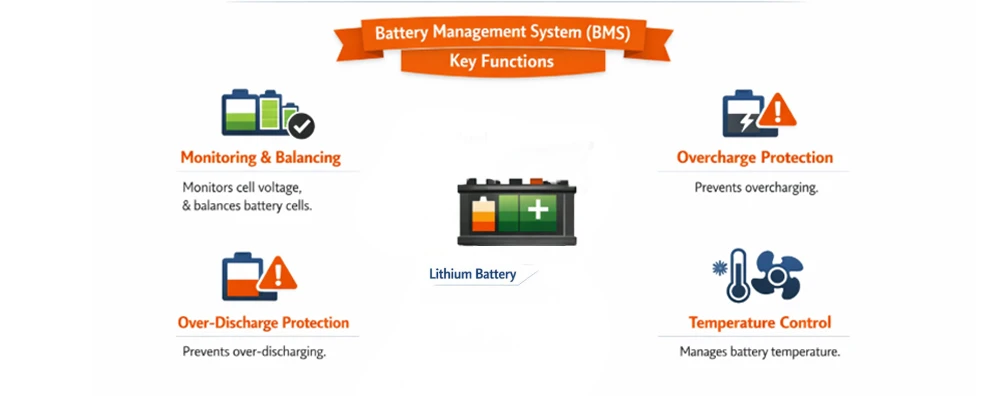
The BMS monitors and controls every charge and discharge cycle. It tracks voltage, current, and temperature at the cell and pack level. These are the parameters that determine whether a lithium battery ages slowly or fails early.
Overcharge protection
When a solar panel pushes too much voltage into a full battery, cell voltage rises beyond safe limits, and degradation accelerates. The BMS cuts off charging at a defined threshold, typically 4.2V per cell for Li-ion, before damage occurs.
Over-discharge protection
Drawing a battery too low is just as damaging as overcharging it. The BMS disconnects the load when voltage drops below a safe limit, preserving the remaining cell capacity and extending cycle life.
Cell balancing
Solar lights today mostly use LiFePO₄ or NMC cells. In a multi-cell battery pack, cells never perform identically. Without correction, the weakest cell limits the entire pack. The BMS balances charge across all cells, ensuring the pack performs as a whole and keeps the pack stable and usable.
Thermal protection
Batteries operate in outdoor environments, from desert heat to winter cold. The BMS monitors temperature and adjusts or halts operation when conditions fall outside safe limits. It blocks charging below 0°C and reduces charge current in high heat (usually over 45°C).
What is the Difference Between BMS and MPPT
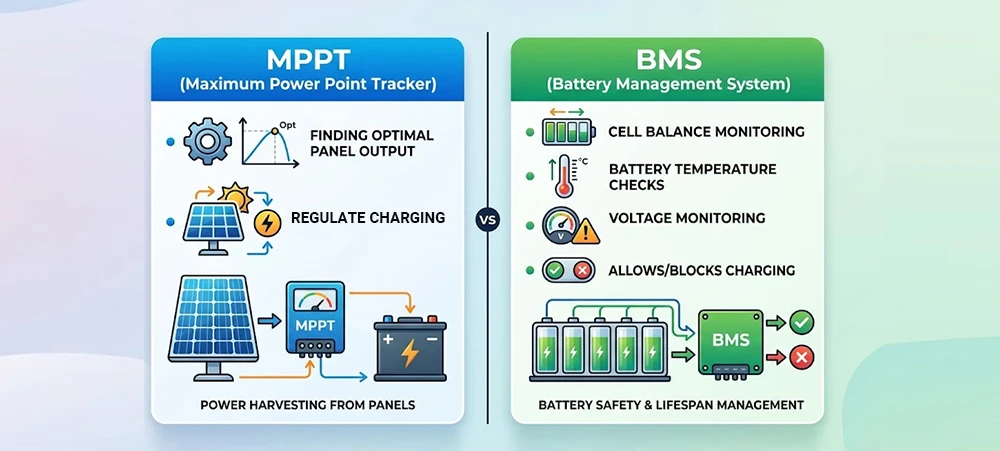
The BMS protects and manages the battery, while the MPPT manages the solar panel.
A BMS manages the battery. It protects the cells, balances charge, and prevents electrical and thermal damage. Its job starts when the energy enters the battery and ends when energy leaves it.
MPPT (Maximum Power Point Tracking) is a function of the solar charge controller. It manages the solar panel, continuously adjusting the electrical operating point to extract the maximum available energy from the panel under changing light conditions. Its job ends at the battery terminal.
In a solar lighting system, the MPPT pushes energy toward the battery, and the BMS decides whether the battery will accept it. If the battery is too cold, too hot, or already full, the BMS will stop the charge, even if the MPPT is still trying to deliver power.
How BMS Directly Affects Battery Lifespan
In the field, we don’t measure a battery’s life in years; we measure it in cycles. A cycle is one full charge and discharge. How the battery is used each night decides how many of those cycles it can handle.
The fastest way to shorten the life of a lithium battery is to discharge it too deeply every night. A battery may be rated at 100 Ah, but that does not mean you should use all of it every night. Doing that puts stress on the cells and speeds up aging.
The BMS controls depth of discharge (DoD), which is the main factor behind cycle life. Every battery has a cycle life curve. The deeper the discharge, the fewer cycles the battery can deliver.
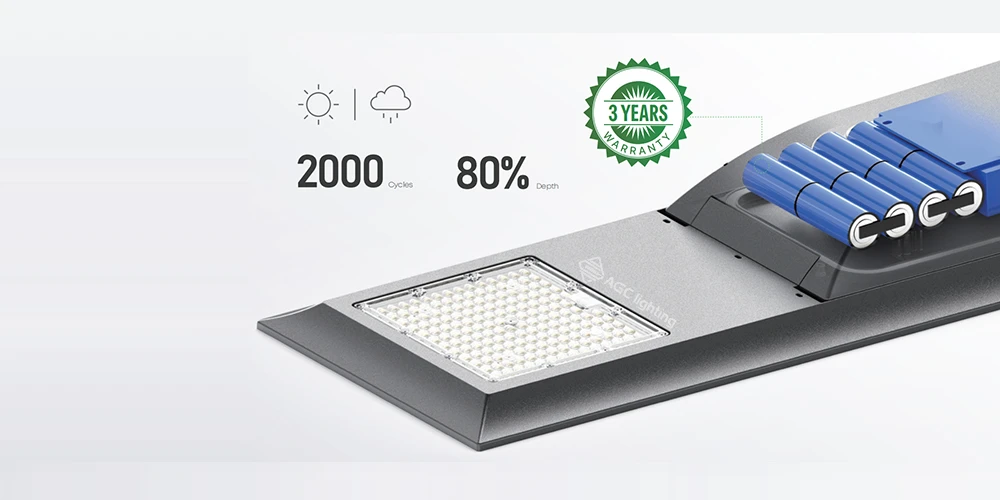
For example, a LiFePO₄ cell cycled at around 80%t depth of discharge may last about 2,000 cycles. Limit the depth of discharge to around 50%, and cycle life often doubles to 4,000 cycles. Push the cell to 100% depth of discharge every day, and the cycle life drops sharply.
The BMS sets the lower limit and stops the discharge before it goes too far. If that limit is set too low, the battery is pushed hard every night. If it is set at a reasonable level, the battery lasts much longer and performs more consistently.
What Happens if BMS Fails
When the BMS fails, the battery loses its protection. Without control over charge and discharge, the cells degrade quickly. Once the battery fails, the entire solar lighting system follows.
A BMS failure is not always obvious at the start. The first signs usually show up in lighting performance. Lights dim earlier in the night. Runtime varies across units in the same installation. Some lights stop working after several cloudy days and do not recover.
Without proper control, overcharging and deep discharging happen more often. This shortens battery life fast. A battery designed for five years of service may only deliver 18 to 24 months. In street lighting or infrastructure projects, this leads to unplanned replacements and potential contractual issues.
In the worst case, a failed or missing BMS increases the risk of thermal runaway in lithium battery systems. This is not common in well-built products, but it is a known risk, especially in low-cost units with weak or poorly designed protection.
At AGC Lighting, battery control is treated as a core part of system design. We provide solar lights with properly specified BMS to maintain cycle life and keep lighting performance stable over time.
If you want to know more about our solar lighting solutions, talk to our team directly.