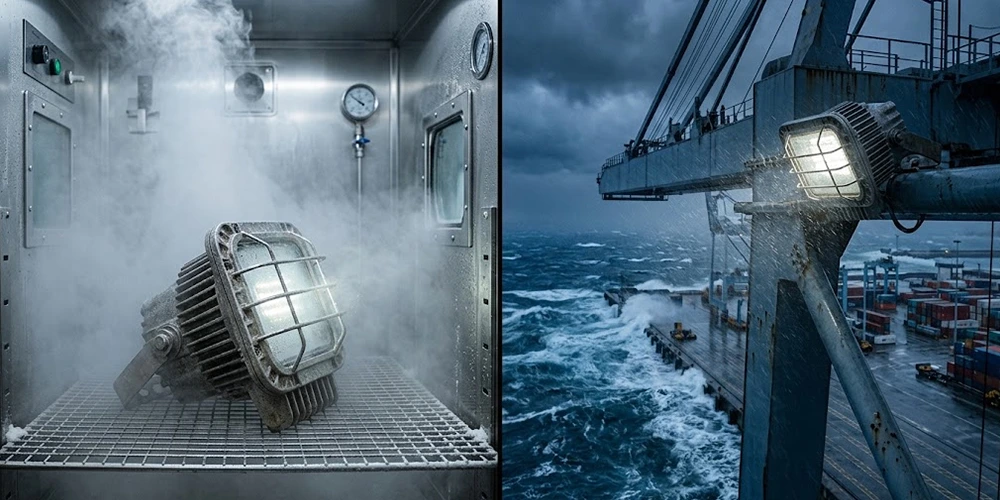
In outdoor and coastal lighting, you will frequently see claims like “1,000-hour salt spray tested”. As we explored in a previous post on whether more salt spray testing guarantees outdoor durability, accelerated chamber hours are not an automatic conversion formula for real-world service life.
However, salt spray testing is not useless. When qualifying luminaires for ISO 12944 Category C5 environments, extended accelerated testing remains an indispensable qualification gate. It proves whether the pre-treatment and powder adhesion hold up when chloride ions attack continuously.
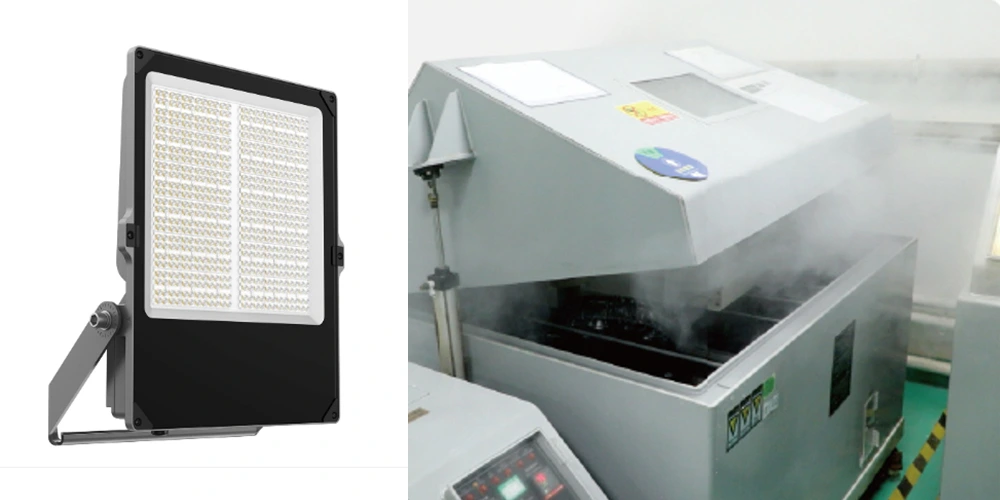
FL72 50-500W is designed for ports and airports. To verify its durability, we subjected it to a 2,000-hour continuous Neutral Salt Spray (NSS) test based on ISO 9227.
The 2,000-Hour Test Results
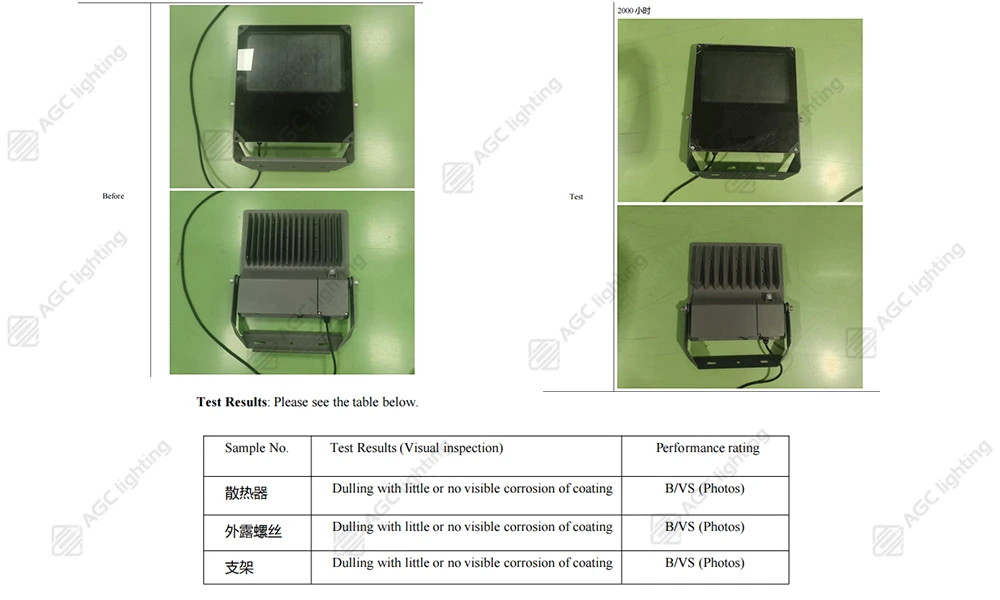
The test exposed FL72 to a continuous 5% sodium chloride (NaCl) fog at 35°C for 2,000 consecutive hours.
After completing the run, technicians rinsed and dried the parts for visual inspection.
Surface dulling is expected after 2,000 hours of aggressive chemical fog exposure. The critical takeaway from the lab report is what did not happen: there was no blistering, no paint flaking, no creep along edges, and no red rust breaking through the steel bracket.
How It Passed 2,000-Hour Salt Spray Test
Passing 2,000 hours without coating breakdown comes down to how different metals are treated before powder coating ever touches them.
FL72 uses two very different structural metals: low-copper die-cast aluminum for the thermal housing, and SPCC cold-rolled steel for the mounting bracket.
Low-Copper Aluminum for the Housing
Normal die-casting aluminum alloys often contain copper levels above 1% to improve fluidity in the mold. In a marine or coastal setting, that copper forms microscopic galvanic cells inside the aluminum itself, causing rapid pitting under the paint film.
FL72 uses a low-copper aluminum alloy (copper content controlled below 0.1%). Removing the internal galvanic triggers keeps the alloy stable even if salt deposits sit on the surface.
Tailored Conversion on the SPCC Steel Bracket
Cold-rolled carbon steel (SPCC) provides the structural stiffness needed for high-wind outdoor brackets. However, carbon steel oxidizes much faster than aluminum once chloride penetrates the coating.
To protect the bracket, the steel goes through an intensive multi-stage degreasing, pickling, and chemical conversion process before coating. This creates a dense, non-metallic conversion layer that locks out moisture and gives the powder coating a microscopic anchor profile.
AkzoNobel Outdoor Powder Coating
Both the aluminum housing and steel bracket are coated with an architectural-grade AkzoNobel outdoor powder coating.
Cheaper polyester powders break down under UV exposure, forming micro-fissures that allow salt water to reach the metal substrate. AkzoNobel exterior-grade powders maintain resin matrix elasticity under thermal expansion and resist UV chalking, keeping the protective barrier sealed across thousands of hours.
Fastener Passivation
Fasteners are the most common corrosion trigger in outdoor fixtures. When an untreated stainless screw sits in a threaded aluminum hole, rainwater turns that contact point into an active galvanic battery.
FL72 uses passivated exterior fasteners engineered to isolate the hardware from the cast housing, preventing thread seizure and edge corrosion.
What does This Mean for Your Project Site?
A 2,000-hour salt spray test does not replace good site engineering. In real coastal conditions, fixtures deal with wet-dry cycles, UV radiation, and wind-driven grit.
But the 2,000-hour salt spray test result does prove that FL72’s anti-corrosion barrier has zero weak links between its raw metals, pre-treatment, and outer powder coat.
For port facilities, coastal perimeter roads, chemical storage yards, and heavy industrial plants classified under ISO 12944 Category C5, it offers verified physical protection rather than an untested marketing claim.
If your project requires marine lighting solutions or relevant test reports, contact us to review the full documentation.