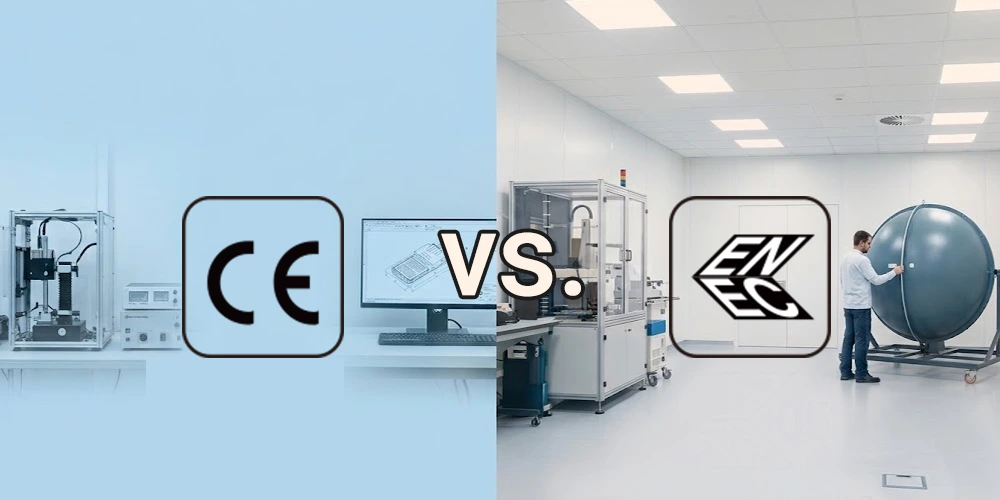

We often hear from project engineers during tenders asking whether our fixtures are “certified.” In many cases, they are referring to CE marking, which is a mandatory requirement for products placed on the European Economic Area (EEA) market.
However, for public infrastructure projects, government tenders, and applications where product failures can lead to safety concerns, delays, or liability issues, the key question is often whether the product has been independently tested and verified. This is where ENEC certification provides additional assurance.
CE marking is a legal conformity requirement based primarily on the manufacturer’s declaration that the product meets applicable European safety, health, and environmental requirements. It allows the product to be placed on the EEA market but does not represent independent third-party certification.
ENEC certification is different. It is a voluntary certification issued by independent, accredited third-party laboratories after detailed product testing and regular factory inspections. It confirms that the product has been evaluated against relevant European standards and that manufacturing processes continue to deliver consistent quality.
What the CE Mark Means
CE stands for Conformité Européenne. It is a mandatory marking for many electrical products placed on the European Economic Area (EEA) market.
By placing the CE mark on a luminaire, the manufacturer declares that the product complies with the applicable EU requirements for safety, health, and environmental protection. For lighting products, these requirements typically include:
- Low Voltage Directive (electrical safety)
- Electromagnetic Compatibility (EMC) Directive
- Restriction of Hazardous Substances (RoHS)
- Ecodesign requirements where applicable
The manufacturer is responsible for preparing the technical documentation, carrying out the required conformity assessment, and issuing the EU Declaration of Conformity.
For most luminaires, CE marking does not require mandatory third-party certification. The CE mark is not issued by a certification body; it is the manufacturer’s own declaration that the product meets the relevant requirements.
CE marking is essential for legal market access, but it does not confirm that an independent laboratory has tested the product or that the manufacturing process is regularly monitored by an external organization.
What the ENEC Certification Means
ENEC stands for European Norms Electrical Certification. It is a voluntary European certification scheme for electrical products, including luminaires and lighting components.
To obtain the ENEC certification, a luminaire must undergo testing by an independent, accredited certification body against relevant European standards, primarily the EN 60598 series for luminaires.
Unlike CE marking, ENEC certification also includes ongoing production surveillance. The manufacturer’s facilities are inspected, and the certified product is monitored to ensure that production continues to match the tested design and approved specifications.
Obtaining and maintaining ENEC involves independent type testing and ongoing factory surveillance. Because of the additional process and cost, manufacturers usually apply it to selected product series rather than every model.
The ENEC certification is recognised across Europe and is issued by certification bodies that participate in the ENEC agreement. The number shown alongside the ENEC certification identifies the certification body responsible for issuing the certificate.
ENEC is not a legal requirement for selling lighting products in Europe. Instead, it provides an additional level of independent verification and confidence for projects where safety, reliability, and long-term performance are critical.
CE vs ENEC: Key Differences
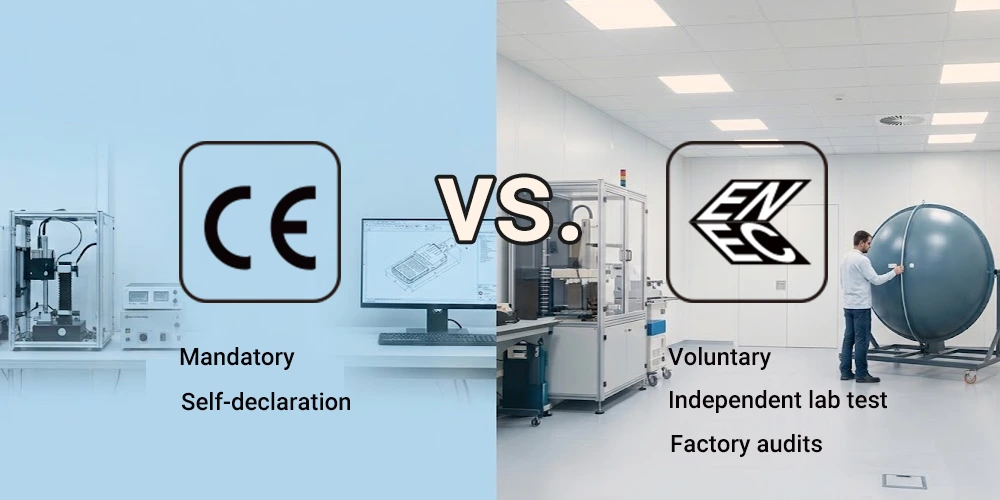
CE is a mandatory self-declaration by the manufacturer. It confirms the product meets the essential legal requirements of relevant EU directives and allows the product to be placed on the European market.
ENEC is a voluntary independent third-party certification. It verifies that the product has been tested against specific European safety standards and that the manufacturer’s production process is regularly monitored.
|
Practical Parameter |
CE Mark |
ENEC Certification |
|
Who verifies it? |
Manufacturer self-declaration |
Independent accredited test lab |
|
Factory audits? |
Never required |
Mandatory annual factory production audits |
|
Production consistency monitoring |
Manufacturer’s responsibility |
Verified through regular surveillance processes |
|
What it mainly demonstrates |
Compliance with applicable EU legal requirements |
Independent verification against relevant European product safety standards |
|
Typical standards involved |
Applicable EU directives and regulations |
EN 60598 series and other relevant European standards |
What This Means for Lighting Projects
CE-only products aren't inferior, and self-declaration doesn't mean untested.
Both CE and ENEC should be viewed as part of the overall product qualification process, not as a simple “good” or “bad” indicator.
For most lighting projects, CE compliance is the starting point. It confirms that the luminaire meets the required European legal requirements and can be placed on the market.
ENEC becomes more relevant when a project requires additional independent verification. This is common in applications where product failure could create operational disruption, safety concerns, or high replacement costs, such as road lighting, public infrastructure, transportation facilities, and large industrial sites.
For these projects, ENEC can help simplify product approval because consultants, contractors, and end users have additional confidence that the product has been independently tested and that the manufacturer’s production processes are regularly monitored.
However, ENEC is not a requirement for every lighting application. Many reliable industrial and outdoor lighting products are successfully used in professional projects with CE compliance and other supporting technical documentation.
The right approach is to match the level of certification and verification to the project requirements.
In our range, every industrial and outdoor luminaire carries CE marking. Selected models, such as the HB01 high bay light, SP25 sports light, ST33 street light and FL57-C4 flood light, also carry ENEC certification.
Need to check compliance details for a project? We’re happy to walk through them with you.