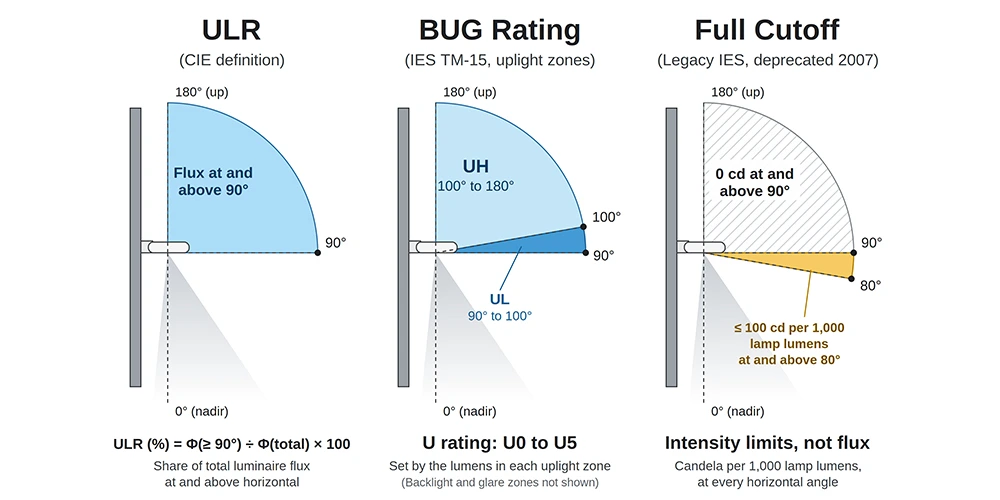
Full cut-off, BUG rating and ULR all describe how much light a luminaire sends upward, but they measure it in different ways
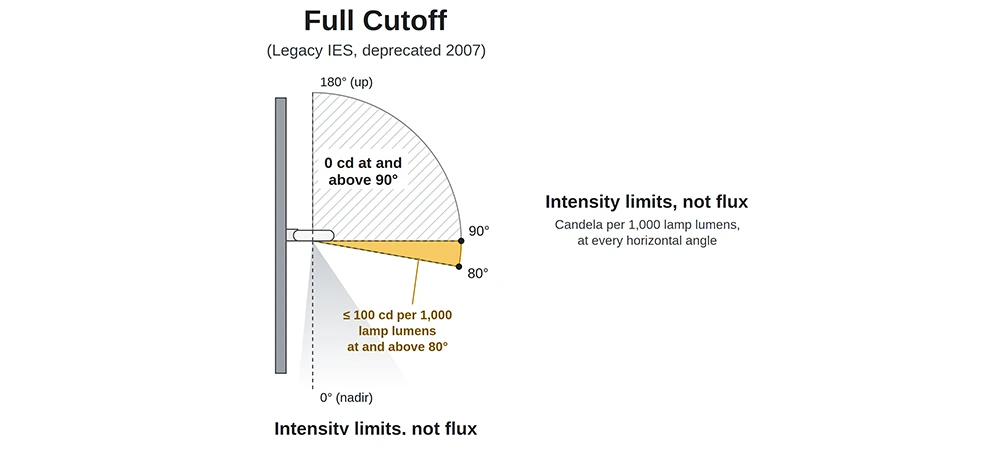
Full cut-off is an old IES category based on light intensity at 80° and 90° from straight down, and the IES deprecated it in 2007.
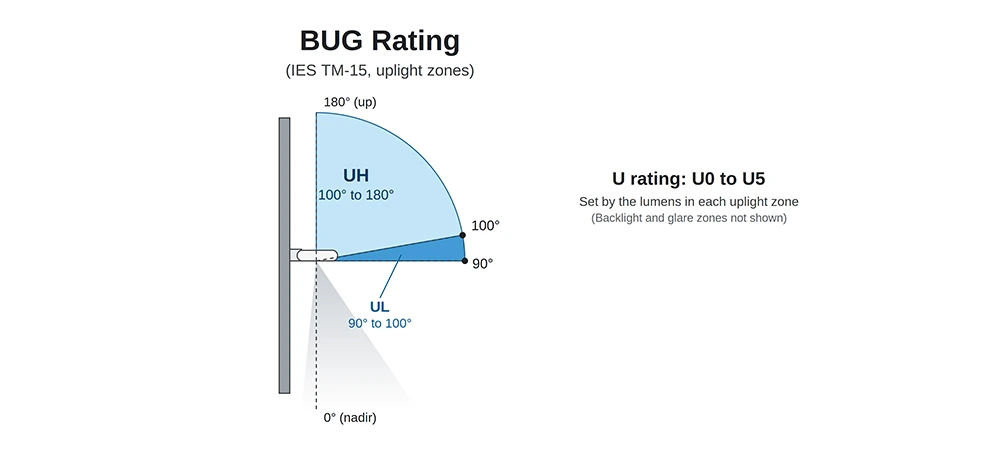
A BUG rating counts lumens in angular zones and returns three values: Backlight (B), Uplight (U), and Glare (G). The Uplight component (U0 to U5) isolates all luminous flux emitted at and above 90° from nadir.
ULR (Upward Light Ratio) evaluates upward emission as a percentage ratio.
European projects demanding CIE ULR percentages encounter North American photometrics built around IES TM-15 BUG ratings.
What Is ULR?
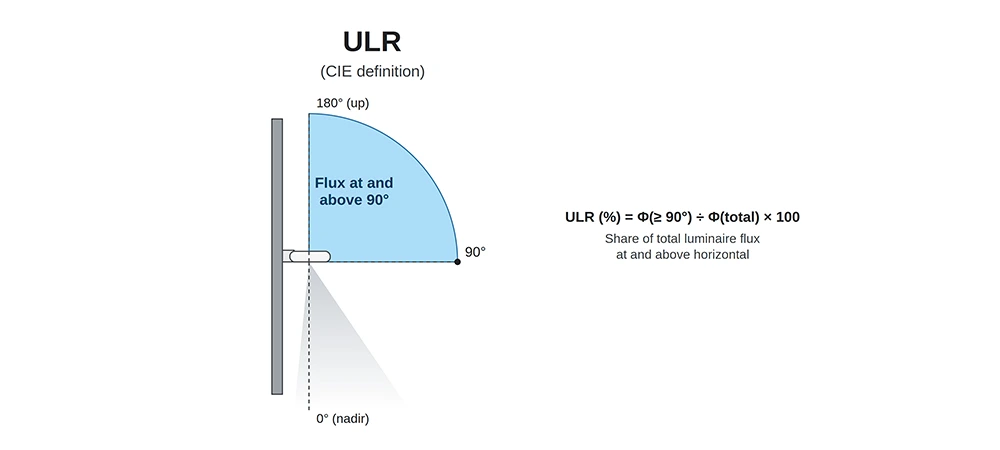
Upward Light Ratio (ULR) is the percentage of a luminaire’s or installation’s total luminous flux that is emitted at or above the horizontal when the luminaire is in its installed position and attitude.
The CIE definition is explicit: the value must reflect the mounting orientation that will actually be used on site. A luminaire that shows 0 % ULR when tested horizontally can produce measurable uplight once tilted.
ULR is the metric most often referenced in European and CIE-based guidance on environmental zones and obtrusive light.
What Is a BUG Rating?
BUG is the Backlight-Uplight-Glare rating system defined in ANSI/IES TM-15. It assigns three independent numbers (for example, B1-U0-G2) based on the absolute zonal lumens emitted into defined solid-angle regions around the luminaire.
- B (Backlight) quantifies light directed behind the luminaire and is used to control trespass onto adjacent property.
- U (Uplight) quantifies light emitted above the horizontal and is the primary indicator of direct contribution to sky glow.
- G (Glare) quantifies high-angle light that can cause discomfort or disability glare for drivers and pedestrians.
The uplight rating uses two zones: Uplight Low (UL, 90°–100°) and Uplight High (UH, 100°–180°). A U0 rating means zero lumens in the uplight zones (90°–100° and 100°–180°).
BUG ratings are the dominant screening tool in North American specifications and many municipal ordinances that reference IES standards.
How Does ULR Relate to a BUG Uplight Rating?
At zero, the two metrics agree. A U0 rating means that the luminaire emits no light above 90°, resulting in a nominal ULR of 0%.
Above zero, however, ULR and the BUG uplight rating can differ because they measure uplight in different ways.
ULR expresses the percentage of a luminaire’s total light output that is emitted above the horizontal (90°). In contrast, the BUG uplight rating is based on the absolute lumens emitted into two defined angular zones above the horizontal. As a result, a luminaire with a relatively low ULR can still receive a high U rating if its total light output is sufficiently high.
The two metrics also differ in how they account for installation position. ULR is defined with reference to the luminaire's installed position, which is why it is important to distinguish between nominal ULR (based on the luminaire's reference orientation) and installed ULR (based on its actual mounting position). A BUG rating, by comparison, is normally determined from the photometric data in the luminaire's prescribed reference orientation.
Therefore, ULR and BUG uplight ratings are related, but they are not interchangeable.
What Does Full Cut-Off Mean?
Full cut-off (sometimes written full cutoff) is the older IES classification that required zero candela at or above 90° from nadir and limited intensity at 80°. In practice, it is treated as a design goal: the luminaire emits no direct light into the upper hemisphere when mounted level.
The term is still widely used in product literature, local ordinances, and DarkSky discussions.
It is less precise than either ULR or a BUG U-rating because it does not quantify backlight or glare and does not automatically account for field tilt. A fixture marketed as full cut-off can still produce uplight if aimed or tilted after installation.
ULR vs BUG Rating vs Full Cut-off
Here is a table that summarizes how ULR, BUG rating, and full cut-off compare across engineering metrics, test procedures, and regional adoption.
|
|
ULR |
BUG Rating |
Full Cut-off |
|
What it measures |
Percentage of total flux above horizontal in the installed position |
Absolute zonal lumens in backlight, uplight, and glare zones |
Zero intensity at/above 90°
|
|
Status |
Active (Europe / International) |
Active (North America / Global) |
Deprecated (Legacy only) |
|
Upper Limit Zone |
Integrated flux (90°-180°)
|
UL (90°–100°) & UH (100°–180°)
|
Candela evaluated at 90° & 80° |
|
Photometric Basis |
Absolute or Relative (CIE 121) |
Absolute Photometry (LM-79) |
Relative Photometry |
|
Incorporates Installation Tilt |
Yes (when calculating installed ULR/UWLR) |
No (rated at nominal 0° lab position) |
No (assumed horizontal mount) |