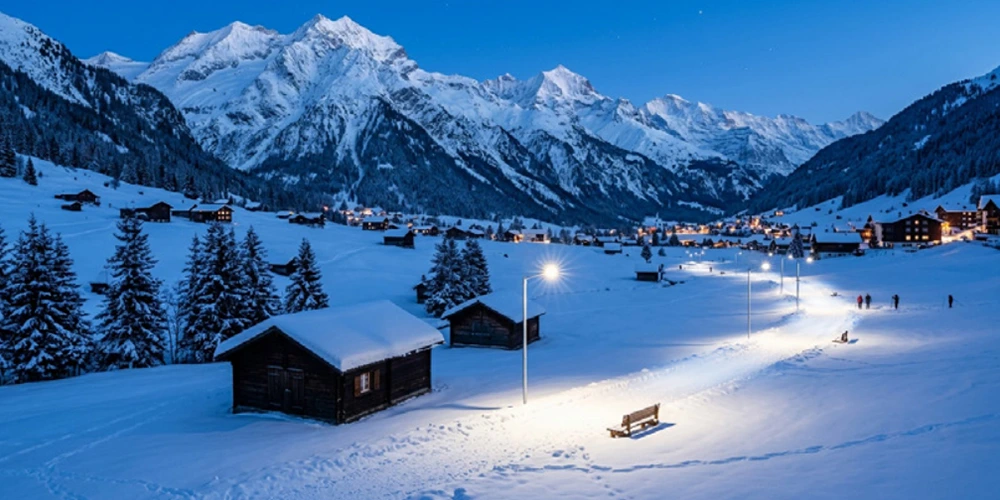

Most cold-climate solar lighting includes internal heating elements in the battery enclosure to ensure charging in sub-zero conditions.
It sounds intuitive. If lithium batteries lose performance below freezing, why not warm them up before charging?
However, during mid-winter at high latitudes, useful peak irradiance is often limited to roughly two to three hours. A typical PTC heating blanket for an integrated battery pack draws 20–35 W simply to offset heat loss through the metal housing.
By the time the pack reaches a safe charging temperature, the sun is frequently already setting. The fixture then enters the night with a warm but largely depleted battery and can shut down after only a few hours.
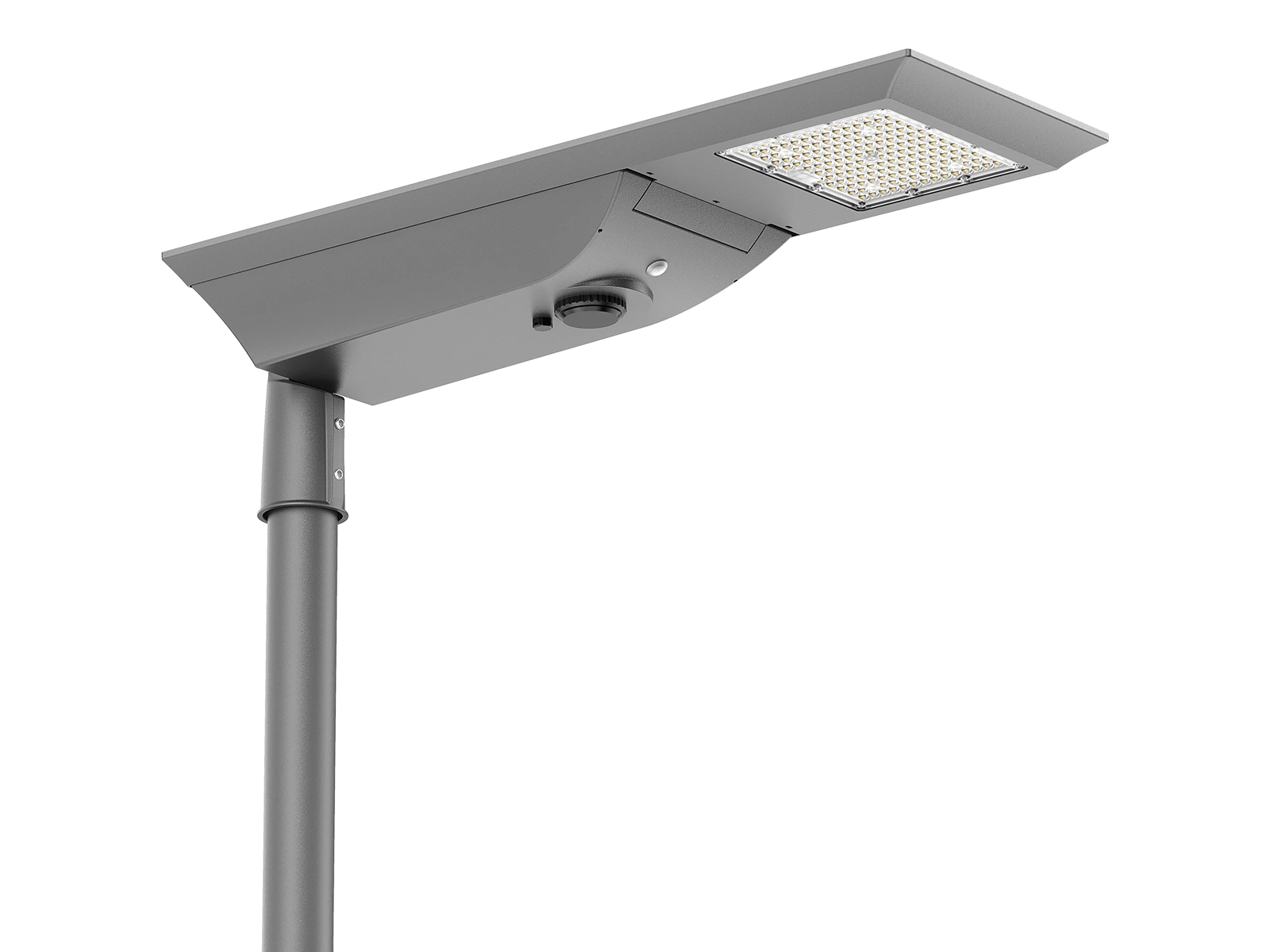
So we developed the SL02 G4.0, a solar street light that operates reliably down to -20°C without a battery heater. The SL02 G4.0 uses a custom low-temperature LiFePO4 cell designed with high-efficiency optics that keep the electrochemistry viable at -20°C without continuous heating.
Let’s explore how the engineering works.
Step 1: Solving Lithium Plating at the Molecular Level
LiFePO4 does not mechanically freeze at -10°C. The breakdown is kinetic.
When conventional cells drop below freezing, lithium-ion diffusion within the graphite anode slows drastically. If you force current into the battery, incoming ions cannot intercalate into the host structure fast enough. Instead, they deposit on the anode surface as metallic lithium.
This creates irreversible capacity degradation, increases the risk of dendrites piercing the separator, and triggers the Battery Management System (BMS) to disable charging to prevent safety hazards.
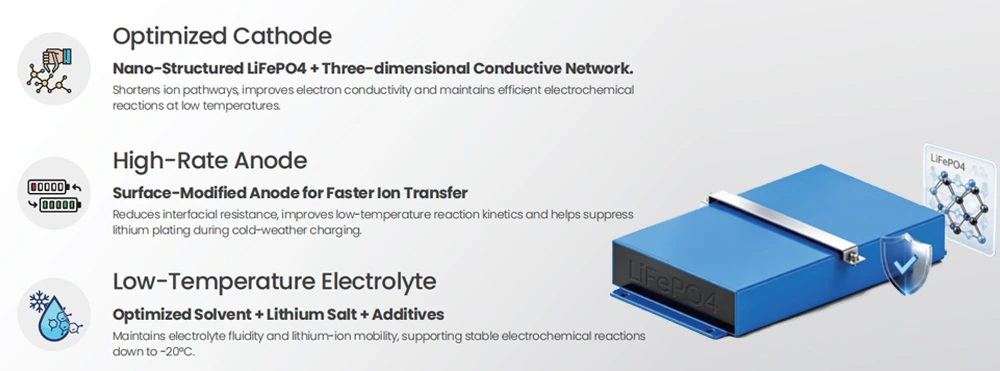
Instead of fighting ambient temperature with resistive heat, our SL02 G4.0 modifies the internal cell materials to operate directly at -20°C:
- Low-Freezing-Point Electrolyte: Formulated with low-viscosity organic solvents and specialized additives that maintain high ionic mobility down to -20°C without gelation.
- Surface-Modified Anode: Reduces interfacial charge-transfer resistance, accelerating lithium-ion intercalation kinetics and suppressing lithium plating during sub-zero charging.
- Nano-Structured Cathode: Incorporates a three-dimensional conductive network that shortens electron transfer paths, sustaining electrochemical activity in cold conditions.
Because the cells accept charge natively, charging starts the moment sunlight hits the monocrystalline panel. The system captures the first photons of dawn without waiting for a heating cycle, while the intelligent BMS protects the pack across more than 2,000 cycles.
Step 2: Using 200 lm/W Efficacy to Shrink Battery Demand
Many project planners view fixture efficacy purely through the lens of lumen output. In off-grid solar systems, optical efficacy directly determines battery sizing and winter survival.
A 130 lm/W solar fixture consumes approximately 31W from its battery pack. Over a 14-hour winter night, that requires 434Wh of stored energy.
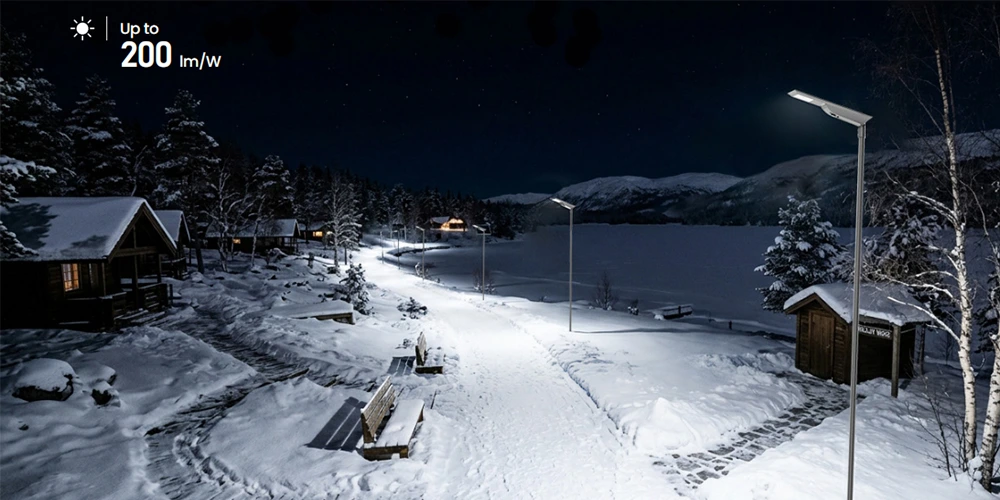
The SL02 G4.0 reaches up to 200 lm/W. Delivering that same 4,000 lumens requires only 20W. Over the same 14-hour period, it draws 280Wh.
Paired with microwave sensor and smart controls, it provides higher light output only when vehicles or pedestrians approach. This dynamic reserve management extends autonomy to two to three consecutive days of winter overcast.
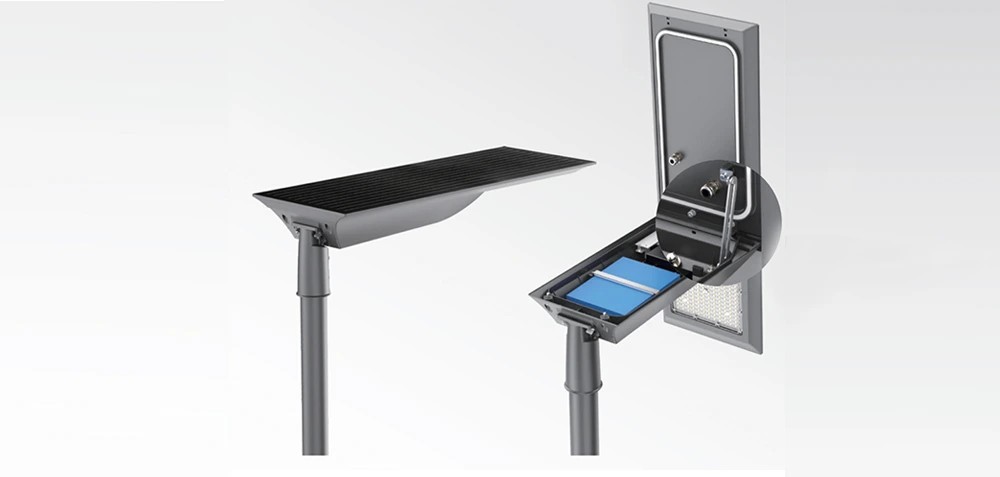
Step 3: Flip-top Design, Easy Battery Maintenance
Field servicing in sub-zero climates introduces high operational costs. In remote industrial sites, mountain passes, and rural corridors, dispatching a bucket truck and an electrical crew can run high costs.
The SL02 G4.0 uses an isolated flip-top service structure. The monocrystalline panel remains securely bolted to the pole arm. Service latches allow the technician to open the upper battery compartment directly from a ladder or work platform. This enables faster and easier battery maintenance and lower costs.
Where the SL02 G4.0 Fits (And Where It Does Not)
For projects across southern Scandinavia, the Baltics, northern US states, southern Canada, and mid-elevation mountain corridors, winter lows typically sit between -10°C and -20°C.
These are the environments the SL02 G4.0 was built for. It eliminates trenching costs on rural branch roads, industrial yards, logistics perimeters, and remote municipal access ways that would otherwise require expensive grid extensions.
But we draw a firm line at three conditions:
- Extreme Arctic latitudes experiencing extended polar night.
- Environments with sustained temperatures plunging below -20°C.
- Heavy, unmaintained snow-drift zones where low-tilt panels get permanently buried.
Off-grid success comes down to winter autonomy math, not guesswork. Send your site coordinates and target lux levels to our engineering team, and we will model your location against historical solar data to prove whether this fixture will survive your coldest month.