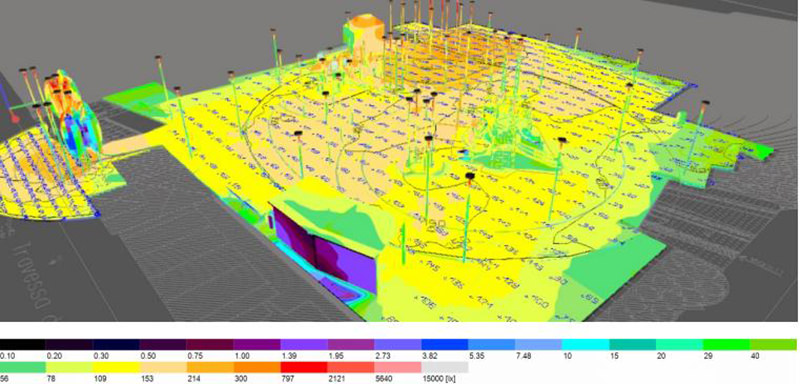
If you are looking at an lighting simulation report, you may find that there is a value in the luminaire information, CIE FLUX CODE.
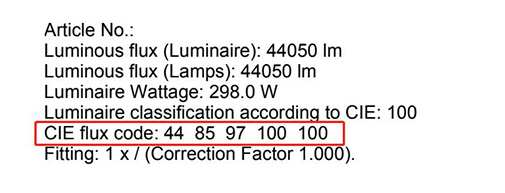
What does it mean? How can we ”decode” them?
We can learn it together!
- The five sets of data behind CIE Flux: (see polar coordinate light distribution curve)
- The first set of data = (luminous flux from 0 to 41.4 degrees / luminous flux within 90 degrees) X 100
- The second set of data = (luminous flux from 0 to 60.0 degrees / luminous flux within 90 degrees) X 100
- The third set of data = (luminous flux from 0 to 75.5 degrees / luminous flux within 90 degrees) X 100
- The fourth set of data = (luminous flux from 0 to 90.0 degrees / luminous flux within 180 degrees is the total luminous flux) X 100
- The fifth set of data = (total luminous flux of lamps / luminous flux of light source) X 100
- The last value is interpreted as the ratio of luminous flux between lamps and light sources by definition, which can be understood as light loss.
Generally, lamps using LED light sources are 100 because the characteristics of LED are considered as a whole; while traditional lamps have relatively large light loss, so they are not 100; say traditional Phxxps lamps are 77/79.
This also confirms the necessity of switching from traditional lamps to LED lamps from the side.
Interesting, right? See you next time!