
Electrical safety is essential for ensuring reliable performance in industrial operations, particularly those exposed to harsh environments. One common issue that can lead to costly downtime or serious safety hazards is leakage current.
Leakage current problems are often invisible and gradual, making them difficult to detect before they cause significant damage. Even brand-new LED high bay lights, the lighting system can still experience leakage. This subtle but continuous flow of electrical current outside its intended path can degrade equipment performance, waste energy, and pose serious risks to workers.
So, what causes leakage current?
In this article, we’ll explore the top five causes of leakage current in industrial environments.
What Is Leakage Current?
Leakage current is the unintended flow of electrical current through insulation or along surfaces that are meant to be non-conductive. In industrial environments, this occurs when electrical energy escapes from its designed circuit path.
International standards such as IEC 60990 and UL 1598 define how leakage current should be measured and set acceptable limits to ensure worker safety and equipment reliability.
Although the term might sound concerning, a small amount of leakage current is normal and expected. For example, LED drivers intentionally include EMI filter capacitors that allow low levels of leakage current to meet electromagnetic interference (EMI) regulations. A single light fixture might produce about 0.5 mA of leakage current, which is completely safe and well within the limits specified by UL 1598.
However, when 100 fixtures are connected on the same circuit, the total leakage can reach 50 mA. This exceeds the 30 mA threshold that typically triggers a standard GFCI breaker.
The difference between normal and problematic leakage depends on three key factors:
- Magnitude: how much current is leaking.
- Path: whether the current is safely diverted through proper grounding.
- Accumulation: whether small individual leaks combine to create hazardous or disruptive levels in the system.

Cause 1: Capacitive Coupling
Capacitive leakage current is a normal electrical phenomenon, but it can become problematic without proper circuit segmentation, grounding, and the correct selection of residual current devices (RCDs or safety switches).
In LED industrial lighting systems, a small amount of current may “leak” even when the system is functioning correctly. This occurs because the live conductors, metal housings, and internal electronic components of luminaires act like small capacitors. When the AC voltage changes direction, a tiny displacement current passes through the insulation or air gap, even though there is no direct electrical connection.
Under normal conditions, this capacitive leakage current is very small, typically only a few milliamps. However, in large installations with many fixtures, long cable runs, and interconnected metal structures, the total leakage can accumulate. The result may include nuisance tripping of RCDs, minor electromagnetic interference (EMI), or a faint LED glow even when the lights are switched off.
Cause 2: Moisture and Humidity Ingress
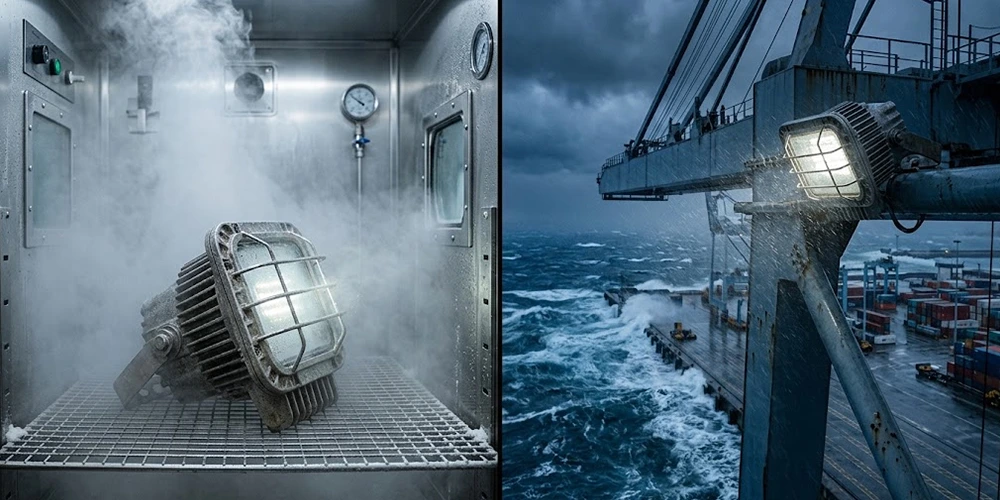
Facilities such as food processing plants, coastal installations, and chemical plants often operate in environments with high levels of moisture, humidity, and sometimes corrosive substances. These harsh conditions can weaken the insulation strength of lighting fixtures and lead to resistive leakage current, which is much more dangerous than normal capacitive leakage.
Water, humidity, and condensation are conductive by nature. When moisture penetrates a fixture housing, a process known as ingress, it greatly reduces the surface resistance of insulation materials, connectors, and circuit boards. Over time, this increases leakage current and raises the risk of electric shock, equipment failure, and fire hazards.
Cause 3: Improper Grounding and Installation Errors
Grounding provides a safe path for fault currents and ensures that excess electricity does not flow through unintended routes. When grounding systems are poorly designed, incorrectly connected, or inadequately maintained, stray currents can leak into equipment housings, cable shields, or even structural components.
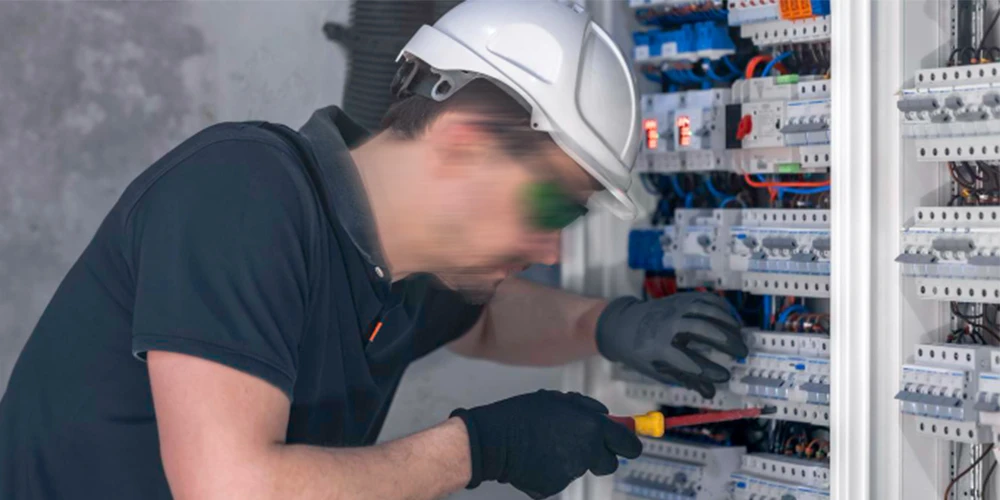
Installation errors can make the situation worse. Miswired connections, loose terminals, or improper insulation practices may create unintended conductive paths. For example, a poorly terminated cable can allow moisture to enter, leading to insulation breakdown and current leakage.
To reduce these risks, organizations should follow strict installation standards, perform regular ground resistance testing, and ensure compliance with international electrical codes such as IEC 60364 and IEEE grounding standards.
Cause 4: Aging and Degraded Insulation
Electrical insulation materials such as polymers, potting compounds, and the dielectric films inside capacitors are designed to resist current flow, but their effectiveness diminishes over time. This deterioration is a natural process that can be accelerated in demanding industrial environments.
Several stress factors contribute to insulation degradation:
- Thermal cycling caused by high ambient temperatures and heat from LED drivers can break down insulation compounds.
- Chemical exposure from solvents, cleaning agents, and oil mist can attack PVC and rubber insulation materials.
- Mechanical stress from vibration, impact, and repeated cable flexing can create microscopic cracks that allow moisture to enter.
As these effects accumulate, the insulation resistance (IR) of the material decreases. This reduction in resistance creates unintended conductive paths between energized conductors and the fixture housing or chassis. Over time, this leads to a gradual increase in resistive leakage current throughout the product’s service life.
Cause 5: Voltage Transients and Surges
Voltage transients and surges are sudden spikes in electrical energy that occur due to lightning strikes, switching operations, or faults in the power grid.
Industrial power systems are inherently noisy. Heavy equipment switching, motor starts, and external events such as lightning strikes can generate brief but intense voltage spikes that may reach thousands of volts, far exceeding the normal line voltage.
Repeated exposure to these surges weakens insulation materials at the microscopic level, creating partial breakdowns that form conductive paths for current leakage. Over time, this damage increases the risk of resistive leakage, equipment failure, or even electrical shock hazards.
Transient events also affect sensitive electronic devices such as variable frequency drives (VFDs), programmable logic controllers (PLCs), and monitoring systems. Even short-lived surges can cause partial discharge or degrade protective coatings, leading to elevated leakage currents and reduced system reliability.
International standards such as IEC 61000-4 and IEEE 1159 provide comprehensive guidance on managing transient disturbances and maintaining electrical system integrity. The installation of surge protection devices (SPDs), proper grounding, and routine power quality assessments are effective mitigation.