Poultry has become the most widely consumed type of livestock in the world over the past 20 years. It is expected to remain the top imported livestock product by volume over the next decade.
However, making a profit in poultry farming can be challenging. Even a small improvement, such as 1% increase in feed conversion efficiency, can determine whether a farm is profitable or not.
One key factor that influences poultry performance is lighting. Light affects nearly every physiological process in birds, including hormone levels that control egg production and stress levels that impact the immune system.
In this blog, we will explore the proper poultry lighting, which can support better poultry health, improve growth, and increase overall production efficiency.
How Poultry Perceive Light
Curious about the best lighting for poultry? First, it's important to understand how birds perceive light differently from humans.
Humans can see visible light in the range of about 400 to 750 nm. Poultry, however, have a broader visual range that includes UVA light, from 315 to 400 nm. UVA light plays a role in the development of features like combs and wattles, which are linked to sexual maturity and egg production. As a result, exposure to UVA can help hens mature more quickly.
Chickens are also highly sensitive to specific parts of the light spectrum, especially red light (around 630 nm) and blue light (around 480 nm). Blue light helps increase pullet growth, while red light is vital for stimulating sexual maturity and egg production.
Interestingly, poultry don't rely only on their eyes to detect light. They can also sense light through thin areas of their skull, where light reaches the pineal gland and deep brain photoreceptors. This means that under the same lighting conditions, poultry may perceive a higher light intensity than humans do.

Flicker-Free Lighting: A Fundamental Requirement
While some older LED or fluorescent lights may appear steady to the human eye, they can actually flicker at a rate that chickens can detect. Chickens have a much higher flicker fusion rate than humans, meaning they perceive what looks like a steady light to us as a rapid, constant strobe.
This invisible flickering acts as a hidden stressor. It can cause discomfort, increase anxiety, and lead to nervous behaviors such as feather pecking and aggression. Over time, this stress can also weaken the immune system, making birds more vulnerable to disease. It can reduce feed intake, cause uneven growth, lower egg production, and ultimately cut into both efficiency and profitability.
That’s why flicker-free lighting is the basis for any modern poultry house aiming for healthy, productive flocks.
Lighting Schedule for Poultry
A poultry house typically includes broilers, breeders, and laying hens, each with unique lighting needs depending on their growth stage. Factors such as light intensity, photoperiod (the length of light exposure per day), and color temperature must be carefully managed to ensure optimal results.
Broilers
In broiler production, the main goal is to improve growth consistency and feed conversion ratio.
During this phase, cool white light between 4000K and 5000K is commonly used. Research suggests that green light can benefit broilers in the early stages of growth by promoting muscle development, while blue light during the later stages can help reduce stress.
From around two and a half weeks of age, broilers typically require a light intensity of 20 to 30 lux and a continuous 24-hour photoperiod. As they near market weight, the light intensity is often reduced to between 5 and 10 lux, while the 24-hour lighting schedule remains unchanged.
Breeders
Breeders have slightly different requirements, as the goal is to produce more fertile eggs and improve hatchability.
Warm white lighting with a red-orange hue works best to support reproductive performance.
Throughout the breeding period, light levels should be maintained between 30 and 50 lux. During the first three weeks, breeders are usually exposed to 14 hours of light per day. This is followed by a reduction to just 8 hours daily between weeks four and twenty. Starting at week twenty and continuing up to week sixty-four, the photoperiod should be increased again to around 15 hours to maintain optimal fertility and egg production.
Laying Hens
For laying hens, the primary focus is on maximizing egg production while minimizing operational costs.
Warm white lighting between 2700K and 3000K is ideal during this phase. Enhanced red wavelengths are particularly important because they can penetrate the skull and stimulate the hypothalamus, which controls reproductive hormone activity. This stimulation helps increase both the quantity and size of eggs.
During the first six weeks, laying hens should be exposed to light levels between 10 and 30 lux with a 16-hour photoperiod. From six to eighteen weeks, the light duration is reduced to about 8 hours per day, with intensity maintained above 5 to 10 lux. After eighteen weeks, the photoperiod is gradually increased to 15 hours to stimulate and support the onset of consistent egg laying, while keeping the light intensity steady.

According to the American Society of Agricultural and Biological Engineers (ASABE), light intensity and photoperiod guidelines should be tailored to the bird type and age. A summary of these recommendations is provided in the following table:
|
Type of poultry |
Age (weeks) |
Minimum light level (lx) |
Photoperiod (hrs/day) |
|
Broilers
|
0-2.5 |
20-30 |
24 |
|
2.5 to market |
5-10 |
24 |
|
|
Breeders
|
0-3 |
30-50 |
14 |
|
4-20 |
30-50 |
8 |
|
|
20-64 |
30-50 |
15 |
|
|
Layers
|
0-6 |
10-30 |
16 |
|
6-18 |
5-10 |
8 |
|
|
18-80 |
5-10 |
15 |
How AGC Helps You Achieve Peak Poultry Production and Efficiency?
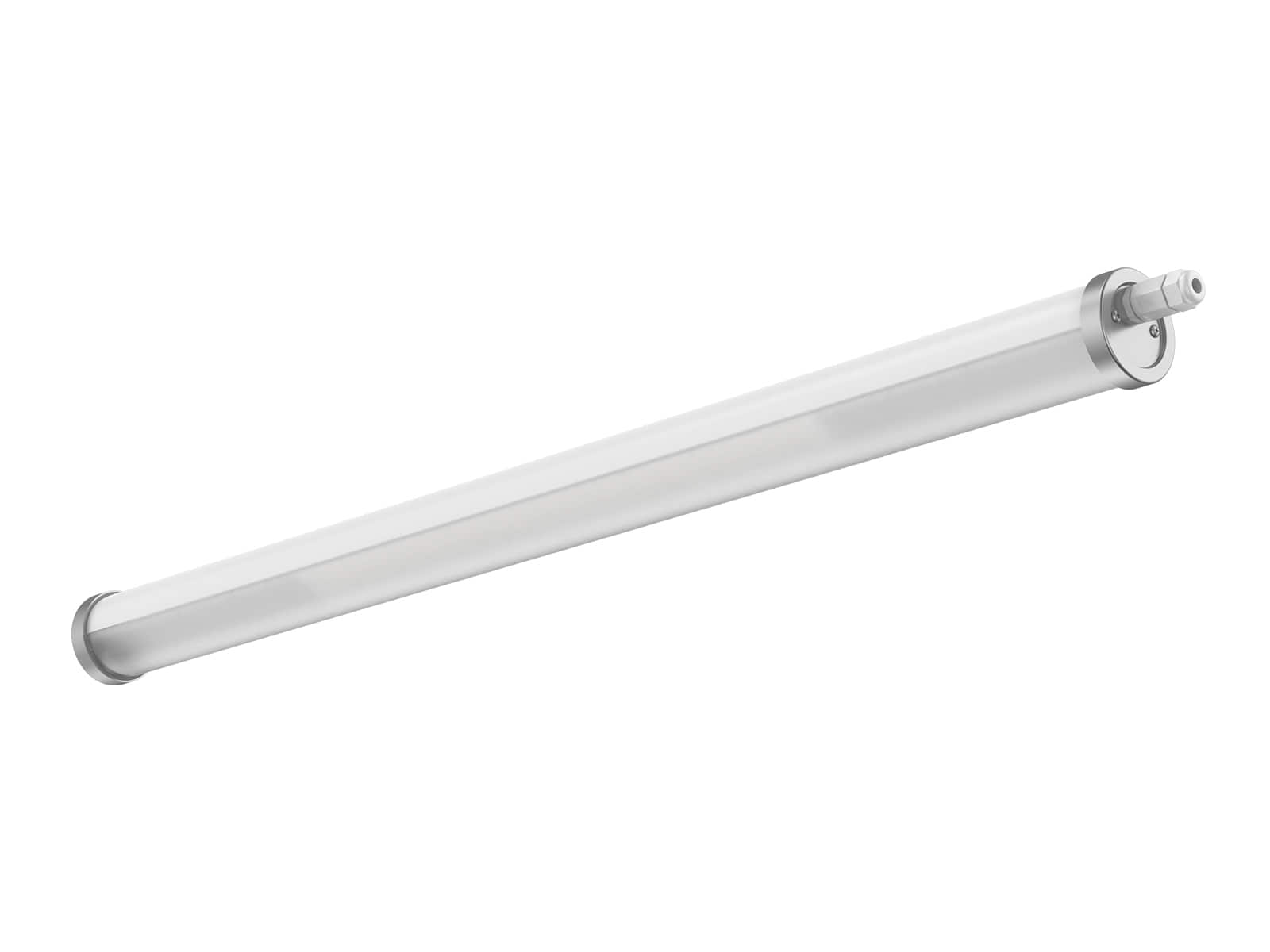
At AGC, we understand the demands of modern poultry farming, and we’re here to help you achieve peak production and efficiency. Our LHB44 CorroLine lighting solution is specifically designed to meet the needs of animal farms, ensuring a healthier environment and more productive flocks.

Let’s take a look at how the LHB44 can support your success.
Flick-Free
Our lighting is flicker-free, which is essential for reducing stress and promoting calm behavior in poultry.
Flexible Lighting
LHB44 supports both 0–10V dimming and DALI control, giving you flexibility to adjust light intensity throughout the various stages of poultry development. We also offer options for 3000K, 4000K, and 5000K color temperatures. If you’re looking for dynamic lighting with adjustable spectrum, color, and brightness, just reach out; our solutions can be tailored to your needs.
Wide Light Distribution
Another key benefit of the LHB44 is its wide light distribution. With a 120° beam angle, it’s a perfect fit for aviary systems. This lighting pattern keeps nest areas slightly dimmer while ensuring walkways are brighter, which encourages proper laying behavior. This helps reduce floor eggs and minimizes aggressive behaviors like pecking.
Anti-Corrosion
But that’s not all. We know poultry houses can be tough environments, so the LHB44 is built for durability and long-term performance. The fixture housing is made from PMMA, which is resistant to ammonia. Screws and end caps are made from 316 stainless steel, offering extra protection against corrosion. With an IP66 or even IP69K rating, the LHB44 is easy to clean and built to withstand high-pressure washdowns, ensuring reliable operation.