Bright LED light alone is no longer enough for good lighting design. The quality of light matters as much. That means not only making sure the light works well for the user, but also preventing uncomfortable glare. Therefore, optical control is important.
Two of the most common tools for optical control are reflectors and diffusers, especially in industrial and retail lighting. A reflector directs light into a specific direction, while a diffuser softens and spreads the light more evenly.
In this blog, we’ll explore how reflectors and diffusers contribute to the overall quality of LED lighting and choose between them.
Light Quality Issues Without Proper Optics
As shown in the picture below, one fixture produces glare, while the other provides a more visually comfortable light with the right optical design.
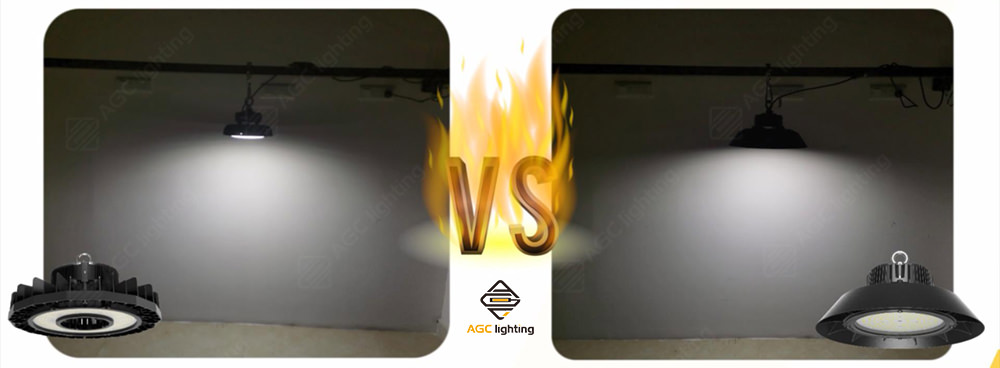
Some LEDs include a primary optic in the package to shape and direct light, while others emit light directly without much control. Without proper optical design, lighting fixtures can produce glare, harsh shadows, hot spots, and uneven illumination, leading to wasted energy and unsatisfactory lighting.
This is why secondary optics, such as external reflectors, lenses, or diffusers, are critical in LED lighting. They help further shape and distribute light to achieve the desired illumination pattern, improve uniformity, and reduce unwanted glare or light loss.
At AGC, we offer optional accessories such as reflectors, lenses, and diffusers to help our customers achieve better lighting results, meet specific project requirements, and succeed in winning lighting projects.
Reflectors in LED Lighting
Reflectors are optical components that redirect and focus light emitted from LEDs, enhancing efficiency and beam control. They can be broadly classified into conic and non-conic reflectors. Conic reflectors include elliptical, zonal, hyperbolic, and parabolic geometries, while non-conic reflectors can be square, rectangular, or asymmetric, often used for specialized beam shaping. The geometry of a reflector significantly affects beam quality, influencing uniformity, intensity, and glare control.
Aluminum is the most commonly used material for reflectors because of its high reflectivity, excellent thermal conductivity, lightweight nature, and durability. Polymers such as polycarbonate and polypropylene are also frequently employed, as they provide greater flexibility in design and allow the creation of complex shapes or finishes.
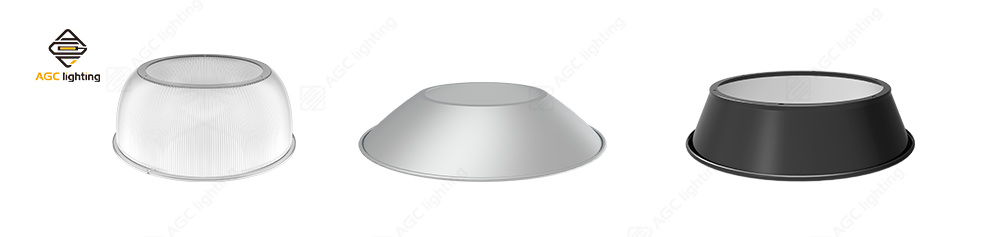
Reflectors are used in various lighting applications, including sports lighting, bollards, downlights, streetlights, and high-bay luminaires. Their functions vary depending on the environment and lighting requirements. A well-designed reflector can direct and diffuse light, reduce glare, manage UV and infrared radiation, assist with thermal management, enhance aesthetics, protect the light source, and improve energy efficiency.
For example, in high-bay lights, reflectors are particularly effective in reducing glare. By shielding the light source and limiting light intensity above critical glare angles, they enhance visual comfort while maintaining high illumination levels.
Check out our video to see how reflectors help high-bay lighting reduce glare and improve performance.
Diffusers for Visual Comfort
A diffuser functions like a light-softening curtain, scattering light from the source to create a smooth, even wash of illumination. By diffusing light as it passes through or reflects off its surface, the diffuser softens harsh beams, reduces glare, and ensures uniform light distribution.
Among the most common options, prismatic diffusers are designed to maximize efficiency while offering precise glare control, making them suitable for spaces where performance and visual clarity are priorities. Opal diffusers, on the other hand, provide soft and uniform illumination with a clean, integrated appearance, creating a comfortable and visually appealing environment.
The choice of material, whether frosted polycarbonate, prismatic acrylic, or a milky lens, determines how much the light is scattered and how the beam is softened. Carefully selected diffusers play a key role in reducing UGR in offices, retail spaces, and workshops, ensuring shadow-free lighting that enhances both comfort and productivity.
It is important to remember that diffusers can reduce lumen output. This trade-off between efficacy and comfort requires lighting fixtures to be highly efficient, so that comfort is achieved without unnecessary energy waste. For example, our HB47 HiSlim incorporates high-quality PC diffusers with an efficacy of up to 155 lm/W. This balance of performance and visual comfort ensures anti-glare lighting that enhances both functionality and aesthetics in commercial settings.

Difference Between Reflectors and Diffusers
The key distinction between reflectors and diffusers lies in how they manage light. Reflectors direct and concentrate light into a specific beam, while diffusers scatter and soften it to create a more uniform distribution.
|
Feature |
Reflector |
Diffuser |
|
Function |
Direct, concentrate, and focus light |
Scatter, soften, and spread light |
|
Material |
Highly reflective material, like polished aluminum |
Translucent materials, like frosted acrylic and PC |
|
Mechanism |
Reflection |
Diffusion |
|
Impact on Beam |
Creates a controlled and defined beam angle |
Softens and widens the beam, making it more uniform |
|
Main benefits |
Maximizes light delivery to the target area |
Reduce glare, enhance visual comfort |
The choice between reflectors and diffusers depends on the lighting requirements of a space.
For example, in a warehouse with tall ceilings or narrow aisles, a focused beam with a narrow angle, typically 30 to 60 degrees, is often preferred. In such cases, reflectors in high-bay fixtures help direct light downward efficiently while minimizing glare to the sides. In more open warehouse areas, diffusers are more suitable, spreading light widely and evenly to reduce shadows and improve visual comfort for workers.