FIFA, the Fédération Internationale de Football Association (International Federation of Association Football), is one of the largest sports organizations in the world. Among its many responsibilities, FIFA organizes major international tournaments, most notably the FIFA World Cup.
For FIFA tournament stadiums and training sites, it sets strict lighting standards to ensure the experience for players, fans, and broadcasters. These demand advanced floodlight systems that provide comfort, visibility, energy efficiency, and long-term sustainability.
For stadium owners and football clubs, meeting these standards is essential, especially for those aiming to host international matches.
In this post, we’ll explore FIFA’s expectations for pitch lighting and show how we can help you meet those standards with precision and reliability.
Requirements for FIFA pitch illuminance systems
Let’s take a look at FIFA’s standards and requirements for pitch floodlight systems.
FIFA is committed to lighting solutions that:
- Prioritize the comfort and unhindered performance of all players and officials.
- Allow for the use of competition-related systems if required (e.g., VAR, goal-line technologies)
- Enhance the experience and enjoyment of spectators at the venue.
- Enable stadium broadcasters to produce world-class content, without production constraints.
- They are efficient and sustainable, minimize waste, and leave a useful post-tournament legacy.
Now, let’s explore how these requirements can be achieved.
Comfort and Unhindered Performance for Players and Officials
To ensure comfort and peak performance for both players and officials, football pitches must be equipped with sufficient, uniform, and low-glare lighting across the entire playing surface.
FIFA classifies football pitches (for matches) into four standards, A, B, C, and D, based on factors such as pitch quality, surface type, and suitability for different levels of competition. Each classification comes with specific lighting requirements to ensure fair play and optimal visibility.
Here are FIFA lighting standards:
|
FIFA Lighting Standard |
Application level |
Average horizontal illuminance |
Average vertical illuminance |
Uniformity U1h |
Uniformity U2h |
Maximum flicker factor |
Glare rating |
|
A |
International matches, World Cup, and top professional leagues |
> 2500 lux |
> 1500 lux |
> 0.5 |
> 0.7 |
< 1% |
< 50 |
|
B |
National and professional competitions |
> 2000 lux |
> 1000 lux |
> 0.5 |
> 0.7 |
< 15% |
< 50 |
|
C |
Training, amateur, and local competitions |
> 1250 lux |
> 700 lux |
> 0.4 |
> 0.6 |
< 30% |
< 50 |
|
D |
Recreational, training |
>1000 lux |
> 400 lux |
> 0.4 |
> 0.6 |
N/A |
< 50 |
FIFA also set lighting standards for training pitches. The table below shows the requirements of illuminance systems for training facilities according to the FIFA training standard.
|
FIFA training standard |
Levels of illuminance conditions |
Total system lumens |
Eh average (Lux) |
|
Grade 1 |
FIFA World Cup training pitch |
11,500klm |
> 750 lux |
|
Grade 2 |
FIFA match practice |
6,200klm |
> 500 lux |
|
Grade 3 |
FIFA standard training |
4,500klm |
> 300 lux |
To meet these requirements, you need a professional and precise lighting simulation and design that ensures sufficient, uniform, and low-glare illumination. Achieving this depends on several factors, such as product power, light distribution, installation angles, pole height, and the number of fixtures and poles.
At AGC, our R&D team of more than 110 highly skilled professionals is dedicated to delivering optimal lighting solutions. Our experienced lighting designers can quickly run accurate simulations for your project, ensuring full compliance with the latest industry standards and recommendations.
Supporting Competition-Related Systems
As FIFA says: ‘’If we bring VAR or GLT into your stadium, the lights must already be good enough for them to work properly.
VAR depends on cameras that can capture sharp and detailed images without shadows or strobing, even when operating at very high frame rates or in super slow motion. GLT, on the other hand, must be able to detect whether the ball has fully crossed the goal line with millimeter accuracy.
For both systems to function correctly, the lighting across the pitch must be consistent, uniform, shadow-free, and completely flicker-free so that cameras and sensors can continuously track both the ball and the players. Areas like penalty boxes, goal lines, and touchlines are critical to ensure a fair game.
Enhancing the Spectator Experience
An entertainment light show before a match can significantly enhance the atmosphere and enjoyment for spectators at the venue. However, it is essential that these effects do not interfere with the required match illuminance conditions.
To operate the light show effectively, the floodlight system is typically controlled through a DMX (Digital Multiplex Signal) lighting console. DMX is a powerful control protocol capable of managing up to 512 channels. By adjusting light intensity, color mixing, and movement patterns, it enables dynamic and engaging visual effects.
After the light show, the floodlight system illuminating the pitch should transition smoothly back to match conditions. A fade-in from 0% to 100% over 5–10 seconds is recommended. This not only enhances spectator comfort but also helps maintain optimal camera exposure for broadcasters.
Enabling Stadium Broadcasters to Deliver World-Class Content
When millions of viewers tune in to watch the World Cup or other major competitions, they expect every pass, every goal, and every moment to look flawless.
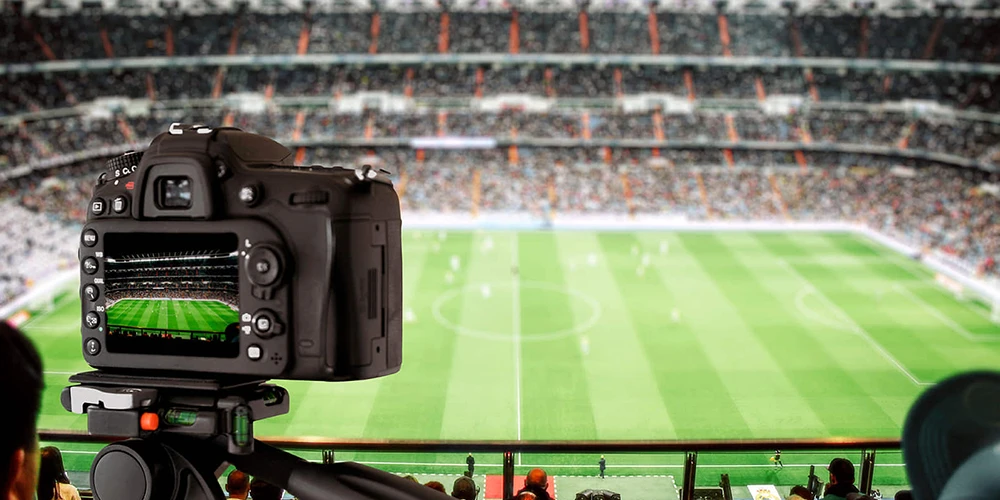
This requires the floodlight system to ensure that every frame is captured in ultra HD, 4K, or even 8K, free from noise, flicker, or uneven brightness. Also, allows slow-motion replays to flow smoothly, colors to appear vivid and natural, and every corner of the field to be perfectly illuminated without shadows or blind spots.
The flicker factor must be below 1%, while color rendering must be accurate, with a CRI of 80 or higher, ideally 90, to make colors appear natural and vivid on screen. The color temperature must also remain stable between 5,000 and 6,200K, preserving consistency across different shots and angles.
For broadcasters, the TLCI (Television Lighting Consistency Index) is even more critical than CRI, as it measures how a camera sensor interprets colors under a specific light source. A high TLCI ensures the colors captured on camera are true to life, reducing the need for costly post-production color correction.
AGC provides lighting solutions to meet these demands. Using high-quality LED chips and advanced drivers, our systems achieve CRI and TLCI values of 90 or higher, provide flicker-free performance, and maintain stable color temperature. This creates the ideal conditions for both broadcast cameras and the human eye, enabling stadium broadcasters to consistently deliver content.
Efficient and Sustainable Lighting Solutions
For efficient and sustainable stadium lighting, LED floodlights are the best choice. Compared to traditional HID lights, LEDs are significantly more energy-efficient and environmentally friendly. In fact, FIFA requires that all new FIFA Standard A and B stadiums use LED luminaires as their light source.
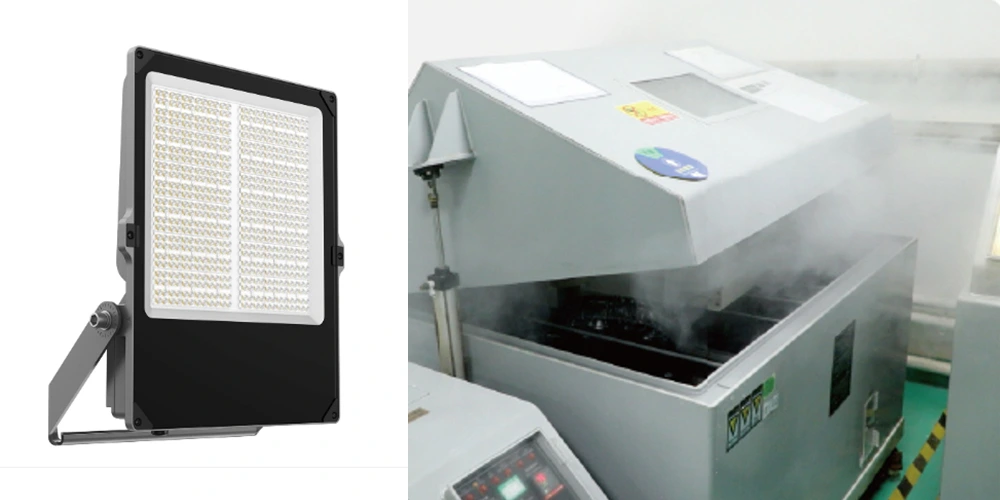
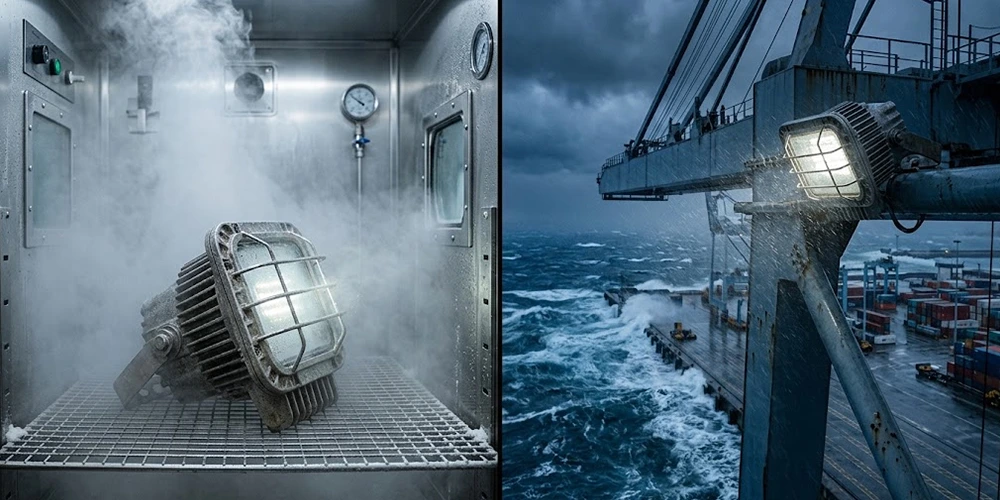
Sustainability also means ensuring long-term performance. In stadiums exposed to harsh weather or airborne dust, the maintenance factor of LED floodlights is typically around 0.8. Choosing durable, high-quality luminaires helps reduce replacements and waste over time.
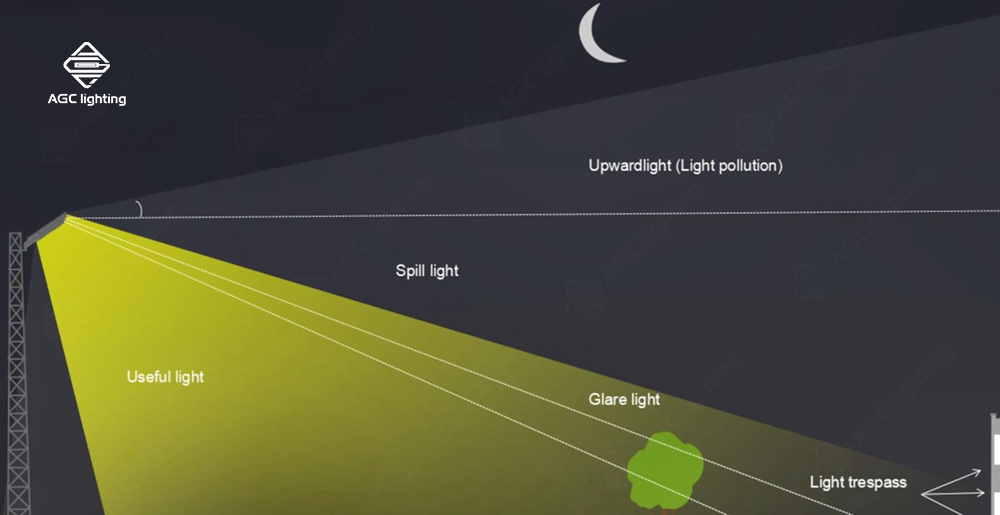
Another important aspect of sustainable lighting is minimizing light pollution and community disturbance. Precise lighting control reduces spill light, preventing unnecessary energy waste while also avoiding glare, disturbance, and safety risks for nearby residents and drivers on adjacent roads.
FIFA guidelines recommend that pitch lighting systems should not produce illuminance greater than 50 lux on the vertical plane at a height of 1.5 m, within 50–200 m from the stadium perimeter.

Our sports lighting solutions are designed to save energy and protect communities. With a luminous efficacy of up to 180 lm/W, our systems provide sufficient brightness with less energy consumption. Our advanced optical design ensures accurate light distribution, reducing waste and environmental impact. In one outdoor sports project, we successfully achieved 0 lux at the property line, helping our client meet strict requirements and win the project.
Looking for reliable lighting solutions for FIFA-standard projects? Contact us.