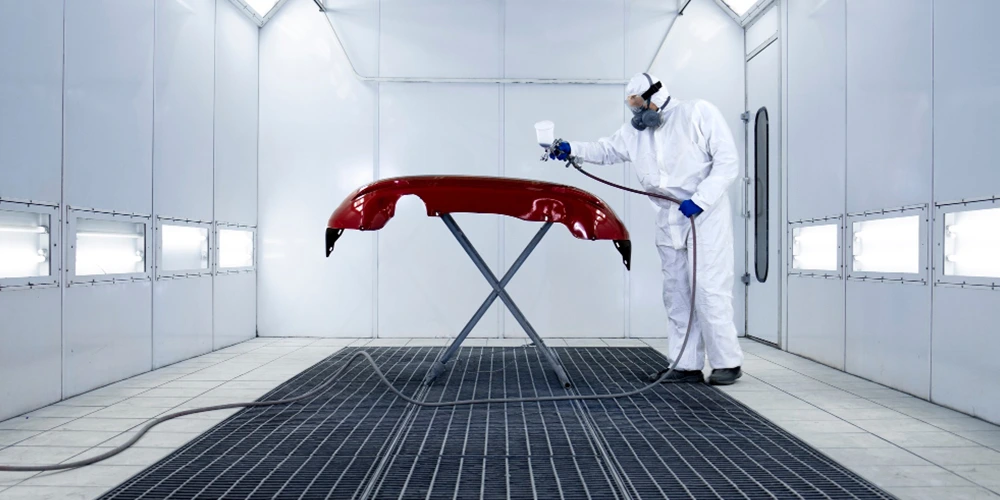
A paint booth is an environment where atomized flammable solvents, compressed air, and electrical equipment operate in close proximity. That combination creates a high fire and explosion risk.
Because of these conditions, paint booths are classified as hazardous locations and require lighting systems that meet strict safety standards.
Spray finishing operations are governed by regulatory frameworks across every major market, NFPA 33 and NEC Articles 500–516 in North America, the ATEX Directive in the European Union, and IECEx standards across international markets.
These standards cover fixture design, hazardous location classifications, installation methods, and maintenance practices to help facilities remain compliant, pass inspections, and protect workers.
Why Paint Booths Are Classified as Hazardous Locations
Paint booths are classified as hazardous locations because spray finishing operations can produce flammable vapors, solvent mists, and combustible residues under normal working conditions.
According to OSHA, a spray area is any area where dangerous quantities of flammable vapors, mists, combustible residues, dusts, or deposits are present due to spraying operations.
During spray painting, the risk is not limited to visible overspray. Many paints, coatings, and thinners contain volatile solvents that evaporate quickly into the air. When these vapors mix with oxygen in an enclosed or poorly ventilated area, they can create a flammable atmosphere. If an ignition source is present, the result can be a flash fire or explosion.
That means explosion-proof fixtures, which are designed to contain any internal ignition and prevent it from propagating to the surrounding atmosphere, are required in the paint booths.
How Hazardous Locations Are Classified
The hazardous classification of a paint booth determines the type of lighting fixtures that can be safely installed. To selecting the correct fixture, let’s starts with understanding how hazardous locations are classified. Here, we take the paint booths that using liquid coatings as an example.
ATEX and IECEx Zone system
In Europe and many international markets, hazardous locations are classified using the ATEX and IECEx Zone system
The safety principle is the same: areas are classified based on how often explosive atmospheres are expected to occur.
- Zone 1, ignitable vapor concentrations present under normal operating conditions, is the direct equivalent of Division 1. The interior of an active enclosed spray booth is a Zone 1 environment.
- Zone 2, ignitable concentrations present only under abnormal conditions, is the equivalent of Division 2. Areas surrounding the booth and its exhaust outlets fall here.
NEC Class/Division system
In North America, hazardous locations are classified under the NEC Class/Division system.
The NEC classifies hazardous locations using three factors: Class, Division, and Group.
The Class identifies the type of hazardous material present in the environment. Paint spray booths are classified as Class I locations because they contain flammable gases or vapors that can form ignitable mixtures in air. These vapors are typically generated by solvent-based paints, coatings, and thinners used during spray operations.
The Division defines how often the hazardous material is present under normal operating conditions.
- Division 1 means ignitable concentrations of flammable vapors are expected during normal operation. The interior of an active spray booth is typically classified as Class I, Division 1.
- Division 2 means hazardous vapors are only present under abnormal conditions. This classification commonly applies to areas outside the booth, including spaces extending up to 3 feet from open booth faces or access doors.
The Group identifies the specific type of gas or vapor based on its ignition characteristics. Most solvent-based paint vapors are classified as Group D, which includes common industrial solvents such as propane, gasoline vapors, alcohols, acetone, and similar materials.
How These Classifications Apply to Paint Booths
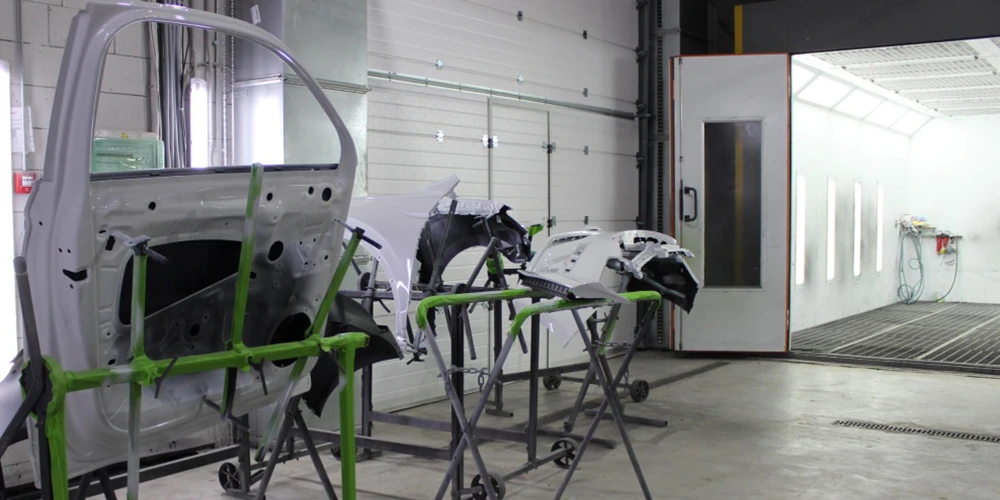
Under the NEC system, a standard enclosed spray booth during active operation is a Class I, Division 1, Group D environment. Under ATEX/IECEx, the same booth interior is Zone 1. The area extending approximately three feet beyond an open-face booth, or around exhaust outlets, is classified as Division 2 / Zone 2.
Beyond 3 feet, you can usually use standard industrial lighting, provided the booth has proper ventilation interlocks.
|
Risk Level |
ATEX / IECEx |
NEC |
Booth Areas |
|
Ignitable vapors present during normal operations |
Zone 1 |
Class I, Division 1 |
Enclosed spray booth interior |
|
Ignitable vapors present only under abnormal conditions |
Zone 2 |
Class I, Division 2 |
Within 3 ft of open booth openings or exhaust areas |
|
No Ignitable vapors present |
- |
- |
Beyond defined hazardous zone |
AGC designs and manufactures explosion-proof lighting in global markets. Our fixtures carry the required UL, ATEX, IECEx, and other regional certifications. If your project requires reliable lighting solutions for hazardous locations, check our website for explosion-proof lighting.
Core Regulations for Paint Booth Lighting
Securing a hazardous location rating is only the first step. Lighting systems must also meet installation, operational, and maintenance requirements defined by fire and workplace safety codes.
NFPA 33 and OSHA go a step further, they define the specific operational and installation requirements that determine whether a compliant fixture is actually installed and used correctly.
For the European market, EN 16985 serves a similar function to NFPA 33 for spray booth design and operation.
Glass Lenses and Enclosures
Fixture lenses must use heat-treated, tempered, or wired glass. The lenses and enclosures must be tightly sealed and gasketed to prevent flammable vapors from migrating into the electrical housing.
Preventing Paint Residue Accumulation
Fixtures must be engineered or positioned so that atomized paint overspray cannot easily deposit and accumulate on the fixture body. Layers of dried paint act as thermal insulation, trapping heat inside the fixture and driving up its surface temperature.
Flush-mounted and recessed fixture designs are commonly used to reduce exposed horizontal surfaces where paint residue can collect.
The Ban on Portable Lights
The use of standard portable extension lamps, shop lights, or uncertified work lights inside the spray area are prohibited inside spray areas. All illumination must come from permanently fixed, grounded fixtures.
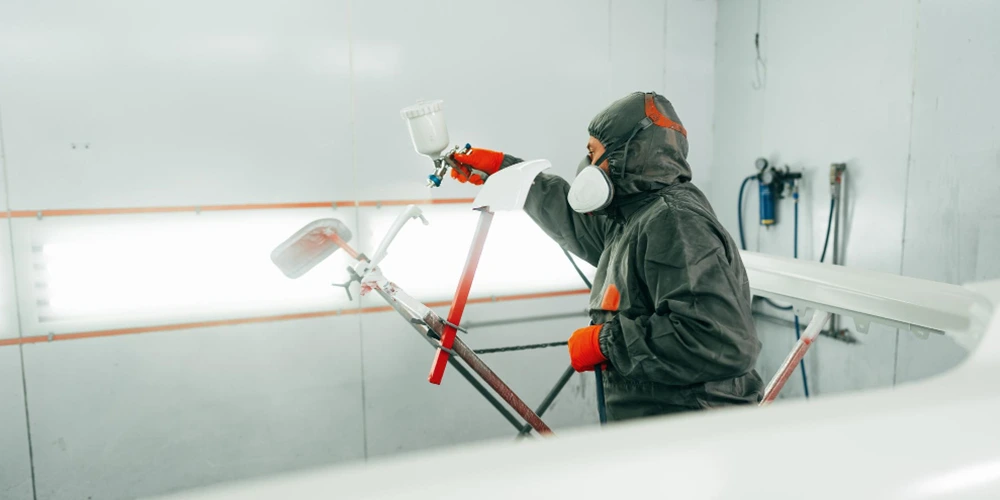
Optical Performance Requirements for Safe Paint Booth Lighting
Safety compliance is mandatory in paint booth lighting, but compliance alone does not guarantee good painting results. The optical performance of the lighting system directly affects finish quality, inspection accuracy, rework rates, and overall production efficiency.
Painters and inspectors must be able to clearly identify surface defects, uneven coating thickness, orange coating thickness, runs and sag, color mismatches, etc.
Three lighting factors have the greatest impact on paint booth visibility: CRI, CCT, and illuminance level.
CRI: Use 90+ for Accurate Color Inspection
CRI measures how accurately a light source shows color.
For paint booths, low-CRI lighting can distort the appearance of coatings and make color matching difficult. For most professional paint booths, use fixtures with a CRI of 90 or higher.
Color Temperature: 5000K–6000K Works Best
Most paint booths use lighting between 5000K and 6000K because it closely matches natural daylight conditions. Warm lighting can shift color appearance, while overly cool lighting may cause visual fatigue over long shifts.
Light Intensity: Around 1000 Lux
A light intensity of around 1000 lux is needed for detailed inspection work without creating harsh glare. Just as important as brightness is fixture placement. Good paint booth lighting should provide even illumination across the entire work area, including vertical surfaces and lower panels.
Need paint booth lighting for your next project? Browse our range of hazardous location fixtures: UL 844 listed, ATEX and IECEx certified, and available across C1D1, C1D2, Zone 1, and Zone 2 classifications.