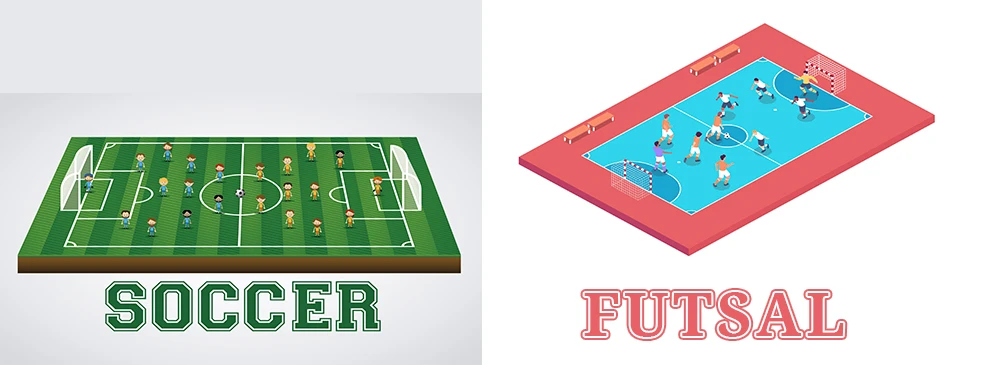
Futsal is a fast-paced version of soccer, usually played indoors on a hard court. Unlike traditional soccer, which has 11 players per side, futsal is played with only 5 players per team on a much smaller court. These differences make futsal a game that emphasizes close ball control, quick passing, creativity, and rapid decision-making.
Because futsal is usually an indoor, high-speed sport, lighting plays a critical role in ensuring precision, speed, and overall visual clarity. Whether for professional and international FIFA/UEFA tournaments or recreational matches, proper lighting is essential for both player safety and performance.
In this blog, we will explore the lighting requirements for futsal courts.
Futsal Lighting vs. Soccer Lighting
Although futsal is closely related to soccer, lighting a futsal court is often more challenging than lighting a full-size soccer pitch.
Futsal is a small-sided version of soccer played indoors on a hard-surfaced court roughly the size of a basketball court. It uses a smaller, low-bounce ball and is played by two teams of five players. These characteristics influence lighting design requirements.
Greater Need for Precise Glare Control
A full-size outdoor soccer field typically measures 100 to 120 meters in length and requires lighting fixtures mounted at heights of 15 to 25 meters to cover large areas. In contrast, futsal courts measure only 25 to 42 meters in length, with luminaires mounted much lower, usually between 6 and 10 meters, in an enclosed indoor environment.
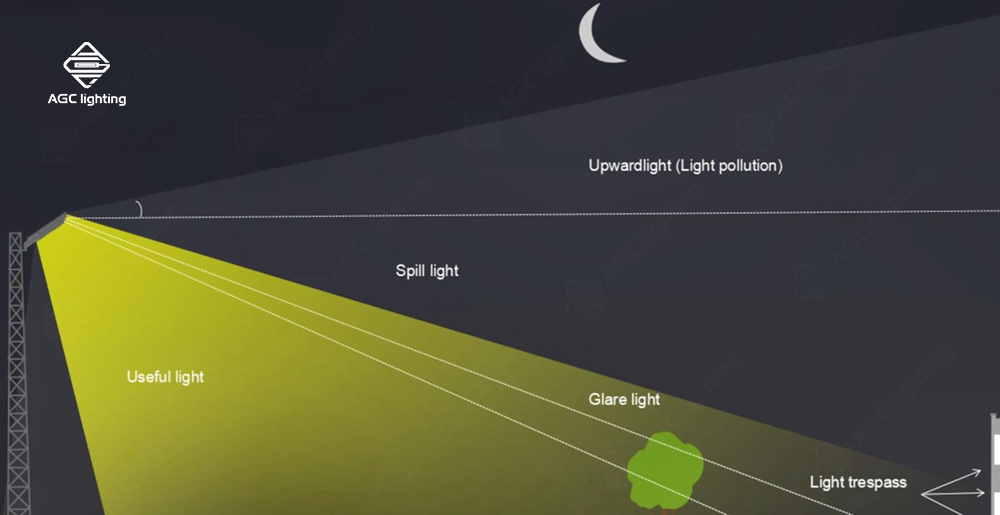
This closer proximity between players and lighting fixtures creates a greater need for precise glare control and lighting uniformity. Players are more likely to look directly toward the luminaires, and the lower mounting height increases the risk of uneven illumination and floor hot spots if the lighting system is not carefully designed.
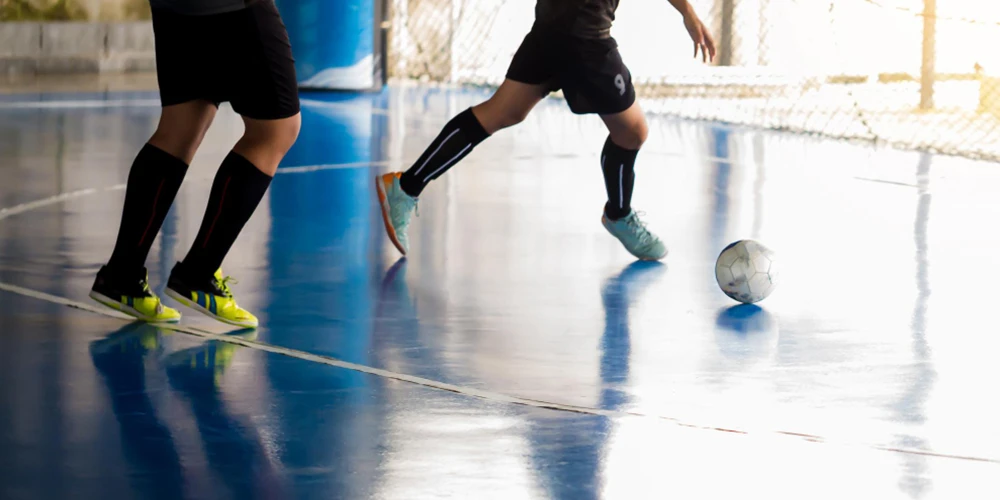
Surface reflectivity further increases the importance of glare management. Outdoor Soccer pitches are typically surfaced with turf, which absorbs a large portion of light. Futsal courts, however, often use wood or synthetic materials that are highly reflective. If the optics are not precisely engineered, light can reflect off the floor, reduce contrast, wash out court markings, and make it difficult for players to track the ball.
Emphasis on Vertical Illuminance
Football uses a larger, high-contrast ball and is played over long distances, while the futsal ball is smaller and designed for close control and low bounce. In futsal, players must track rapid movements in confined spaces and make quick decisions, which makes visual clarity especially important.
While horizontal illuminance ensures that the court surface is clearly visible, vertical illuminance is essential for depth perception and spatial awareness. Adequate vertical lighting allows players to read body movement and positioning more accurately. It is also critical for video recording and broadcasting, where clear visibility of players and the ball from multiple camera angles is required.
Lighting Standards for Futsal Courts
Futsal is played extensively around the world and, as a result, is officially recognized and supported by both FIFA and UEFA. Although futsal is relatively new in England, The Football Association actively supports its growth and promotes it as a preferred format of small-sided soccer.
FIFA Lighting Standards
FIFA does not publish a standalone lighting standard exclusively dedicated to futsal courts. However, lighting requirements for futsal can be derived from FIFA’s broader competition and venue guidelines, as well as from standards applied to indoor sports facilities.
FIFA’s lighting framework is generally based on the level of competition and broadcast requirements. While the FIFA Football Stadium Lighting Guide primarily addresses outdoor eleven-a-side soccer, its fundamental principles also apply to official futsal venues, particularly for international competitions.
FIFA categorizes lighting installations into Standards A through E. For major futsal events such as the FIFA Futsal World Cup, venues are typically required to comply with Standard A or Standard B. Facilities that are not intended for television broadcasting are not required to meet the higher lighting requirements associated with Standards A, B, C, or D.
Here is the table of the FIFA Lighting Standard.
|
FIFA Lighting Standard |
Ev 0° |
Eh |
Color Temperature |
Color rendering |
Glare Rating |
|
A |
Minimum > 1,000 lux Average > 1,500 lux |
Minimum > 1,500 lux Average > 2,500 lux |
5,000-6,200K |
≥ 80Ra |
< 50 |
|
B |
Minimum > 650 lux Average > 1,000 lux |
Minimum > 1,200 lux Average > 2,000 lux |
5,000-6,200K |
≥ 80Ra |
< 50 |
|
C |
Minimum > 350 lux Average > 700 lux |
Minimum > 800 lux Average > 1,250 lux |
4,200-6,200K |
≥ 70Ra |
< 50 |
|
D |
Minimum > 250 lux Average > 400 lux |
> 1000 lux |
4,200-6,200K |
≥ 70Ra |
< 50 |
UEFA Futsal Champions League Lighting Regulations
UEFA provides more explicit lighting requirements for elite futsal competitions. According to the UEFA Futsal Champions League regulations:
- Matches must be played in halls equipped with a lighting system that provides a minimum vertical illuminance of 1,200 lux to ensure optimal conditions for broadcast activities.
- For the finals, a minimum vertical illuminance of 1,800 lux is required. The host venue must provide UEFA with a valid lighting certificate confirming compliance.
- An emergency lighting system delivering at least 1,000 lux should also be available to ensure that a match can be completed safely in the event of a power failure.
These requirements highlight the importance of vertical lighting levels for futsal, particularly where broadcasting is involved.
FA Lighting Standards
The Football Association also provides guidance for futsal facilities in England. To help minimize running costs, lighting systems may be designed with multiple lighting levels. Lower lighting levels can be used for recreational play, training, and community use.
For these non-competitive applications, the lighting level should not fall below a maintained average illuminance of 75 lux.
Here are the floodlighting requirements for outdoor futsal:
|
Property |
Requirement |
|
Maintained average luminance |
> 120 Lux |
|
Uniformity |
>0.6 |
|
Glare rating |
≤50 |
|
Color temperature |
> 4000 K |
|
Color rendering |
≥ 65 |
Meeting Futsal Lighting Standards
Understanding lighting standards is one thing. Delivering them consistently in real futsal facilities is another.
Our lighting solutions are specifically designed to match the level of play, the intended use of the facility, and any broadcast requirements. Each solution is tailored to the court dimensions, mounting heights, surface reflectance, and operational needs of the venue. This approach ensures that the final installation meets all compliance requirements while avoiding unnecessary over-specification.
Professional lighting calculations and simulations are used to verify that illuminance levels, uniformity, and visual comfort targets are achieved across the entire court. This reduces risk for facility owners and ensures that the lighting system performs as intended from the first match onward.
Looking for a compliant and well-designed lighting system that supports performance, safety, and future growth?
Contact our lighting specialists to discuss your project and receive a tailored futsal lighting solution.