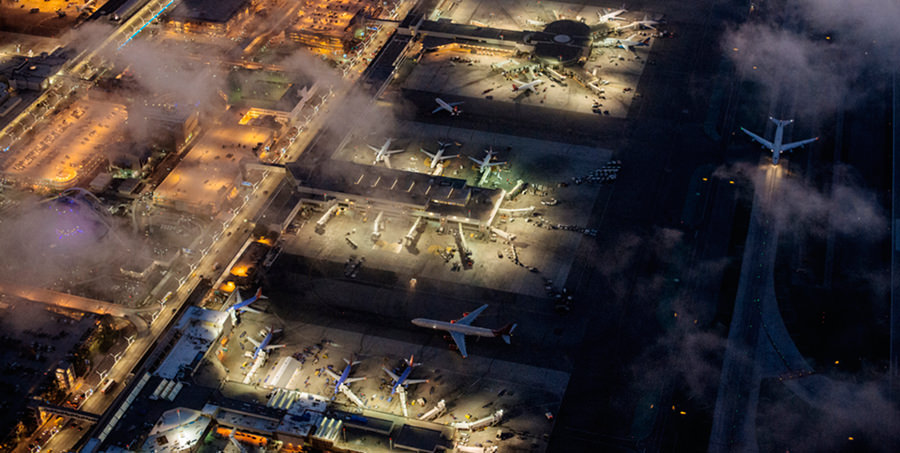
A tremendous number of passengers fly to their destination through airports regardless of day or night. There are also multiple workers engaged in different jobs to ensure passengers have a nice trip. Except for the uncontrollable weather during the trip, airports have a great deal of responsibility to keep the safety and security of both passengers and workers.
Lighting is one of the significant impacts on safety and security. However, airport lighting is complex due to the wide coverage, myriad zones, and high demands. Lighting requirements vary for different applications in airports. For outdoor airport environments, the runway, taxiway, and apron are three applications that highly depend on the assistance of lighting to achieve clearer identification and visibility.
Runway lighting offers the right information
Runway lighting is aimed to offer information, including distance, alignment, lateral displacement, and roll for pilots by marking edges, centerline, and edges of the runway. Various patterns can be arranged in the runway lighting system, and pilots can easily interpret the condition of the runway from these lighting patterns.
Thousands of lights are installed along the runway that take charge of providing a clear environment for pilots, workers, and passengers. Pilots are able to figure out whether they are on the right track to landing or takeoff. Lights for the runway are white and of an elevated type. There is an instrument of yellow color at the last 400m of the runway to remind pilots to pay attention to the caution zone. Locations of runway lights are regulated so that runway lights can’t protrude more than 1 cm from the surface of the runway.
The black hole effect generally occurs when pilots are driving on the runway. Pilots concentrate their visual field on the center line, while the edge lights of the runway have moved far and fast on both sides of peripheral vision. Since the contrast of peripheral visual and central visual information, the central area present black in color for pilots.
Taxiway lighting reduces accidents
Though airplanes are moved at a low speed on taxiways, serious accidents can also possible to occur under poor visibility conditions. Adequate lighting and guidance are critical along the taxiway.
The taxiway is located close to the runway and apron. Therefore, taxiways should be easily clarified from the runway and apron through different lighting arrangements, or pilots may be confused about the proper track between the runway and apron.
Intersections of taxiway, taxiway-runway, and taxiway-apron should also be easily identified. Clear marks are not only beneficial to classify the runway and taxiway but also reduce the risk of accidents. The space of lights affects the visual effects as well. A distance of about 6m to 7.5m is appropriate for the straight section, while 3m to 3.6m for the curves.
The requirement for the location of edge lights at the taxiway is less strict than runway. An extended distance below 75cm of the pavement surface is acceptable. When a plane is going to land or take off, lighting on the taxiway edge is blue in color, while the taxiway center is green. Lights of different colors transfer information for the pilot to reach the right traffic guidance. So, lights for the taxiway are omnidirectional but not dazzling.
Apron lighting ensures safety
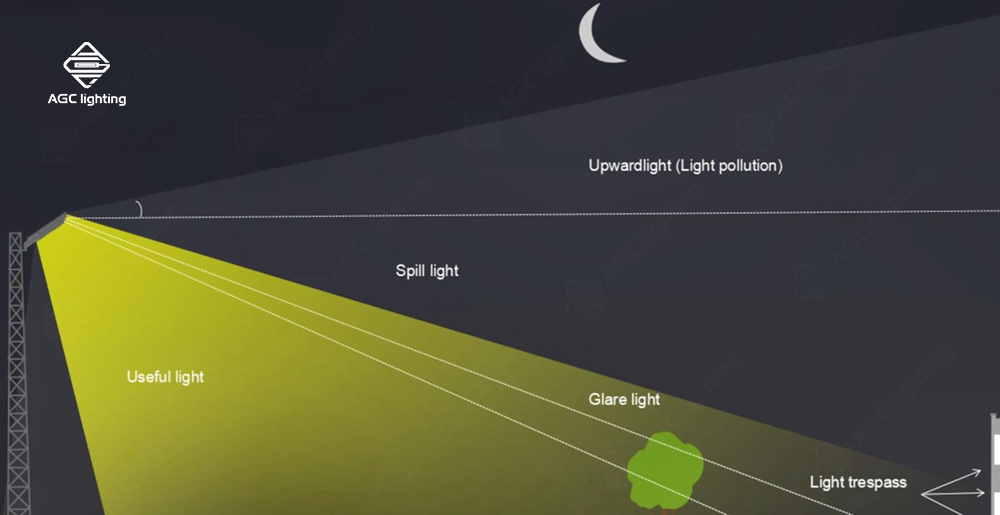
Apron is one of the busiest applications in an airport. Pilots, workers, and passengers are all engaged in these areas. Lighting plays an important role in ensuring their safety and security. Sufficient and uniform lighting without glare and trespass is required at the apron.
Pilots need comfortable lighting to taxi the plane. Passenger need suitable lighting to guide their way for embarkation and debarkation. Workers need ample lighting to load cargo. LED flood lights are generally used at an apron due to their high output and ability to illuminate a large area. They are installed at least 15m above the ground.
Glare, however, will decrease the visibility of pilots, causing sudden blindness to directional and guiding marks. Trespass lighting may distract tower personnel, resulting in wrong guidance. Nowadays, LED lights have shields to reduce the annoying glare and trespass lighting.
To achieve appropriate apron lighting, ICAO (International Civil Aviation Organization) stated the apron lighting requirements. The requirements are as follows:
- The average horizontal illumination on the apron should be no less than 10 lux. (except for the areas with service functions).
- The optimal uniformity ratio of apron lighting is 4:1. (average to minimum)
- Average horizontal illumination for areas between aircraft stands and apron (parking area, service roads) should be 10 lux.
High-power floodlight for the airport
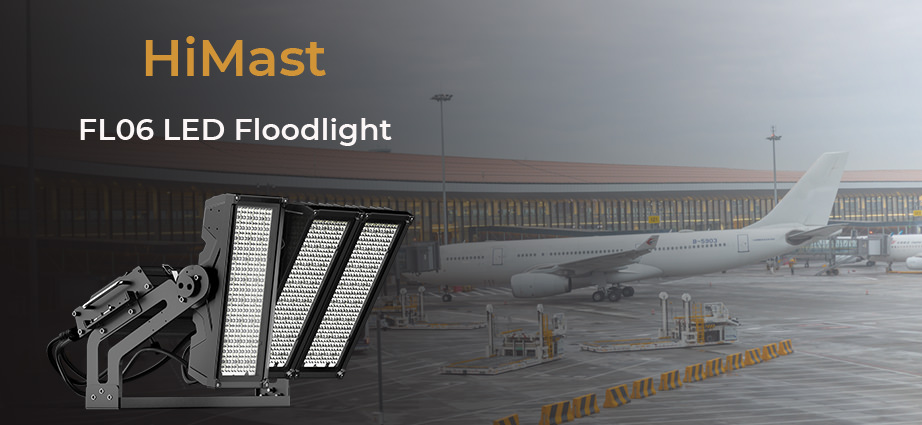
HiMast is the first high-power flood light of AGC, designed with up to 300W high output in one module.
It also has an optional 70° and 40° rotating range.
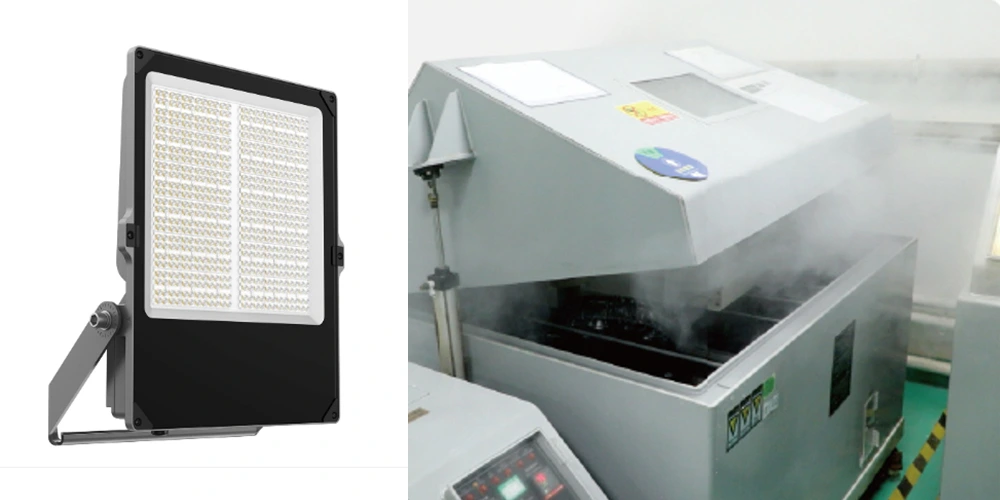
IP66 & IK08 rated for outdoor usage, and each module is equipped with a vent to keep the internal housing pressure balanced, with no vapor.
Quick connection and easy assembly save efforts for maintenance and installation.
There is no need to worry about the quality of HiMast because it passed the wind test certification and has 10KV surge protection.