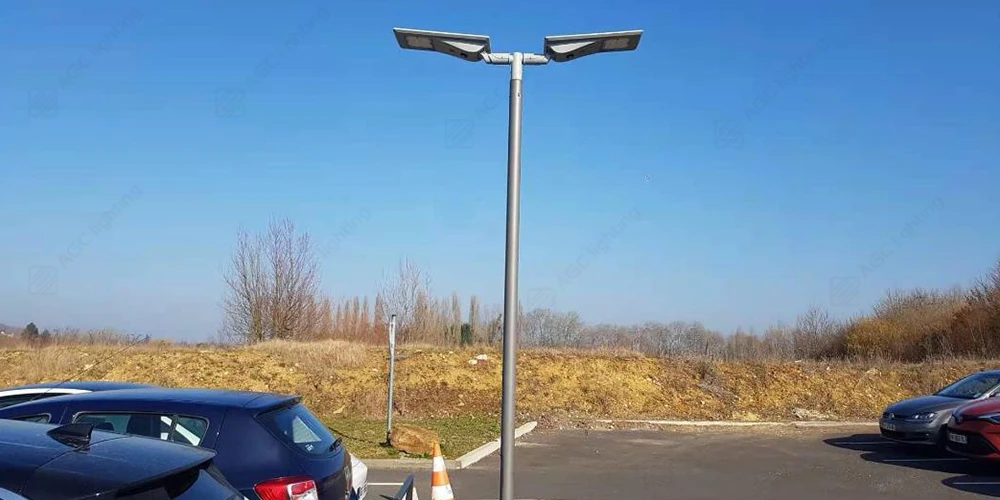
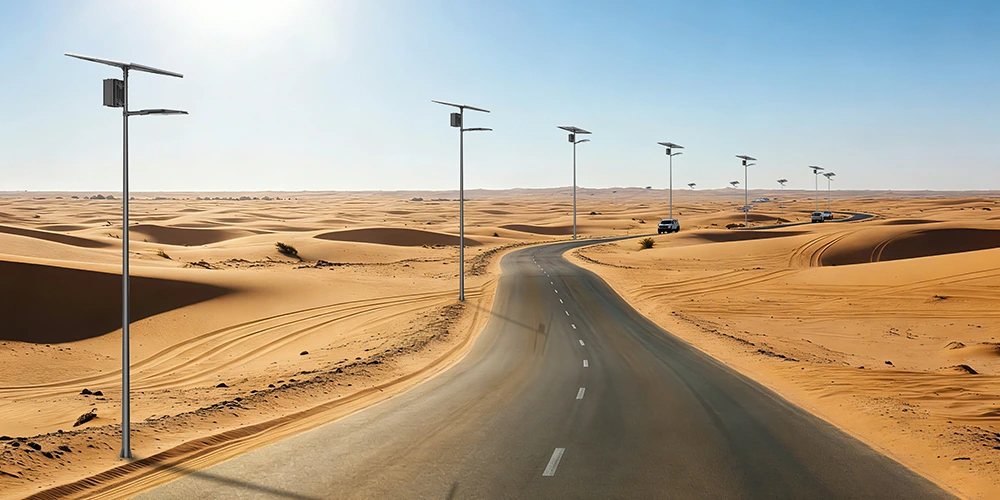
Solar streetlights are well-suited for desert regions because these areas receive around 50% more solar radiation than temperate climates. But deserts also create one of the harshest operating environments for outdoor lighting. Dust and sand are constant abrasive forces that gradually degrade both optical and mechanical components.
Fine dust settles on solar panels and reduces energy generation. Wind-driven sand scratches lenses and solar panels, lowering light transmission over time. Dust also infiltrates housings, connectors, and heat sinks, where it accelerates corrosion, traps heat, and shortens component life. In severe conditions, the combined effect can reduce lighting performance long before the system reaches its intended service life.
In this article, we examine how dust and sand damage solar streetlights and, more importantly, how we engineer our desert solar lighting solutions. From solar panels and optical materials to housing seals and structural design, every part of the fixture must be built for long-term durability in desert and arid environments.
- How Dust Damages Solar Streetlights
- How Sand Makes the Problem Worse
- How We Build Solar Streetlights to Last in Dust and Sand
- Abrasion Resistant Solar Panels
- Adjustable Mounting for Reduced Dust Accumulation
- Optical Systems Designed for Sand Exposure
- Sealed Housings That Keep Dust Out
- Need Solar Streetlights for Desert or Dusty Environments?
How Dust Damages Solar Streetlights
In desert environments, dust is constant. It accumulates on solar panels, optical surfaces, and heat dissipation areas, gradually reducing the performance and lifespan of solar streetlights.
The first problem starts at the solar panel. Dust forms a thin, and sometimes heavy, layer across the glass surface. In the solar industry, this is known as soiling. Even dust levels as low as 1 g/m² can reduce panel efficiency by roughly 5% to 10% under certain conditions.
In regions with frequent dust storms and limited rainfall, the effect becomes much more severe. The National Renewable Energy Laboratory, or NREL, has documented annual soiling related power losses reaching up to 50% in parts of the Middle East.
The battery receives less charge during the day, which can result in lower brightness, shorter runtime, or reduced autonomy during consecutive cloudy days.
Dust also contributes to overheating. A dust covered panel absorbs and retains more heat, while the layer of particles disrupts natural cooling across the panel surface. Depending on the cell type, every 1°C increase in operating temperature can reduce electrical efficiency by approximately 0.3% to 0.5%.
The same issue affects the lighting fixture itself. Dust accumulates on heat sinks and ventilation paths, reducing the fixture’s ability to dissipate heat. As internal temperatures rise, LED efficiency declines and component stress increases.
Another long term issue is damage to the optical surfaces. Dust sits on the lens cover. In desert environments, fine particles are carried at high speed by wind and act as abrasive material. The result is lower light transmission and reduced lux levels on the ground.
How Sand Makes the Problem Worse
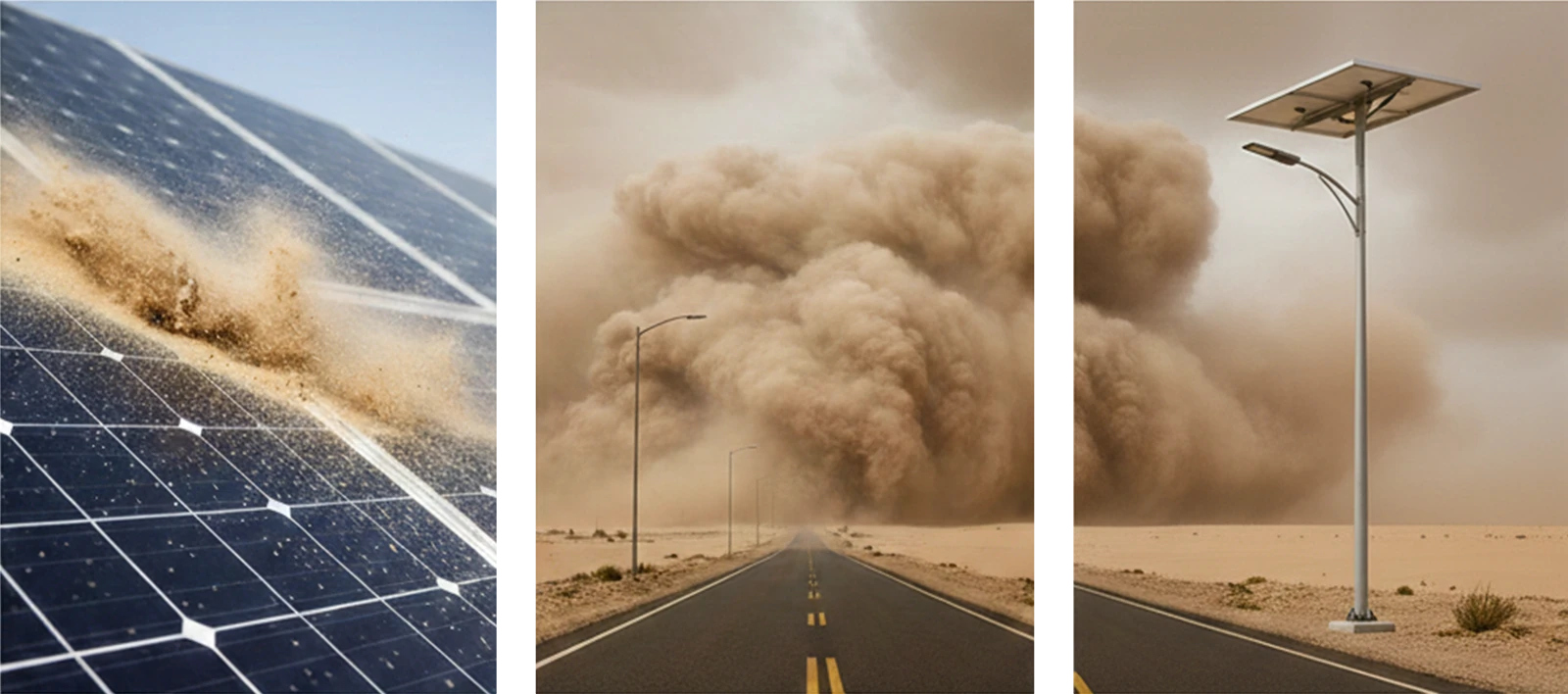
Sand creates many of the same problems as dust, but with far greater mechanical force. While dust mainly reduces performance through accumulation, sand actively wears down materials and components through abrasion and impact.
The most obvious damage appears on the solar panel surface. During sandstorms, wind driven sand particles repeatedly strike the panel glass at high speed. Each impact creates microscopic scratches on the glass surface. Over time, these scratches accumulate into a permanent haze that reduces light transmission to the photovoltaic cells underneath.
As the glass becomes more opaque, the solar panel generates less power even after cleaning.
The same abrasion affects the optical system of the fixture. Lenses and protective optical materials are continuously exposed to airborne sand particles. Repeated impact gradually roughens the surface, reducing optical clarity and increasing light scattering.
Sand also creates mechanical and environmental problems inside the fixture. During sandstorms, fine particles can penetrate poorly sealed housings through ventilation paths, cable entries, and gasket gaps. Once inside the fixture, sand contamination affects both electrical and thermal performance.
Common problems include poor electrical contact, corrosion, heat retention, and accelerated battery aging.
These problems often reinforce each other. Reduced solar charging leaves the battery operating in a lower state of charge more frequently, while poor heat dissipation raises battery temperature. Together, these conditions accelerate battery aging and reduce overall system reliability.
How We Build Solar Streetlights to Last in Dust and Sand
In dusty and sandy regions, long term reliability depends as much on mechanical durability as electrical performance.
Our desert solar streetlights are engineered to maintain charging efficiency, protect internal electronics, and resist surface erosion after years of exposure to wind, dust, and sandstorms.
Abrasion Resistant Solar Panels
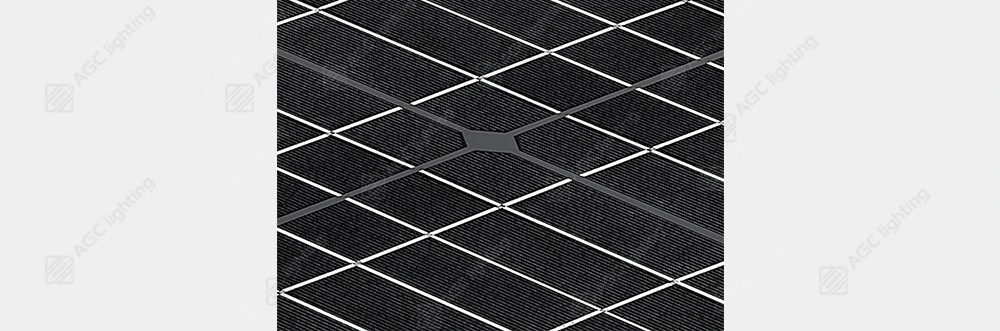
We use high efficiency monocrystalline solar panels because they maintain stronger energy output under high temperatures and partial soiling conditions compared with lower efficiency alternatives.
But panel efficiency alone is not enough in desert installations. The glass surface must also resist airborne sand impact.
We achieve this through an ultra-hard nano-ceramic coating applied to the panel glass, rated at a hardness level of approximately Mohs 7 or higher, harder than most natural minerals found in desert sand.
Without surface protection, repeated sand impact gradually creates micro scratches on solar glass. Over time, these scratches reduce light transmission and permanently lower photovoltaic performance. A hardened protective coating slows this wear process and helps preserve long term panel output.
Adjustable Mounting for Reduced Dust Accumulation
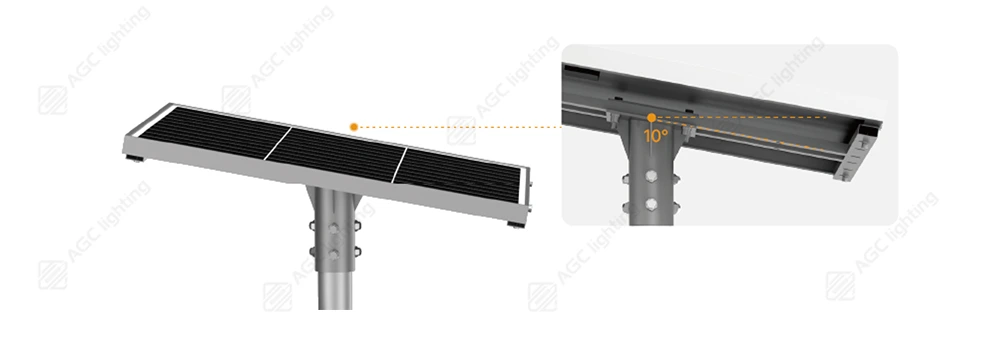
Our solar panels are installed on adjustable heavy duty brackets that allow tilt optimization based on the project location and solar conditions. Correct panel tilt improves solar exposure throughout the year while also reducing dust accumulation.
When the panel angle is too shallow, dust and sand settle more easily on the glass surface. A properly inclined panel allows wind and gravity to remove part of the loose dust naturally, especially in dry regions with occasional strong airflow.
Even with optimized tilt angles, regular cleaning is still necessary in desert environments. Under typical dusty conditions, inspection and cleaning every 3-4 months is generally recommended to maintain stable charging performance.
Optical Systems Designed for Sand Exposure
The LED module of our product is protected by a thickened polycarbonate lens with a thickness of at least 4 mm.
At this thickness, polycarbonate provides strong impact resistance against wind driven debris while maintaining good optical durability. The lens surface also receives scratch resistant treatment to reduce long term hazing caused by repeated sand abrasion.
By improving abrasion resistance at the lens surface, the fixture maintains more stable light output and optical performance throughout its service life.
Sealed Housings That Keep Dust Out
Dust and sand intrusion not only affect optics. It also damages drivers, connectors, thermal systems, and batteries.
Our solar streetlights use fully sealed housing structures designed to prevent dust ingress under outdoor operating conditions.
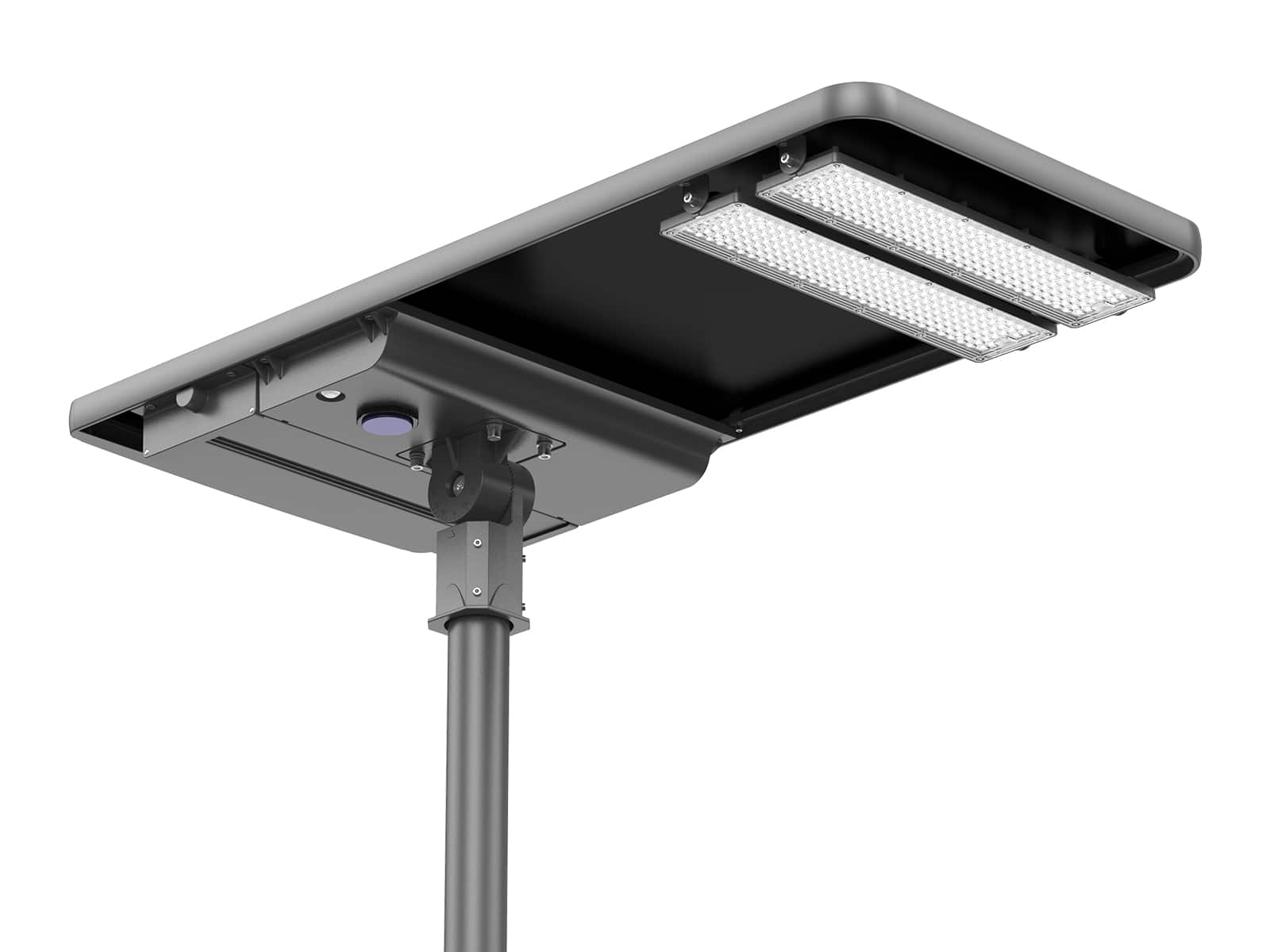
But for the desert, we don’t stop here. The LiFePO4 battery and control electronics are enclosed inside a sealed die-cast aluminum housing. The enclosure design minimizes entry points where sand or fine dust particles could penetrate into the battery compartment or driver cavity.

Need Solar Streetlights for Desert or Dusty Environments?
If your project faces sandstorms, heavy dust accumulation, or remote operating conditions, the fixture design needs to match the environment.
We provide solar streetlights typically designed for long term performance in these conditions.
Contact us to discuss your project requirements. We are ready to support your project.