One of the most consistent complaints we hear from our customers is this: changing the beam angle on a high bay light is a real pain.
And they're right.
The traditional approach requires the customers to take the fixture down (not a small job when it's mounted at 8 to 15 meters), unscrew the housing, swap out the lens, reassemble everything, and rehang it. Doing that a few times across a large warehouse, our customers want a more concise way to solve the problem.
AGC develops products that are particularly close to the market, customer-oriented, and geared to the end user.
So the question became: can we let users change the beam angle without touching the lens?
The short answer is yes. Here's how we got there.
Why Beam Angle Adjustment Is Harder Than It Looks
On a standard sealed LED high bay, the lens position is fixed relative to the heatsink. The optics, including the reflector geometry and the lens curve, are all designed around LEDs sitting in one specific position. If the LEDs don't move, the light doesn't change direction.
So if you want to change the beam angle without swapping the lens, you have to change something upstream: specifically, the direction the LEDs themselves emit light, or the proportion of light hitting different parts of the optic. That's the core principle we worked from.
Three Engineering Problems We Had to Solve
When we set out to design a high bay with a beam angle you could adjust with a simple twist, we ran into three engineering hurdles that most people don't see.
1. One lens, three beam angles
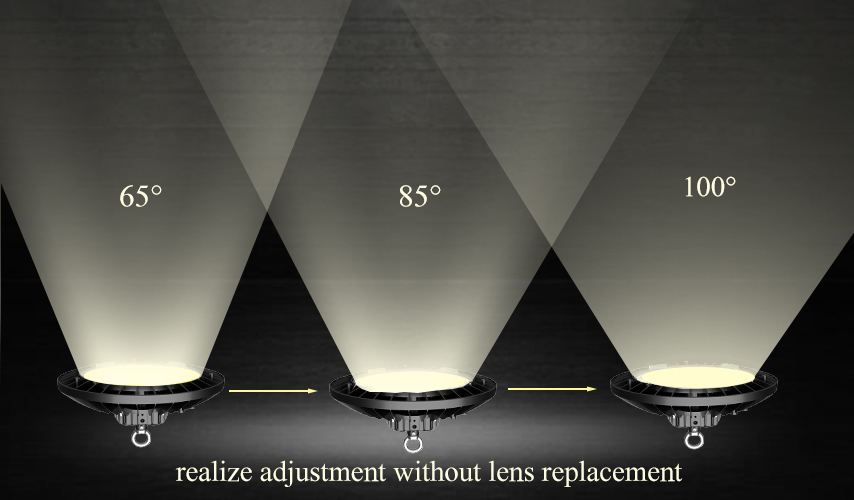
Previously, each beam angle required a different lens. We wanted to offer three beam angle options, typically 60°, 90°, and 120°, through a single installed lens. That means the light distribution going into the lens has to change, not the lens itself.
We achieved this by allowing the LED array to shift position relative to the optic, which changes how the light hits the lens and, therefore, how it exits.
2. A reliable adjustment mechanism
The adjustment works through a rotating shaft connected to the LED module. Rotating it repositions the light source, which changes the beam spread.
The challenge here was integration. The shaft has to connect cleanly with the adjusted component, and the external control has to work in sync with the optic housing so the fixture still looks like a single coherent product, not a retrofit experiment. The lens cover itself was redesigned to accommodate this while keeping the aesthetics clean.
3. Stability, uniformity, and weatherproofing
This is where a lot of concepts fall apart in practice.
A beam angle that shifts after a knock from a forklift is useless. We needed the selected angle to lock firmly in place.
We also needed to confirm that illuminance uniformity doesn't degrade after adjustment, because a narrower beam that creates a bright hot spot in the center defeats the purpose. And because these fixtures go into real facilities with cleaning, condensation, and variable humidity, the additional mechanical components couldn't compromise the IP rating or create new ingress points.
How We Developed Adjustable Beam Angle LED High Bay Lights
Those three challenges didn't have obvious answers. They required our team to go back to first principles on both the optics and the mechanical design.
We started by rethinking the relationship between the LED module and the fixed lens. Rather than designing a new optic for each beam angle, we looked at whether repositioning the light source relative to a single optic could produce meaningfully different beam spreads.
Several design iterations went into the rotation mechanism alone. It had to be smooth enough for a technician to adjust quickly, firm enough to stay locked after adjustment, and robust enough to hold its position in an industrial environment where vibration and accidental contact are facts of life.
Now, AGC provides an Adjustable Beam Angle LED high bay light that provides the user with maximum flexibility to achieve a custom lighting effect tailored to each specific location.
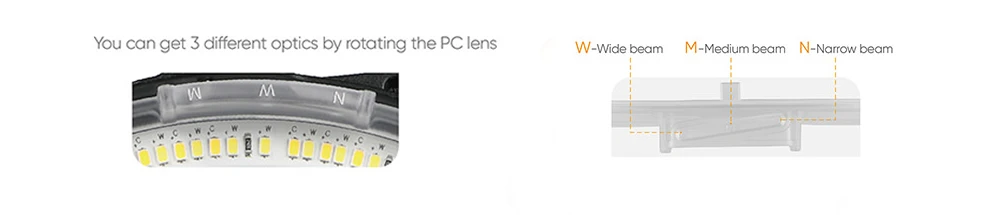
It features rotatable lenses and a combined snap-on and helical locking mechanism, enabling tool-free adjustment of three beam angles: 60°, 90°, and 120°.
There are still a lot of great features and a bigger surprise in this product. If you are interested, contact us for details.