Avoid new underground power cabling for the lighting system.
Skip to content
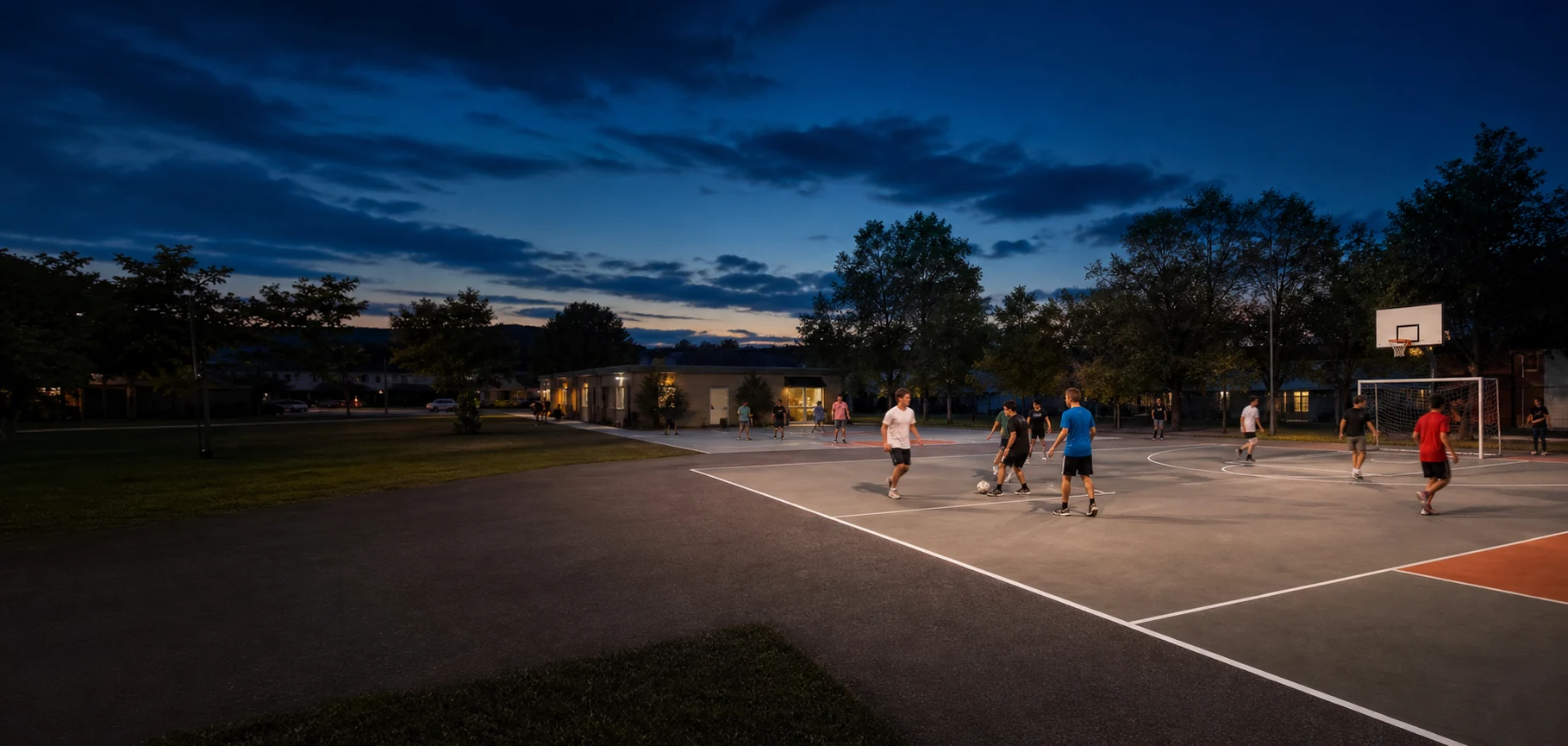
Light the court.
01No grid trenching
02No purchased electricity
03No daily switching
The court is built.
01
02
03
Sunlight in.
One modular platform.
Power range30–480 WSeven configurations
Luminous fluxUp to 88,800 lmRa70, 4000 K
System efficacyUp to 185 lm/WAt 4000 K, Ra70
Battery capacityUp to 4,608 WhLiFePO4, >2,000 cycles*
ProtectionIP66 / IK08IK rating excludes solar panel
Optical choice4 distributionsSymmetrical and asymmetrical
Less infrastructure.
01
02
03
04
05
06
OFF-GRID COMMUNITY SPORTS LIGHTING
Light the court.
Skip the grid.
Extend safe, active hours for community courts without grid trenching, purchased electricity or someone remembering to switch the lights on.
Project sizing is based on location, court geometry, target illuminance and operating schedule.
Solar energy powers normal operation once installed and commissioned.
Dusk detection and programmable schedules automate operation.
THE PUBLIC-SPACE CHALLENGE
The court is built.
The grid is not.
For many neighborhood courts, the lighting problem is not the need for light. It is everything that comes with conventional power: civil works, approvals, recurring bills and day-to-day responsibility.
Connection becomes a construction project.
Trenching, cabling and switchgear can add disruption, time and coordination long before the first evening game.
The electricity bill needs an owner.
Public courts often serve everyone, while the responsibility for ongoing energy cost is not always clear.
Someone must manage the lights.
Manual switching creates unnecessary visits, inconsistent operating hours and lights left on when the court is empty.
AUTOMATIC BY DESIGN
Sunlight in.
Community time out.
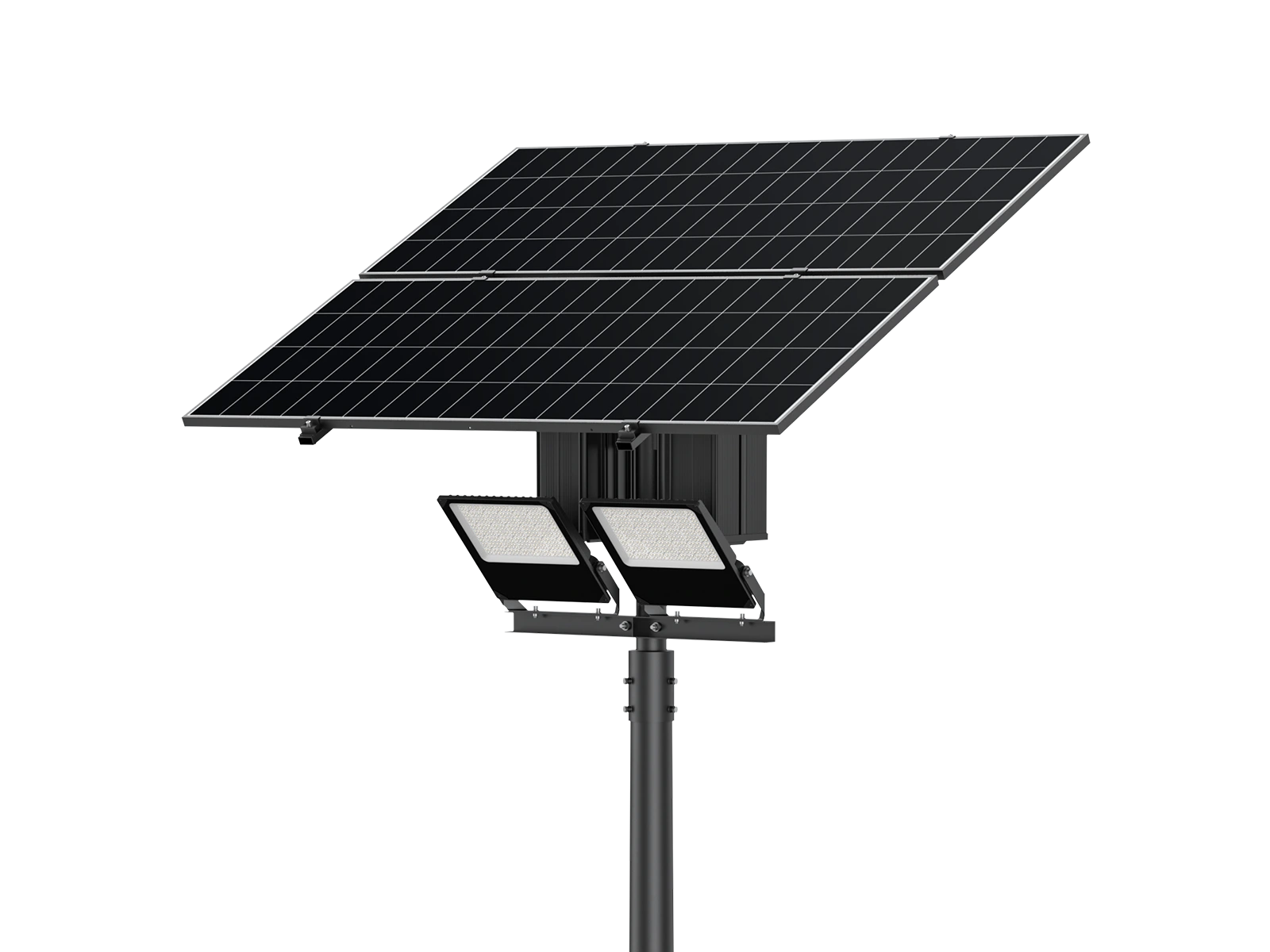
The SL53 separates the solar panel, battery and floodlight into serviceable modules. MPPT charging captures solar energy during the day; the controller then runs the selected lighting schedule after dusk.
DAY
Harvest
Mono-crystalline panels charge the LiFePO4 battery through an MPPT controller.
DUSK
Switch on
The system detects the day-to-night threshold and starts automatically.
EVENING
Follow the schedule
Multiple time periods and dimming levels balance activity needs with stored energy.
SET TIME
Switch off
Program the court to close after its approved operating window—without a site visit.
Flexible operating profiles
Choose a preset mode or program project-specific time blocks and output levels with the remote controller. Selected intelligent schedules can support approximately 2–3 days of operation on a full charge.
ENGINEERED FOR REAL COURTS
One modular platform.
Seven power levels.
From a small neighborhood half-court to a larger multi-sport facility, SL53 gives the lighting designer a broad system range without changing the core architecture.
SL53 HIGH-POWER SOLAR FLOOD LIGHT
*Battery cycle figure stated at 80% depth of discharge. Operating temperature: 0°C to +50°C. Refer to the current specification and project design for final selection.
WHY IT FITS COMMUNITY COURTS
Less infrastructure.
More usable hours.
Grid independent
Bring evening lighting to sites where a new electrical connection is impractical or disproportionate.
Automatic operation
Use light-based switching and scheduled dimming instead of daily manual control.
Serviceable modules
Separate luminaire, battery, controller and panel assemblies simplify inspection and component replacement.
Court-ready optics
Select symmetrical or asymmetrical distributions to support useful coverage and limit wasted light.
Adjustable solar capture
Set the panel from 0° to 52° to suit the installation latitude and project conditions.
Defined warranty
Three years for the battery and five years for other parts under AGC warranty terms.
FROM IDEA TO PROJECT QUOTE
Five inputs give us a better starting point.
Solar lighting is a system, not a wattage guess. Share the basic site information and AGC can evaluate the suitable product configuration and lighting-design path.
- 01
Project locationCity and country for solar-resource assessment
- 02
Court dimensionsLength, width and playing-area layout
- 03
Target illuminanceRequired lux level or intended use
- 04
Pole arrangementQuantity, height and proposed positions
- 05
Operating scheduleEvening hours and seasonal expectations
IMPORTANT ENGINEERING NOTE
Designed for the site—not selected from a headline.
Final wattage, battery capacity, panel size, luminaire quantity, autonomy and lighting performance depend on local solar irradiation, seasonal weather, shading, court geometry, target illuminance, pole layout and operating profile. “No electricity bills” refers to no purchased grid electricity during normal solar operation; equipment, installation and maintenance costs remain. Pole foundations and other civil works may still be required.
A COURT SHOULD NOT GO DARK BECAUSE THE GRID STOPS SHORT.
Light more community hours.
Tell us where the court is and how it should be used. We will help turn the requirement into a project-ready solar lighting proposal.
Request a project quote